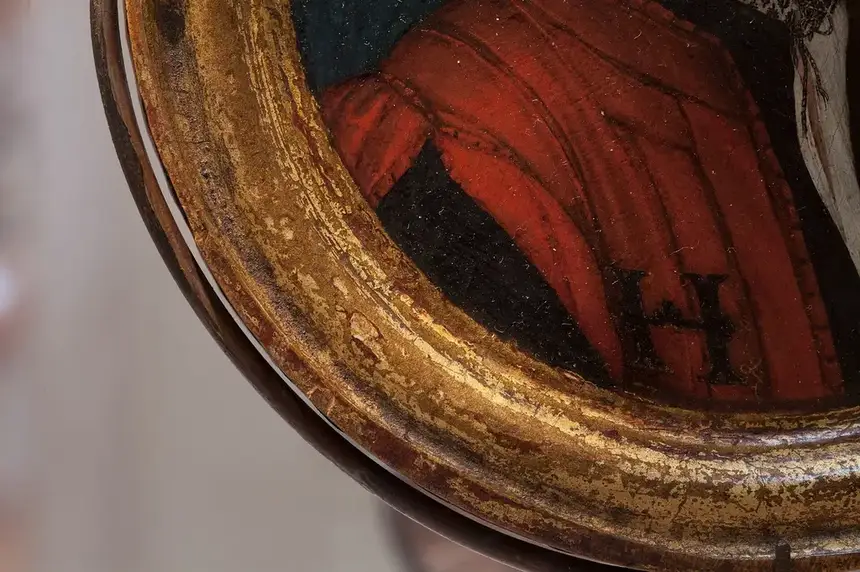
About Portrait of a Man in a Red
Because Hans Holbein the Younger died in 1543, this work is in the public domain. We are painting a copy of a painting — we never pass it off as the original, and neither should anyone selling you one.
We paint it in oil on canvas, one at a time, in Dafen Village. Nothing is printed, scanned or transferred.
It is an original composition painted before 1543, and our version is painted from the surviving image of it.
You are buying a painting, not a file. That distinction is the whole business we are in.
What the painting is doing
The sitter in Portrait of a Man in a Red is built out of half-tones. Those half-tones are the whole painting.
The whole portrait is organised around the light source, and everything else follows from it.
Skin here is translucent: light goes in, bounces, and comes back warm. That is done with thin paint over a lighter ground.
Our painter mixes on the palette but finishes on the canvas, which is where the small variations come from.
The marks have a direction, and the direction follows the form.
The difficult part is not the detail. It is keeping the whole canvas at the same stage of finish.
It wants a wall where the light rakes across it, because the surface is part of the picture.
| Artist | Hans Holbein the Younger |
|---|---|
| Title | Portrait of a Man in a Red |
| Medium | Oil on canvas, hand-painted to order |
| How it is made | Painted by hand in oil on canvas, to your size |
| Public domain | Yes — the artist died over 70 years ago |
Hand-painted, not printed
A print reproduces the shapes and drops the substance. It is the substance you are buying.
Edges are left soft where the form turns away and sharp where it does not. That single habit is what separates a painting from a copy.
| Aspect | Hand-painted oil | Printed canvas |
|---|---|---|
| Corrections | We adjust it and repaint the passage | The file is reprinted or it is not |
| Impasto | Real paint standing off the canvas | Flat ink, sometimes embossed to imitate |
| Depth | Built in layers, catches light from the side | Flat; highlights are printed as pale ink |
| Handling of colour | Mixed on the palette and finished on the canvas | Fixed by the colour profile |
| Value over time | Can be re-stretched, cleaned and re-framed | Little value beyond the print |
The risk with a portrait is overworking, and the way to avoid it is knowing when to stop.
Every canvas is painted to order, so the quote follows your size, frame and destination rather than a fixed list. Tell us what you need on WhatsApp and we reply with an exact figure, usually within the hour. You are buying from the workshop, not a catalogue.
From blank canvas to finished painting
This is how the painting is built, in the order our painters build it:
- We start with the canvas itself — stretched, sized and left to settle before any colour is mixed.
- The drawing goes down — charcoal or thin paint, done by eye rather than traced from a printout.
- The big shapes are blocked in — thin paint, one colour at a time, the whole canvas at once.
- The values are established — this is the stage that decides whether the painting works.
- Colour is built up — warmer and cooler versions of each passage, laid over the underpainting.
- Finishing passes — the loaded highlights go on at the end and stay there.
- It dries, then gets varnished — and only then is it photographed for you.
Anyone can copy the shapes. The skill is in the transitions, and that is what takes the days.
What goes into it
Varnish goes on only once the paint is properly dry, months after the last stroke, not before. Large canvases get a cross-brace; anything over about a metre and a half needs one.
The paint is built in layers, fat over lean, which is what stops it cracking later. Linen is worth the extra cost above about a metre across, because it holds tension better in humid rooms.
Frames
Framing is quoted separately, so you can decide after you have seen the finished canvas in photographs.
Most clients wait for the photographs before choosing a frame, which is the sensible order.
Care and cleaning
Once the varnish has cured the surface can be cleaned by a conservator, but in a normal house it will not need it for decades.
What size works
You are not choosing from a list; you are telling us a measurement. These are the common ones:
| Size (inches) | Size (cm) | Best for |
|---|---|---|
| 20 × 16 in | 50 × 40 cm | Bedroom, hallway, above a console |
| 16 × 12 in | 40 × 30 cm | A shelf, a small wall, a gallery group |
| 64 × 48 in | 163 × 122 cm | Villa scale, lobby, hospitality wall |
| 48 × 36 in | 122 × 91 cm | Large living room, stairwell, loft |
| 40 × 30 in | 102 × 76 cm | Living room focal wall, above a sofa |
Tell us the wall width and we will tell you what looks right rather than what is standard. Import charges, where they exist, are the buyer's responsibility (DAP). We never add them to the quote and never guess what they will be.
This reads well above a sofa or a sideboard, where it will be seen from two to three metres.
Tell us the size and frame — exact quote back, usually within the hour.
💬 Get a Quote for Portrait of a Man in a Red Cap MET LC-50 145 24-2Order, painting, shipping
The painting takes 9–15 days, and delivery is priced separately on the quote so there is no surprise later.
In transit it is typically 7–10 business days by air, tracked door to door. Every shipment goes out with tracking. We do not send anything untracked.
You see photographs of the finished painting before it ships, and you tell us what to adjust. If something is not right, tell us what to adjust and we adjust it.
Our terms are DAP, meaning the freight is paid by us and any import charges are yours to settle. We will not estimate them, because the figure is your customs authority's to set.
Work begins on a deposit and ships on the balance. Both figures are on the quote. Report any transit damage within 48 hours with photographs and we will deal with the carrier. We will not promise a payout, but we will not leave you to argue alone either.
Questions worth asking
Can I change something in the composition?
Often yes — background, cropping, or adapting the proportions to your wall. Tell us what you have in mind and we will say honestly whether it will work.
Does changing the size change the composition?
No — we keep the original's proportions and scale from there, rather than cropping the image to fit a standard frame.
Can I resell the reproduction?
Yes. Because the underlying work is in the public domain, the hand-painted canvas is yours to sell, gift or install commercially.
Can you paint it from a different photograph of the same work?
Yes. If you have a better reference, send it on WhatsApp and we will work from yours.
What does it cost?
Every canvas is quoted on size, frame and destination rather than a fixed list. Tell us what you need and we reply with an exact figure.
How long does it take?
Allow 9–15 days for the painting itself, then roughly 7–10 business days in transit.
Will I see it before it ships?
Yes. We send photographs of the finished canvas and wait for your reply before packing.
Is it really painted by hand?
Yes — oil on canvas, brush and knife. There is no printing, no giclée and no canvas transfer at any stage.
What is the canvas made of?
Cotton or linen, oil colour, and varnish. Stretcher bars are wedged so the canvas can be re-tensioned later.
Who pays the import duty?
The buyer does. Terms are DAP: duties and taxes, where they apply, are paid on arrival. We never add a tax line of our own.
Can you paint a different work by Hans Holbein the Younger?
Yes. Send the image and we will quote it, or browse the other paintings we have listed.
What if it arrives damaged?
send us photographs within 48 hours and contact us directly — we will sort it out with you.