About Bacio a Letto
Because Henri de Toulouse-Lautrec died in 1901, this work is in the public domain. We are painting a copy of a painting — we never pass it off as the original, and neither should anyone selling you one.
Ours is a painting made with brushes. There is no giclée, no canvas transfer and no digital underlayer anywhere in the process.
It is an original composition painted before 1901, and our version is painted from the surviving image of it.
You are buying a painting, not a file. That distinction is the whole business we are in.
What to look at
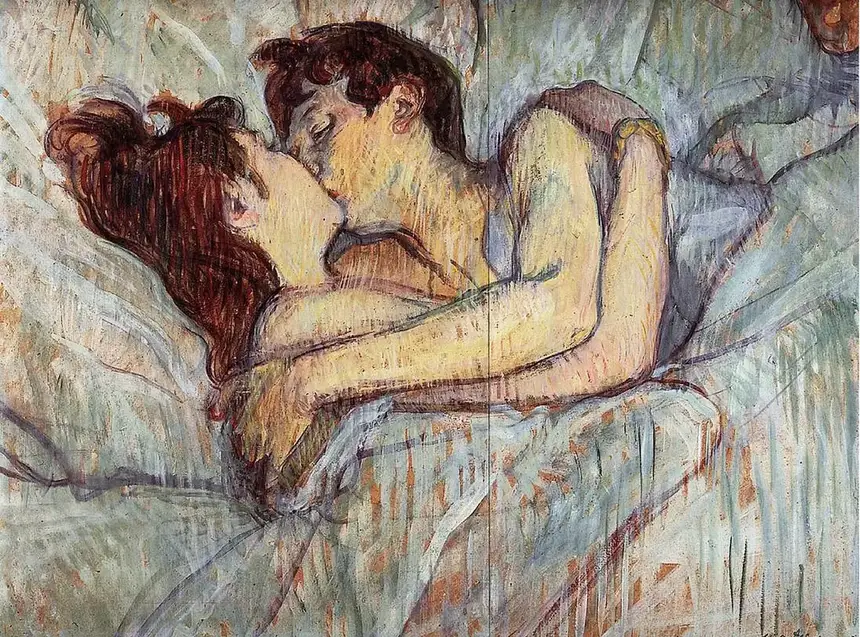
Bacio a Letto rewards a second look because the light is doing something specific, and it only does it in oil.
Where the original has an awkward crop, we keep it. Correcting it would be painting a different picture.
Light is handled as a value problem: how dark the darkest dark is determines the whole picture.
Colour here is mixed for the passage, not for the object, which is why nothing looks like it was filled in.
Our painter loads the brush differently for the near and far passages, and you can read the difference.
This one repaints badly, so our painter gets the values right early and leaves them.
It suits a room with warm, low light. Strong downlighting flattens the surface.
| Artist | Henri de Toulouse-Lautrec |
|---|---|
| Title | Bacio a Letto |
| Created (original) | 1892 |
| Medium | Oil on canvas, hand-painted to order |
| How it is made | Painted by hand in oil on canvas, to your size |
| Copyright | Public domain; the original is out of copyright |
The case for painting it by hand
The difference is not subtle when the two hang side by side. Ink sits on the surface; oil stands off it.
Where the original is loaded, ours is loaded. Where it is thin, ours is thin. Matching the weight of the paint matters more than matching the colour.
| Aspect | Hand-painted oil | Printed canvas |
|---|---|---|
| Sense of depth | Real, created by layers of paint | Simulated by darker ink |
| Edges | Chosen by the painter, passage by passage | Whatever the file happens to contain |
| The surface | Built up with brushes and knives | Printed flat in one pass |
| Time to make | Days of one painter's working time | Minutes |
| Size | Any size, painted to your wall | Limited by the printer |
Anyone can copy the shapes. The skill is in the transitions, and that is what takes the days.
Every canvas is painted to order, so the quote follows your size, frame and destination rather than a fixed list. Tell us what you need on WhatsApp and we reply with an exact figure, usually within the hour. You are buying from the workshop, not a catalogue.
The sequence on our floor
Here is what actually happens between your message and the crate:
- We start with the canvas itself — stretched, sized and left to settle before any colour is mixed.
- The drawing goes down — charcoal or thin paint, done by eye rather than traced from a printout.
- The big shapes are blocked in — thin paint, one colour at a time, the whole canvas at once.
- The values are established — this is the stage that decides whether the painting works.
- Building the colour — a warm and a cool version of each passage, put down in order.
- Detail and highlights last — put on thickly and then not touched again.
- Left to dry before varnish — nothing is photographed or packed until the surface is ready.
What takes time here is the number of separate decisions, not the size of the canvas.
Looking after it
Once the varnish has cured the surface can be cleaned by a conservator, but in a normal house it will not need it for decades.
Framing
Frames are priced once you have chosen them, not estimated in advance.
If you are shipping, an unframed canvas rolled in a tube is considerably cheaper to move than a framed one.
Materials
The paint is built in layers, fat over lean, which is what stops it cracking later. The ground is a proper acrylic sizing, so the oil does not rot the fabric over time.
Large canvases get a cross-brace; anything over about a metre and a half needs one. We use cotton duck for most sizes and linen where the canvas is large or the client asks for it.
Choosing a size
The canvas is cut to your wall, not the other way round. For reference, these are the dimensions most often requested:
| Size (inches) | Size (cm) | Best for |
|---|---|---|
| 40 × 30 in | 102 × 76 cm | Living room focal wall, above a sofa |
| 32 × 24 in | 81 × 61 cm | Living room, above a sideboard |
| 30 × 24 in | 76 × 61 cm | Dining room, bedroom feature wall |
| 24 × 20 in | 60 × 50 cm | Study, home office, above a desk |
| 20 × 16 in | 50 × 40 cm | Bedroom, hallway, above a console |
| 16 × 12 in | 40 × 30 cm | A shelf, a small wall, a gallery group |
Tell us the wall width and we will tell you what looks right rather than what is standard. Shipments go out DAP. If your customs office charges duty or tax on arrival, that is between you and them — we do not collect it and we do not put a number on it.
Hang it at eye level — roughly 145 cm from the floor to the centre — and it will hold the wall.
Tell us the size and frame — exact quote back, usually within the hour.
💬 Get a Quote for Bacio a LettoHow it reaches you
The painting takes 9–15 days, and delivery is priced separately on the quote so there is no surprise later.
Transit is usually 7–10 business days, tracked all the way. Every shipment goes out with tracking. We do not send anything untracked.
You approve the painting from photographs before it is packed — that is the checkpoint. Adjustments are part of the process. Say what you want different and it gets done.
Import charges, where they exist, are the buyer's responsibility (DAP). We never add them to the quote and never guess what they will be.
You pay a deposit to start and the remainder before shipping. Nothing is hidden in between. Damage in transit should be reported to us within 48 hours, with photographs. We pursue it with the carrier rather than promising a refund.
The practical questions
When will it actually arrive?
Studio time is 9–15 days, then a few more days for the oil to set before we can photograph and pack it. We tell you where your canvas is at each stage.
Can I change something in the composition?
Often yes — background, cropping, or adapting the proportions to your wall. Tell us what you have in mind and we will say honestly whether it will work.
Will it look exactly like the image?
Not exactly, and that is the point — it is a painting, not a scan. Composition, colour and drawing follow the original closely; the surface is where a painter's own decisions show.
How long does it take?
From order to finished canvas is 9–15 days; delivery adds about 7–10 business days by air.
Is it really painted by hand?
Yes — oil on canvas, brush and knife. There is no printing, no giclée and no canvas transfer at any stage.
How do I hang it?
Roughly 145 cm from floor to centre works for most rooms. Tell us your wall and we will give you the measurement.
Do you ship to my country?
We ship to over 20 countries. Give us your city and the freight appears as its own line on the quote.
Who pays the import duty?
The buyer does. Terms are DAP: duties and taxes, where they apply, are paid on arrival. We never add a tax line of our own.
Can I change the size?
Any size you like. We paint to the number you give us rather than to a standard range.
Is owning a reproduction legal?
Yes. The painting is out of copyright because Henri de Toulouse-Lautrec died more than 70 years ago. We paint copies honestly and never claim they are originals.
What if it arrives damaged?
Report damage within 48 hours with photographs. We deal with the carrier rather than leaving you to argue alone.
Can you change the colours to suit my room?
We can shift the palette, but we will tell you honestly when a change would spoil the painting.