What you are buying into
Henri-Edmond Cross died in 1910, so the work has been in the public domain for decades. Reproducing it by hand is legal, and so is owning one.
We paint it in oil on canvas, one at a time, in Dafen Village. Nothing is printed, scanned or transferred.
The painting was made in the years before 1910, and what we reproduce is the record of it, not the object.
If you want something printed, we are the wrong workshop. We do not own a printer that touches canvas.
Looking at it properly
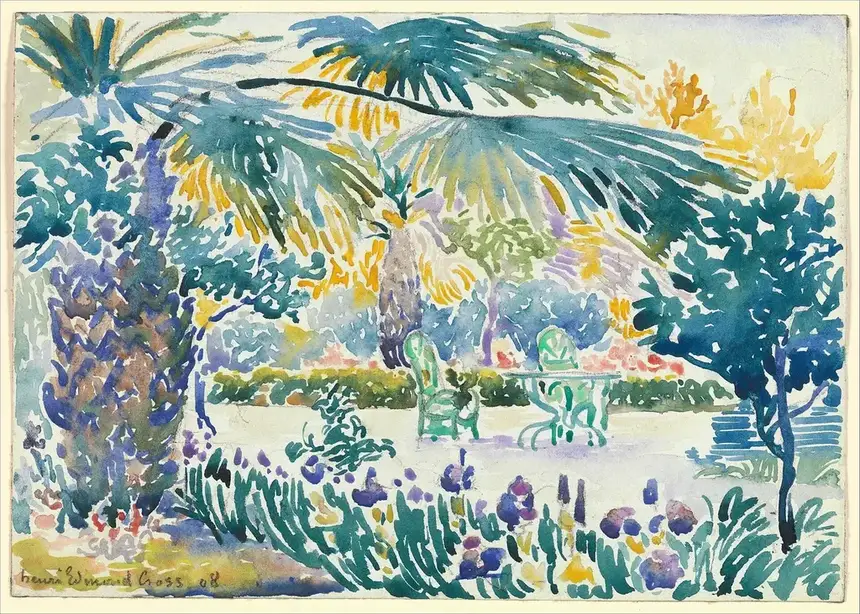
A copy can be accurate and still be dead. The thing that keeps Garden of the Painter at alive is that the marks were made in a deliberate order.
Nothing is traced or projected. The drawing is done by eye, which is what keeps the proportions related.
Shadows stay transparent. They are lit by something, and painting them as flat grey kills the picture.
The saturation is deliberately uneven: strongest at the focal point, weaker everywhere else.
Our painter loads the brush differently for the near and far passages, and you can read the difference.
What takes time here is the number of separate decisions, not the size of the canvas.
It is a picture for a room you use, not a corridor you walk through.
| Artist | Henri-Edmond Cross |
|---|---|
| Title | Garden of the Painter at |
| Created (original) | 1908 |
| Medium | Oil on canvas, hand-painted to order |
| Reproduction | Hand-painted oil on canvas, made to order |
| Original status | Public domain (artist deceased) |
Why this one cannot be printed
Prints are good at information and bad at paint. This subject is mostly paint.
Edges are left soft where the form turns away and sharp where it does not. That single habit is what separates a painting from a copy.
| Aspect | Hand-painted oil | Printed canvas |
|---|---|---|
| Impasto | Real paint standing off the canvas | Flat ink, sometimes embossed to imitate |
| The surface | Built up with brushes and knives | Printed flat in one pass |
| Edges | Chosen by the painter, passage by passage | Whatever the file happens to contain |
| Handling of colour | Mixed on the palette and finished on the canvas | Fixed by the colour profile |
| Depth | Built in layers, catches light from the side | Flat; highlights are printed as pale ink |
The risk with a religious subject is overworking, and the way to avoid it is knowing when to stop.
Every canvas is painted to order, so the quote follows your size, frame and destination rather than a fixed list. Tell us what you need on WhatsApp and we reply with an exact figure, usually within the hour. No resellers, no drop-shipper. The painter's studio handles your commission from first message to final crate.
How your painting is made
Every canvas is painted to order, so nothing is pulled off a shelf. This is the sequence:
- Stretching and priming the support — cotton duck or linen goes onto the bars and gets its ground.
- The drawing goes down — charcoal or thin paint, done by eye rather than traced from a printout.
- The first colour pass — thin and simple, establishing the main shapes only.
- Setting the key — how dark the darks go determines everything that follows.
- Building the colour — a warm and a cool version of each passage, put down in order.
- Detail and highlights last — put on thickly and then not touched again.
- Drying and varnishing — the final varnish goes on once the paint has set, before we photograph it.
Getting Garden of the Painter at right means painting it in the right order, and the order is not obvious.
On framing
Most clients wait for the photographs before choosing a frame, which is the sensible order.
A frame is a separate line on the quote, not a bundle. You choose it once the painting exists.
Living with it
Oil paint needs very little: no water, no cleaners, no sprays. A dry brush and a stable room.
What it is made of
The varnish is removable, so a conservator can clean the painting in fifty years without touching the paint. Pigment is artist-grade oil colour, not acrylic and not house paint. It behaves differently and it lasts.
We buy pigment in tubes from the same suppliers the village has used for years, not in bulk drums. The paint is built in layers, fat over lean, which is what stops it cracking later.
Sizing it
You are not choosing from a list; you are telling us a measurement. These are the common ones:
| Size (inches) | Size (cm) | Best for |
|---|---|---|
| 30 × 24 in | 76 × 61 cm | Dining room, bedroom feature wall |
| 24 × 20 in | 60 × 50 cm | Study, home office, above a desk |
| 20 × 16 in | 50 × 40 cm | Bedroom, hallway, above a console |
| 16 × 12 in | 40 × 30 cm | A shelf, a small wall, a gallery group |
Tell us the wall width and we will tell you what looks right rather than what is standard. We sell DAP: the price covers the painting and the freight, and any import duties or taxes are the buyer's to settle with customs. We do not collect them and we do not estimate them.
Hang it at eye level — roughly 145 cm from the floor to the centre — and it will hold the wall.
Give us your size and framing preference and you will have a quote shortly.
💬 Get a Quote for Garden of the Painter at Saint Clair MET DP35Order, painting, shipping
Painting takes 9–15 days. Freight is quoted as its own line on the quote, agreed before you pay anything, and never added afterwards.
Transit is usually 7–10 business days, tracked all the way. Unframed canvases are rolled face-out on a tube; framed ones are corner-protected and crated.
You approve the painting from photographs before it is packed — that is the checkpoint. If something is not right, tell us what to adjust and we adjust it.
Import charges, where they exist, are the buyer's responsibility (DAP). We never add them to the quote and never guess what they will be.
You pay a deposit to start and the remainder before shipping. Nothing is hidden in between. Report any transit damage within 48 hours with photographs and we will deal with the carrier. We will not promise a payout, but we will not leave you to argue alone either.
Before you order
Is there a rush option?
It depends on the canvas and what else is in the studio. Ask on WhatsApp with your size and we will tell you straight what is possible.
Why not just print it?
A print flattens the surface into a poster: the distance collapses and the highlights turn to grey. Paint keeps the depth and the texture the original was built from.
Does it come with a certificate of authenticity?
No, and we would be wary of anyone who issues one for a public-domain reproduction. What you receive is a hand-painted canvas and photographs of it before it ships.
Does it come framed?
Framing is quoted separately, so you can decide once you have seen the finished painting in photographs.
Can I change the size?
Any size you like. We paint to the number you give us rather than to a standard range.
Do you take a deposit?
Work begins on a deposit and ships once the balance is paid. Nothing is charged that is not on the quote.
Do you sell prints?
No. Hand-painted oil on canvas only. No printing, no giclée, no canvas transfer.
Will I see it before it ships?
Yes — photographs of the actual painting go to you first, and nothing is packed until you have seen them.
Is it really painted by hand?
Yes — oil on canvas, brush and knife. There is no printing, no giclée and no canvas transfer at any stage.
Is owning a reproduction legal?
Yes. The painting is out of copyright because Henri-Edmond Cross died more than 70 years ago. We paint copies honestly and never claim they are originals.
What if it arrives damaged?
Report damage within 48 hours with photographs. We deal with the carrier rather than leaving you to argue alone.
What is the canvas made of?
Cotton duck as standard, linen on request, artist-grade oil paint, and a final varnish once the paint is fully dry.