What you are buying into
Henri Regnault died in 1871. That puts the painting well outside copyright, which is why we can paint it and you can own it anywhere in the world.
Ours is a painting made with brushes. There is no giclée, no canvas transfer and no digital underlayer anywhere in the process.
The painting was made in the years before 1871, and what we reproduce is the record of it, not the object.
You are buying a painting, not a file. That distinction is the whole business we are in.
Looking at it properly
The subject is ordinary. What is not ordinary is how the paint is loaded — that is the part a press cannot reproduce.
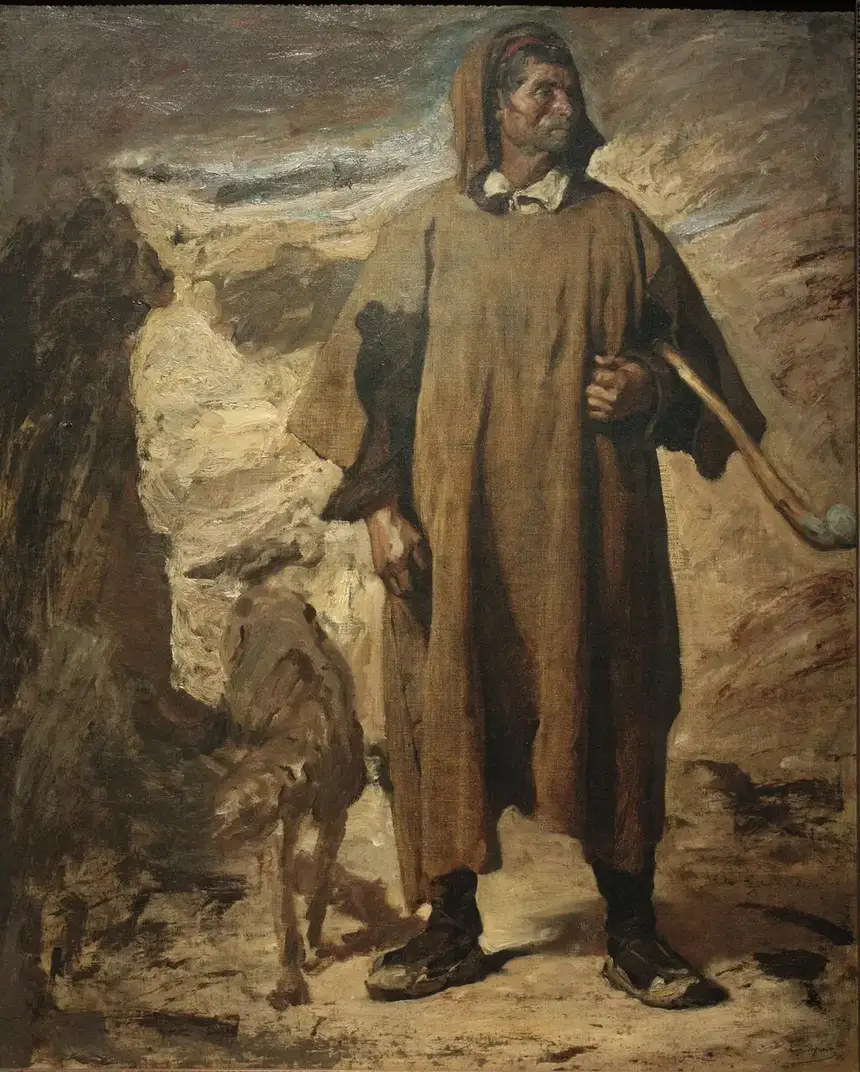
Nothing in Berger des montagnes de la Castille is centred for the sake of being centred; the weight sits where the painter wanted it.
Our painter keeps the shadows transparent, because a shadow in a landscape is lit by the sky, not by nothing.
Whites here are never white. They are warm or cool depending on the light, and that is what makes them read.
The marks have a direction, and the direction follows the form.
The difficult part is not the detail. It is keeping the whole canvas at the same stage of finish.
Hang it at eye level — roughly 145 cm from the floor to the centre — and it will hold the wall.
| Artist | Henri Regnault |
|---|---|
| Title | Berger des montagnes de la Castille |
| Created (original) | 1868 |
| Medium | Oil on canvas, hand-painted to order |
| What you receive | A hand-painted oil painting on canvas |
| Copyright | Public domain; the original is out of copyright |
Why this one cannot be printed
What you lose in a print is the air. A press lays ink flat; a painter builds depth in layers, and the depth is what you actually see.
Where the original is loaded, ours is loaded. Where it is thin, ours is thin. Matching the weight of the paint matters more than matching the colour.
| Aspect | Hand-painted oil | Printed canvas |
|---|---|---|
| How it ages | Warms and settles; cleanable by a conservator | Fades, then cracks at the stretcher |
| Available sizes | Whatever you need, painted to order | What the printer can output |
| Sense of depth | Real, created by layers of paint | Simulated by darker ink |
| Changing something | Tell us and the passage gets repainted | Usually means starting the file again |
| Texture | Ridges and drag you can see from across a room | None, or a printed imitation of it |
Getting Berger des montagnes de la Castille right means painting it in the right order, and the order is not obvious.
Every canvas is painted to order, so the quote follows your size, frame and destination rather than a fixed list. Tell us what you need on WhatsApp and we reply with an exact figure, usually within the hour. There is no agency in between; the studio that paints your canvas is the one answering your messages.
How your painting is made
No two canvases are painted the same way, but the sequence is always this:
- Stretching and priming the support — cotton duck or linen goes onto the bars and gets its ground.
- The drawing goes down — charcoal or thin paint, done by eye rather than traced from a printout.
- The big shapes are blocked in — thin paint, one colour at a time, the whole canvas at once.
- Getting the values right — the stage that decides whether the finished painting holds together.
- Colour is built up — warmer and cooler versions of each passage, laid over the underpainting.
- The detail and highlights go on — last, loaded, and left alone once they are down.
- Drying and varnishing — the final varnish goes on once the paint has set, before we photograph it.
The risk with a landscape is overworking, and the way to avoid it is knowing when to stop.
What goes into it
We use cotton duck for most sizes and linen where the canvas is large or the client asks for it. Brushes, knives and rags. That is the equipment list; there is no machine in the process.
Linen is worth the extra cost above about a metre across, because it holds tension better in humid rooms. Stretcher bars are kiln-dried and wedged, so the canvas can be re-tensioned years later.
On framing
Framing is quoted separately, so you can decide after you have seen the finished canvas in photographs.
If you are shipping, an unframed canvas rolled in a tube is considerably cheaper to move than a framed one.
Keeping it
Dust it with a dry, soft brush. Keep it out of direct sun and away from radiators, and it will outlive you.
Choosing a size
Because each piece is painted from scratch, you are not limited to stock dimensions. These are the sizes clients ask for most:
| Size (inches) | Size (cm) | Best for |
|---|---|---|
| 48 × 36 in | 122 × 91 cm | Large living room, stairwell, loft |
| 40 × 30 in | 102 × 76 cm | Living room focal wall, above a sofa |
| 32 × 24 in | 81 × 61 cm | Living room, above a sideboard |
| 30 × 24 in | 76 × 61 cm | Dining room, bedroom feature wall |
| 24 × 20 in | 60 × 50 cm | Study, home office, above a desk |
| 20 × 16 in | 50 × 40 cm | Bedroom, hallway, above a console |
If your wall is an odd shape, send the measurement and we will work to it. Proportions from the original are kept unless you ask us to change them. Import charges, where they exist, are the buyer's responsibility (DAP). We never add them to the quote and never guess what they will be.
A plain wall is better than a busy one; the painting supplies the interest.
Tell us where it will hang and how big it needs to be — we will price it properly.
💬 Get a Quote for Berger des montagnes de la CastilleHow it reaches you
Painting takes 9–15 days. Freight is quoted as its own line on the quote, agreed before you pay anything, and never added afterwards.
Air freight runs about 7–10 business days, tracked, to your door. Rolled in a tube it travels cheaper and safer than framed; most overseas clients take it that way.
You see photographs of the finished painting before it ships, and you tell us what to adjust. Changes are handled by telling us what to change; we change it and send new photographs.
We quote DAP, so any duty or tax your country charges is settled by you at import. We do not add a tax line of our own.
You pay a deposit to start and the remainder before shipping. Nothing is hidden in between. Damage in transit should be reported to us within 48 hours, with photographs. We pursue it with the carrier rather than promising a refund.
Before you order
When will it actually arrive?
Studio time is 9–15 days, then a few more days for the oil to set before we can photograph and pack it. We tell you where your canvas is at each stage.
How do I clean and care for it?
Dust lightly with a dry, soft brush and keep it out of direct sun. Nothing else is needed for decades; oil paint is slow to change and easy to live with.
Who pays the import duty?
The buyer does. Terms are DAP: duties and taxes, where they apply, are paid on arrival. We never add a tax line of our own.
Can you paint it from a different photograph of the same work?
Yes. If you have a better reference, send it on WhatsApp and we will work from yours.
Can you paint a different work by Henri Regnault?
Yes. Send the image and we will quote it, or browse the other paintings we have listed.
How long does it take?
Painting takes 9–15 days. Air freight is usually 7–10 business days on top of that, tracked.
Can you change the colours to suit my room?
Sometimes. We will adjust the palette if it can be done without ruining the picture, and say so if it cannot.
Does it come framed?
Frames are priced on their own line. Most clients choose after seeing the photographs.
What if it arrives damaged?
Report damage within 48 hours with photographs. We deal with the carrier rather than leaving you to argue alone.
Will I see it before it ships?
Yes — photographs of the actual painting go to you first, and nothing is packed until you have seen them.
Do you take a deposit?
Work begins on a deposit and ships once the balance is paid. Nothing is charged that is not on the quote.