What you are buying into
Hieronymus Bosch died in 1516. That puts the painting well outside copyright, which is why we can paint it and you can own it anywhere in the world.
We paint it in oil on canvas, one at a time, in Dafen Village. Nothing is printed, scanned or transferred.
It is an original composition painted before 1516, and our version is painted from the surviving image of it.
You are buying a painting, not a file. That distinction is the whole business we are in.
Looking at it properly
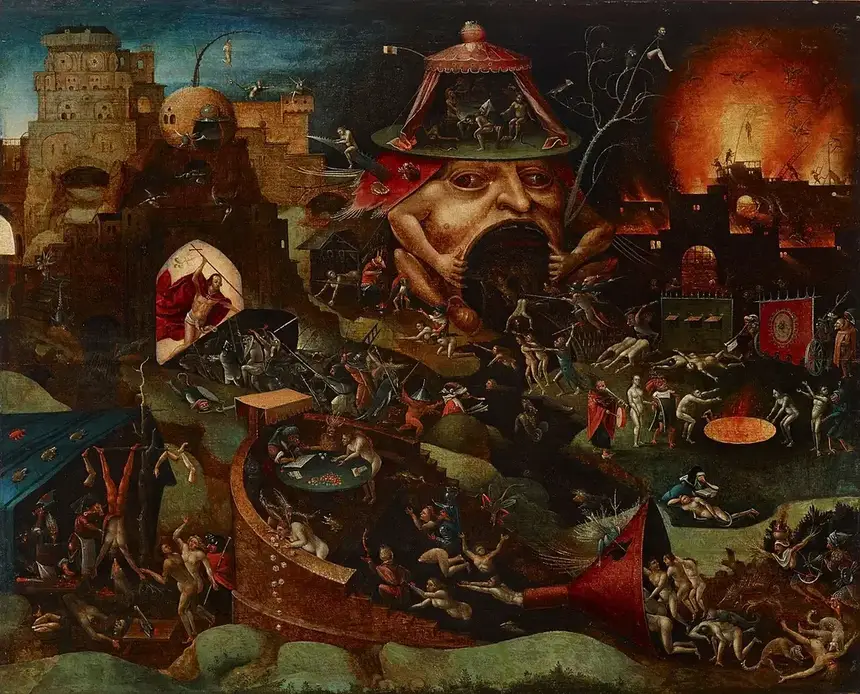
Christ in Limbo rewards a bigger canvas than you think, because the detail is painted rather than reproduced.
Light is used as a device here, and we paint it as light rather than as pale paint.
Our painter keeps the halo or highlight passages as light, built in layers rather than painted opaque.
Our painter mixes on the palette but finishes on the canvas, which is where the small variations come from.
Our painter loads the brush differently for the near and far passages, and you can read the difference.
The hardest passage is the quiet one, where a small mistake has nowhere to hide.
Hang it at eye level — roughly 145 cm from the floor to the centre — and it will hold the wall.
| Artist | Hieronymus Bosch |
|---|---|
| Title | Christ in Limbo |
| Medium | Oil on canvas, hand-painted to order |
| How it is made | Painted by hand in oil on canvas, to your size |
| Public domain | Yes — the artist died over 70 years ago |
What a print loses
What you lose in a print is the air. A press lays ink flat; a painter builds depth in layers, and the depth is what you actually see.
Where the original is loaded, ours is loaded. Where it is thin, ours is thin. Matching the weight of the paint matters more than matching the colour.
| Aspect | Hand-painted oil | Printed canvas |
|---|---|---|
| Value over time | Can be re-stretched, cleaned and re-framed | Little value beyond the print |
| Handling of colour | Mixed on the palette and finished on the canvas | Fixed by the colour profile |
| The surface | Built up with brushes and knives | Printed flat in one pass |
| What it takes | One painter, several days, start to finish | A machine, a few minutes |
| Edge quality | Soft where the form turns, sharp where it does not | Uniformly sharp or uniformly blurred |
The difficulty is restraint: leaving out most of what a photograph would show.
Every canvas is painted to order, so the quote follows your size, frame and destination rather than a fixed list. Tell us what you need on WhatsApp and we reply with an exact figure, usually within the hour. There is no agency in between; the studio that paints your canvas is the one answering your messages.
From blank canvas to finished painting
No two canvases are painted the same way, but the sequence is always this:
- The canvas is stretched and primed — cotton or linen, sized and ready before any paint goes near it.
- A loose underdrawing — proportions checked by eye against the source image.
- Blocking the masses — thin paint, working the whole surface rather than one corner at a time.
- Setting the key — how dark the darks go determines everything that follows.
- Building the colour — a warm and a cool version of each passage, put down in order.
- The detail and highlights go on — last, loaded, and left alone once they are down.
- Drying and varnishing — the final varnish goes on once the paint has set, before we photograph it.
The passage that will take longest is the one that looks simplest.
Canvas, paint and varnish
Nothing is sprayed, sealed or laminated. The surface you see is paint and varnish, and that is all. Each painter works on one canvas at a time — the painting you ordered is not shared with another order.
Pigment is artist-grade oil colour, not acrylic and not house paint. It behaves differently and it lasts. Oil paint dries by oxidation, not evaporation, which is why a finished canvas needs weeks before it travels.
Keeping it
Oil paint needs very little: no water, no cleaners, no sprays. A dry brush and a stable room.
Whether to frame it
Most clients wait for the photographs before choosing a frame, which is the sensible order.
If you are shipping, an unframed canvas rolled in a tube is considerably cheaper to move than a framed one.
Choosing a size
Because each piece is painted from scratch, you are not limited to stock dimensions. These are the sizes clients ask for most:
| Size (inches) | Size (cm) | Best for |
|---|---|---|
| 40 × 30 in | 102 × 76 cm | Living room focal wall, above a sofa |
| 32 × 24 in | 81 × 61 cm | Living room, above a sideboard |
| 30 × 24 in | 76 × 61 cm | Dining room, bedroom feature wall |
| 24 × 20 in | 60 × 50 cm | Study, home office, above a desk |
| 20 × 16 in | 50 × 40 cm | Bedroom, hallway, above a console |
Anything outside this table is fine — we paint to the number you give us. DAP terms: we pay the freight, you settle any duty or tax your country applies. We do not collect taxes on anyone's behalf.
It wants a wall where the light rakes across it, because the surface is part of the picture.
Tell us where it will hang and how big it needs to be — we will price it properly.
💬 Get a Quote for Christ in LimboGetting it to you
Painting takes 9–15 days. Freight is quoted as its own line on the quote, agreed before you pay anything, and never added afterwards.
Air freight runs about 7–10 business days, tracked, to your door. Rolled in a tube it travels cheaper and safer than framed; most overseas clients take it that way.
Before anything is packed, you get photographs of the actual canvas and a chance to ask for changes. Adjustments are part of the process. Say what you want different and it gets done.
Import charges, where they exist, are the buyer's responsibility (DAP). We never add them to the quote and never guess what they will be.
You pay a deposit to start and the remainder before shipping. Nothing is hidden in between. Damage in transit should be reported to us within 48 hours, with photographs. We pursue it with the carrier rather than promising a refund.
Before you order
Can I resell the reproduction?
Yes. Because the underlying work is in the public domain, the hand-painted canvas is yours to sell, gift or install commercially.
Will it look exactly like the image?
Not exactly, and that is the point — it is a painting, not a scan. Composition, colour and drawing follow the original closely; the surface is where a painter's own decisions show.
What if it arrives damaged?
send us photographs within 48 hours and contact us directly — we will sort it out with you.
How do I hang it?
Roughly 145 cm from floor to centre works for most rooms. Tell us your wall and we will give you the measurement.
What is the canvas made of?
Cotton or linen, oil colour, and varnish. Stretcher bars are wedged so the canvas can be re-tensioned later.
Who pays the import duty?
You do. We sell DAP, so any duty or tax your customs authority charges is settled by you at import. We do not collect it and we do not estimate it.
What does it cost?
Every canvas is quoted on size, frame and destination rather than a fixed list. Tell us what you need and we reply with an exact figure.
Is owning a reproduction legal?
Yes. Hieronymus Bosch died more than 70 years ago, so the work is in the public domain and owning a hand-painted version is legal anywhere. We never pass ours off as the original.
Do you ship to my country?
We export to more than 20 countries. Tell us where you are and we will quote the freight as a separate line.
Do you take a deposit?
Work begins on a deposit and ships once the balance is paid. Nothing is charged that is not on the quote.
Can I change the size?
Any size you like. We paint to the number you give us rather than to a standard range.