About the original
Hugo Simberg died in 1917. That puts the painting well outside copyright, which is why we can paint it and you can own it anywhere in the world.
We paint it in oil on canvas, one at a time, in Dafen Village. Nothing is printed, scanned or transferred.
The painting was made in the years before 1917, and what we reproduce is the record of it, not the object.
If you want something printed, we are the wrong workshop. We do not own a printer that touches canvas.
What to look at
There is a reason a landscape is the hardest thing to print and the easiest thing to paint: the paint itself carries the depth.
Our painter blocks the big shapes first and lets the detail come last, so the composition holds at any size.
Sunlight and shadow are two different temperatures here, not one colour at two strengths.
Our painter keeps the colour relationships rather than the exact hues, because relationships are what survive.
Nothing here is blended flat. Blending is what makes a painting look printed.
The passage that will take longest is the one that looks simplest.
Given the subject, this sits naturally in a living room or a study rather than a hallway.
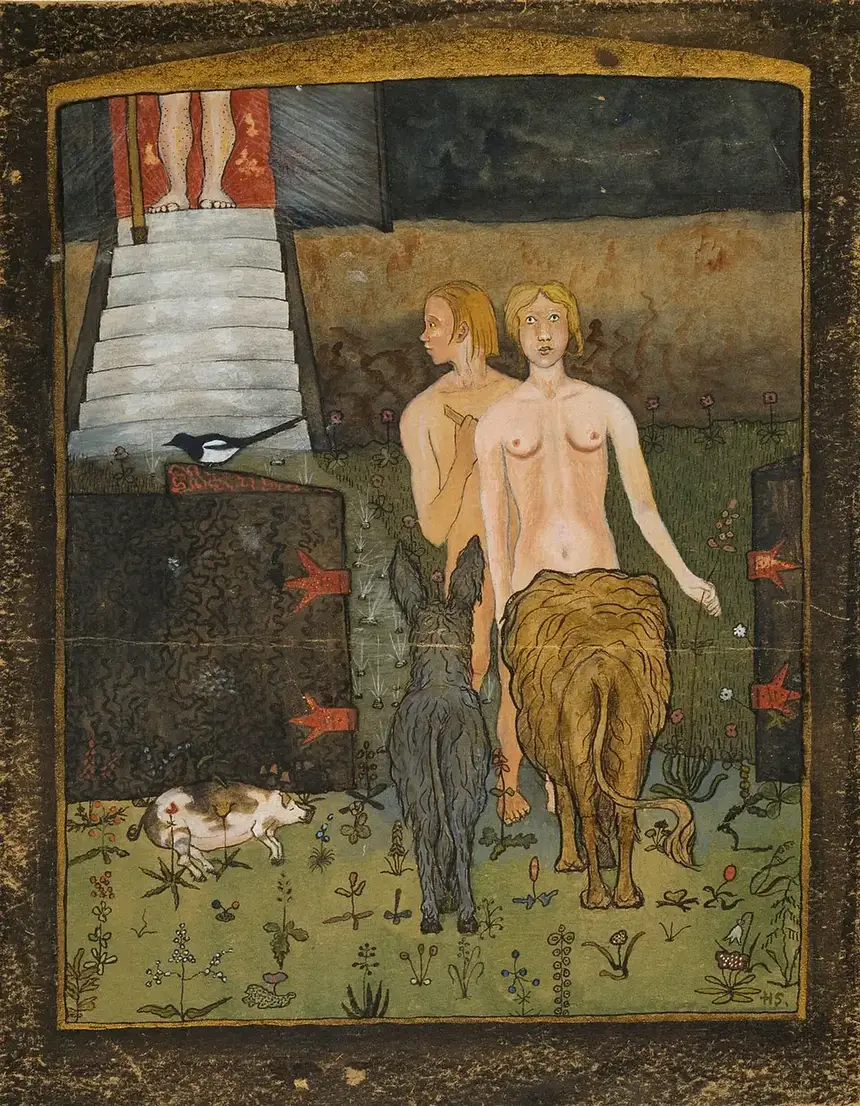
| Artist | Hugo Simberg |
|---|---|
| Title | Aatami ja Eeva |
| Medium | Oil on canvas, hand-painted to order |
| Reproduction | Hand-painted oil on canvas, made to order |
| Copyright | Public domain; the original is out of copyright |
What a print loses
The difference is not subtle when the two hang side by side. Ink sits on the surface; oil stands off it.
Where the original is loaded, ours is loaded. Where it is thin, ours is thin. Matching the weight of the paint matters more than matching the colour.
| Aspect | Hand-painted oil | Printed canvas |
|---|---|---|
| Later on | Can be restored, re-framed, handed on | Replaceable, and usually replaced |
| Edge quality | Soft where the form turns, sharp where it does not | Uniformly sharp or uniformly blurred |
| Corrections | We adjust it and repaint the passage | The file is reprinted or it is not |
| Lifespan | Slow to change; varnish can be refreshed decades later | Fades and cracks sooner |
| Sense of depth | Real, created by layers of paint | Simulated by darker ink |
Anyone can copy the shapes. The skill is in the transitions, and that is what takes the days.
Every canvas is painted to order, so the quote follows your size, frame and destination rather than a fixed list. Tell us what you need on WhatsApp and we reply with an exact figure, usually within the hour. You are buying from the workshop, not a catalogue.
How your painting is made
The order of work matters as much as the work itself. Ours runs like this:
- We start with the canvas itself — stretched, sized and left to settle before any colour is mixed.
- Laying in the drawing — done by eye from the reference, not traced or projected.
- The big shapes are blocked in — thin paint, one colour at a time, the whole canvas at once.
- The values are established — this is the stage that decides whether the painting works.
- The colour passes — each area gets its own mixture rather than one colour used throughout.
- Detail and highlights last — put on thickly and then not touched again.
- Left to dry before varnish — nothing is photographed or packed until the surface is ready.
The risk with a landscape is overworking, and the way to avoid it is knowing when to stop.
Looking after it
Oil paint needs very little: no water, no cleaners, no sprays. A dry brush and a stable room.
Materials
We buy pigment in tubes from the same suppliers the village has used for years, not in bulk drums. Varnish goes on only once the paint is properly dry, months after the last stroke, not before.
Oil paint dries by oxidation, not evaporation, which is why a finished canvas needs weeks before it travels. The varnish is removable, so a conservator can clean the painting in fifty years without touching the paint.
On framing
If you are shipping, an unframed canvas rolled in a tube is considerably cheaper to move than a framed one.
Frames are priced once you have chosen them, not estimated in advance.
What size works
Any size is possible. These are simply the ones that come up most often in quotes:
| Size (inches) | Size (cm) | Best for |
|---|---|---|
| 30 × 24 in | 76 × 61 cm | Dining room, bedroom feature wall |
| 24 × 20 in | 60 × 50 cm | Study, home office, above a desk |
| 20 × 16 in | 50 × 40 cm | Bedroom, hallway, above a console |
| 16 × 12 in | 40 × 30 cm | A shelf, a small wall, a gallery group |
| 64 × 48 in | 163 × 122 cm | Villa scale, lobby, hospitality wall |
| 48 × 36 in | 122 × 91 cm | Large living room, stairwell, loft |
If your wall is an odd shape, send the measurement and we will work to it. Proportions from the original are kept unless you ask us to change them. DAP terms: we pay the freight, you settle any duty or tax your country applies. We do not collect taxes on anyone's behalf.
For a stairwell or a double-height space, go larger than you think — the composition was built for distance.
Tell us the size and frame — exact quote back, usually within the hour.
💬 Get a Quote for Aatami ja EevaGetting it to you
From order to finished canvas is 9–15 days. Freight appears as a separate line on the quote and is fixed before you pay.
Air freight runs about 7–10 business days, tracked, to your door. Every shipment goes out with tracking. We do not send anything untracked.
Before anything is packed, you get photographs of the actual canvas and a chance to ask for changes. If something is not right, tell us what to adjust and we adjust it.
We sell DAP: the price covers the painting and the freight, and any import duties or taxes are the buyer's to settle with customs. We do not collect them and we do not estimate them.
A deposit starts the canvas and books the painter's time; the balance is due before the crate leaves. Damage in transit should be reported to us within 48 hours, with photographs. We pursue it with the carrier rather than promising a refund.
Before you order
What happens after I message you?
You tell us the painting, size and whether you want a frame. We quote, a painter starts on your canvas, and you get photographs before it ships.
Why not just print it?
A print flattens the surface into a poster: the distance collapses and the highlights turn to grey. Paint keeps the depth and the texture the original was built from.
When will it actually arrive?
Studio time is 9–15 days, then a few more days for the oil to set before we can photograph and pack it. We tell you where your canvas is at each stage.
Do you sell prints?
No. Hand-painted oil on canvas only. No printing, no giclée, no canvas transfer.
Is it really painted by hand?
Yes — oil on canvas, brush and knife. There is no printing, no giclée and no canvas transfer at any stage.
Do you ship to my country?
We ship to over 20 countries. Give us your city and the freight appears as its own line on the quote.
Will I see it before it ships?
Yes. We send photographs of the finished canvas and wait for your reply before packing.
How long does it take?
From order to finished canvas is 9–15 days; delivery adds about 7–10 business days by air.
Is owning a reproduction legal?
Yes. Hugo Simberg died more than 70 years ago, so the work is in the public domain and owning a hand-painted version is legal anywhere. We never pass ours off as the original.
Do you take a deposit?
A deposit starts the canvas and the balance falls due before it ships. Both figures appear on the quote.
Can you change the colours to suit my room?
We can shift the palette, but we will tell you honestly when a change would spoil the painting.
Can I change the size?
Yes. The canvas is painted to your measurement, not taken from a stock list.