About the original
Jan van Eyck died in 1441. That puts the painting well outside copyright, which is why we can paint it and you can own it anywhere in the world.
Ours is a painting made with brushes. There is no giclée, no canvas transfer and no digital underlayer anywhere in the process.
The painting was made in the years before 1441, and what we reproduce is the record of it, not the object.
You are buying a painting, not a file. That distinction is the whole business we are in.
Where the painting lives
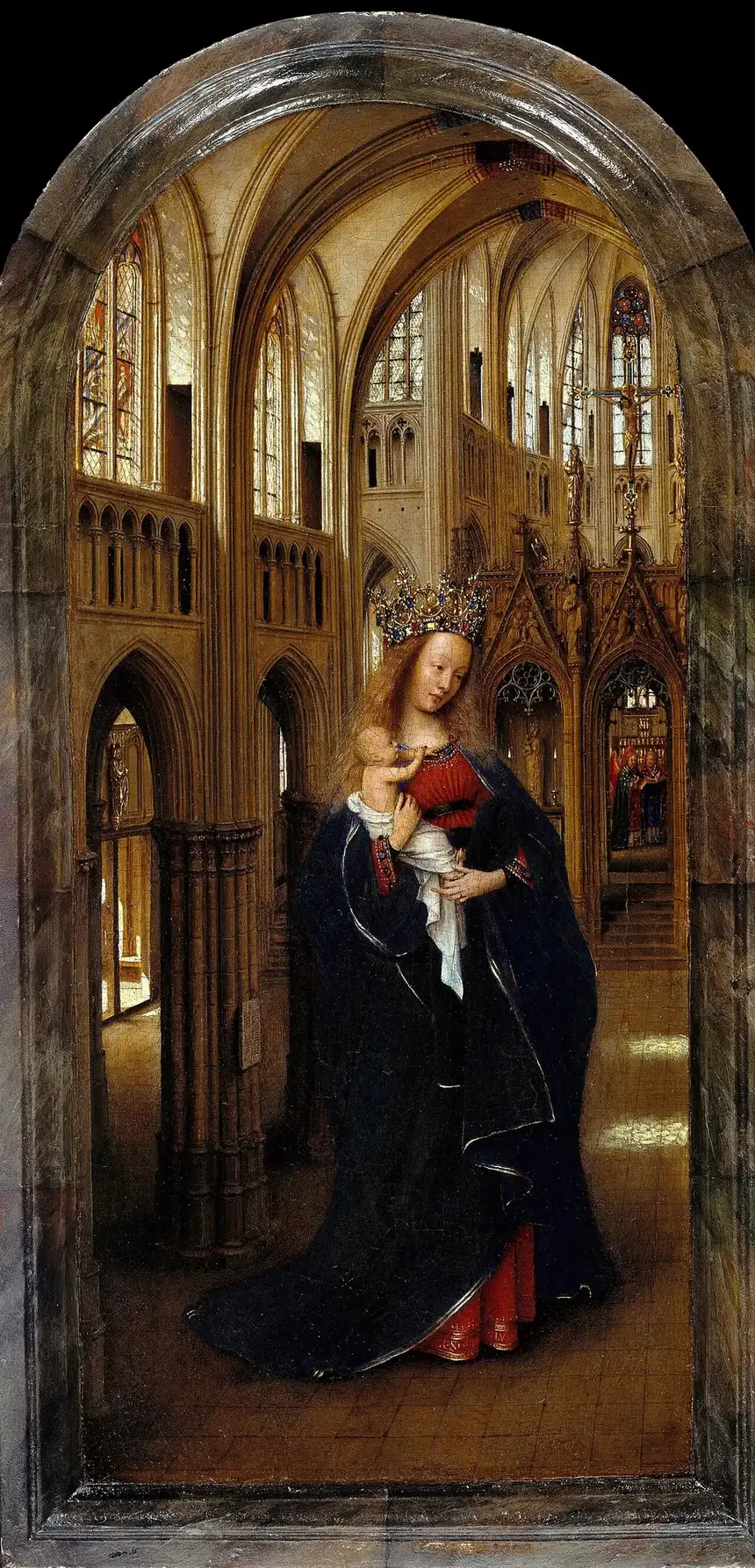
What a print does to The Madonna in the Church is remove the gold. Not the colour — the actual sense of light coming through.
Where the source has gold or strong highlights, we build them in layers rather than painting them flat.
Our painter uses glazes for the glow, which is the only way to get it.
We keep the original's palette rather than brightening it, even where a modern eye would.
The thick paint is kept for the light and the thin paint for the dark, which is the traditional way round.
What takes time here is the number of separate decisions, not the size of the canvas.
For a stairwell or a double-height space, go larger than you think — the composition was built for distance.
| Artist | Jan van Eyck |
|---|---|
| Title | The Madonna in the Church |
| Medium | Oil on canvas, hand-painted to order |
| What you receive | A hand-painted oil painting on canvas |
| Original status | Public domain (artist deceased) |
What a print loses
A print reproduces the shapes and drops the substance. It is the substance you are buying.
Paint goes on in the original's order — thin first, thick last — so the surface behaves the way the painter intended.
| Aspect | Hand-painted oil | Printed canvas |
|---|---|---|
| Time to make | Days of one painter's working time | Minutes |
| How it ages | Warms and settles; cleanable by a conservator | Fades, then cracks at the stretcher |
| Available sizes | Whatever you need, painted to order | What the printer can output |
| Edges | Chosen by the painter, passage by passage | Whatever the file happens to contain |
| Changing something | Tell us and the passage gets repainted | Usually means starting the file again |
The difficult part is not the detail. It is keeping the whole canvas at the same stage of finish.
Every canvas is painted to order, so the quote follows your size, frame and destination rather than a fixed list. Tell us what you need on WhatsApp and we reply with an exact figure, usually within the hour. You are talking to the people who will actually paint it, not a middleman.
How it gets painted
Here is what actually happens between your message and the crate:
- The canvas is stretched and primed — cotton or linen, sized and ready before any paint goes near it.
- The drawing goes down — charcoal or thin paint, done by eye rather than traced from a printout.
- The first colour pass — thin and simple, establishing the main shapes only.
- The values are established — this is the stage that decides whether the painting works.
- The colour passes — each area gets its own mixture rather than one colour used throughout.
- Detail and highlights last — put on thickly and then not touched again.
- Drying and varnishing — the final varnish goes on once the paint has set, before we photograph it.
Matching the original's degree of finish is harder than matching its colours.
On framing
We can supply a simple floater frame, a traditional gilt, or nothing at all. It is your call.
A frame is a separate line on the quote, not a bundle. You choose it once the painting exists.
What it is made of
Linen is worth the extra cost above about a metre across, because it holds tension better in humid rooms. The varnish is removable, so a conservator can clean the painting in fifty years without touching the paint.
We use cotton duck for most sizes and linen where the canvas is large or the client asks for it. Nothing is sprayed, sealed or laminated. The surface you see is paint and varnish, and that is all.
Care and cleaning
Dust it with a dry, soft brush. Keep it out of direct sun and away from radiators, and it will outlive you.
Sizing it
Because each piece is painted from scratch, you are not limited to stock dimensions. These are the sizes clients ask for most:
| Size (inches) | Size (cm) | Best for |
|---|---|---|
| 24 × 20 in | 60 × 50 cm | Study, home office, above a desk |
| 20 × 16 in | 50 × 40 cm | Bedroom, hallway, above a console |
| 16 × 12 in | 40 × 30 cm | A shelf, a small wall, a gallery group |
| 64 × 48 in | 163 × 122 cm | Villa scale, lobby, hospitality wall |
Anything outside this table is fine — we paint to the number you give us. Terms are DAP. Import duties and taxes, where they apply, are paid by the buyer on arrival — we never collect them in advance and never guess at the amount.
It works best on a wall you pass rather than one you sit and stare at — the paint rewards a moving eye.
Message us the dimensions you have in mind and we will come back with a figure.
💬 Get a Quote for The Madonna in the ChurchFrom order to your wall
The painting takes 9–15 days, and delivery is priced separately on the quote so there is no surprise later.
Expect 7–10 business days in transit, with tracking from our door to yours. Every shipment goes out with tracking. We do not send anything untracked.
You approve the painting from photographs before it is packed — that is the checkpoint. If something is not right, tell us what to adjust and we adjust it.
We quote DAP, so any duty or tax your country charges is settled by you at import. We do not add a tax line of our own.
You pay a deposit to start and the remainder before shipping. Nothing is hidden in between. Damage in transit should be reported to us within 48 hours, with photographs. We pursue it with the carrier rather than promising a refund.
What people ask us
What size should I order?
You choose the size. Each canvas is cut to your measurements rather than pulled from stock, so tell us the wall dimensions and we will tell you what proportion works.
How do I clean and care for it?
Dust lightly with a dry, soft brush and keep it out of direct sun. Nothing else is needed for decades; oil paint is slow to change and easy to live with.
Do you frame it?
Framing is quoted separately, so you can decide once you have seen the finished canvas in photographs.
Is owning a reproduction legal?
Yes. Jan van Eyck died more than 70 years ago, so the work is in the public domain and owning a hand-painted version is legal anywhere. We never pass ours off as the original.
Do you ship to my country?
We export to more than 20 countries. Tell us where you are and we will quote the freight as a separate line.
Is it really painted by hand?
Yes. One painter, oil paint, brushes. We do not own a printer that touches canvas.
Can you paint a different work by Jan van Eyck?
Yes. Send the image and we will quote it, or browse the other paintings we have listed.
How long does it take?
Painting takes 9–15 days. Air freight is usually 7–10 business days on top of that, tracked.
Will I see it before it ships?
Yes. We send photographs of the finished canvas and wait for your reply before packing.
Do you sell prints?
No prints at all — no giclée, no canvas transfer, nothing machine-made.
Can I change the size?
Yes. The canvas is painted to your measurement, not taken from a stock list.
How do I hang it?
Roughly 145 cm from floor to centre works for most rooms. Tell us your wall and we will give you the measurement.