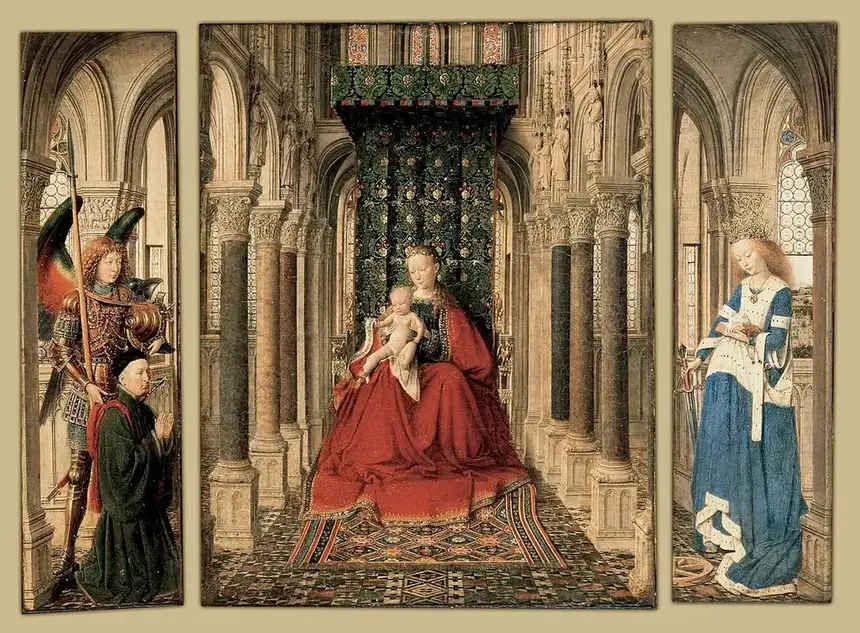
About Triptych of Mary and Child,
Because Jan van Eyck died in 1441, this work is in the public domain. We are painting a copy of a painting — we never pass it off as the original, and neither should anyone selling you one.
Every version we make is oil on canvas, painted by one painter from start to finish. No printing is involved at any stage.
The painting was made in the years before 1441, and what we reproduce is the record of it, not the object.
If you want something printed, we are the wrong workshop. We do not own a printer that touches canvas.
Where the painting lives
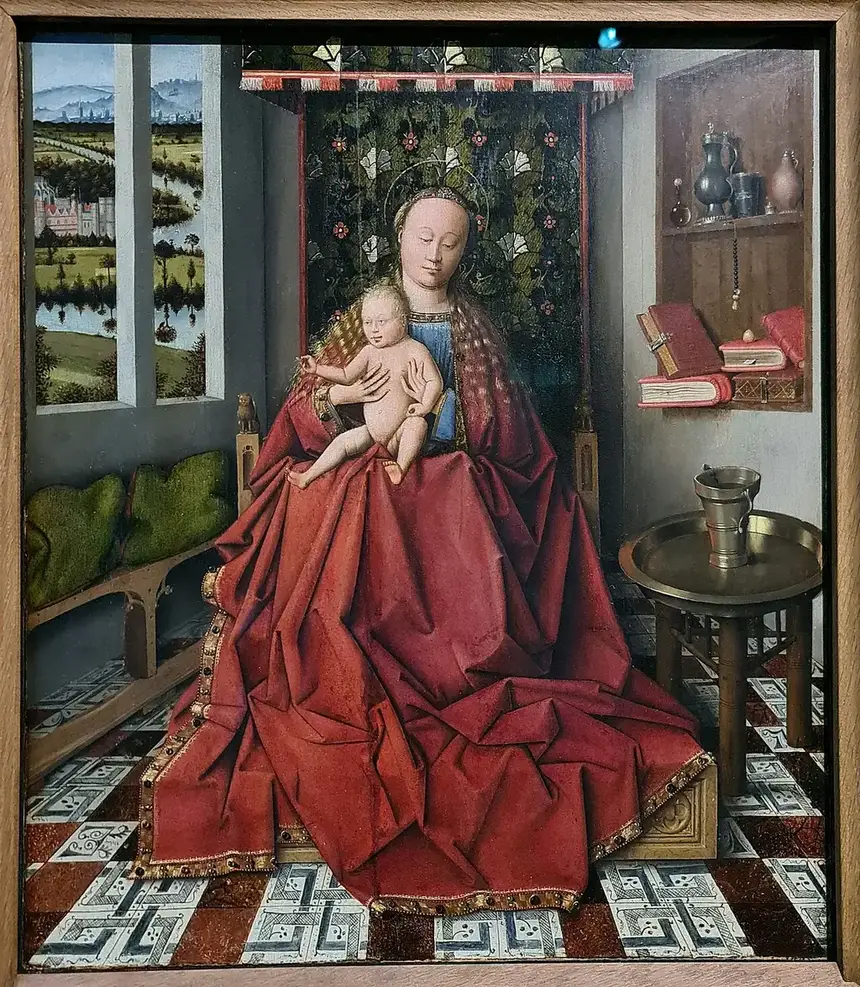
Painted by hand, Triptych of Mary and Child, keeps the soft edge where the face turns away — the edge a print turns into a line.
Our painter starts with the structure of the head and paints the features into it, not onto it.
Eyes are painted as spheres with a shadow, not as shapes with a highlight.
Every colour in Triptych of Mary and Child, has a warm version and a cool version, and the painter chooses between them passage by passage.
The brushwork is left visible, which is the whole argument for painting it by hand.
What takes time here is the number of separate decisions, not the size of the canvas.
For a stairwell or a double-height space, go larger than you think — the composition was built for distance.
| Artist | Jan van Eyck |
|---|---|
| Title | Triptych of Mary and Child, |
| Medium | Oil on canvas, hand-painted to order |
| Our version | Oil on canvas, painted by hand to order |
| Copyright | Public domain; the original is out of copyright |
What a print loses
Prints are good at information and bad at paint. This subject is mostly paint.
Paint goes on in the original's order — thin first, thick last — so the surface behaves the way the painter intended.
| Aspect | Hand-painted oil | Printed canvas |
|---|---|---|
| Available sizes | Whatever you need, painted to order | What the printer can output |
| Lifespan | Slow to change; varnish can be refreshed decades later | Fades and cracks sooner |
| Texture | Ridges and drag you can see from across a room | None, or a printed imitation of it |
| Changing something | Tell us and the passage gets repainted | Usually means starting the file again |
| The surface | Built up with brushes and knives | Printed flat in one pass |
The risk with a portrait is overworking, and the way to avoid it is knowing when to stop.
Every canvas is painted to order, so the quote follows your size, frame and destination rather than a fixed list. Tell us what you need on WhatsApp and we reply with an exact figure, usually within the hour. No resellers, no drop-shipper. The painter's studio handles your commission from first message to final crate.
How it gets painted
This is how the painting is built, in the order our painters build it:
- Stretching and priming the support — cotton duck or linen goes onto the bars and gets its ground.
- A loose underdrawing — proportions checked by eye against the source image.
- Blocking the masses — thin paint, working the whole surface rather than one corner at a time.
- Getting the values right — the stage that decides whether the finished painting holds together.
- Colour is built up — warmer and cooler versions of each passage, laid over the underpainting.
- The detail and highlights go on — last, loaded, and left alone once they are down.
- It dries, then gets varnished — and only then is it photographed for you.
Matching the original's degree of finish is harder than matching its colours.
Keeping it
Once the varnish has cured the surface can be cleaned by a conservator, but in a normal house it will not need it for decades.
On framing
We can supply a simple floater frame, a traditional gilt, or nothing at all. It is your call.
Frames are priced once you have chosen them, not estimated in advance.
Materials
We use cotton duck for most sizes and linen where the canvas is large or the client asks for it. The paint is built in layers, fat over lean, which is what stops it cracking later.
Linen is worth the extra cost above about a metre across, because it holds tension better in humid rooms. Nothing is sprayed, sealed or laminated. The surface you see is paint and varnish, and that is all.
Sizing it
The canvas is cut to your wall, not the other way round. For reference, these are the dimensions most often requested:
| Size (inches) | Size (cm) | Best for |
|---|---|---|
| 16 × 12 in | 40 × 30 cm | A shelf, a small wall, a gallery group |
| 64 × 48 in | 163 × 122 cm | Villa scale, lobby, hospitality wall |
| 48 × 36 in | 122 × 91 cm | Large living room, stairwell, loft |
| 40 × 30 in | 102 × 76 cm | Living room focal wall, above a sofa |
| 32 × 24 in | 81 × 61 cm | Living room, above a sideboard |
| 30 × 24 in | 76 × 61 cm | Dining room, bedroom feature wall |
We will size the canvas to the room, not to a stock list. Send us the measurement. We sell DAP: the price covers the painting and the freight, and any import duties or taxes are the buyer's to settle with customs. We do not collect them and we do not estimate them.
It wants a wall where the light rakes across it, because the surface is part of the picture.
Give us your size and framing preference and you will have a quote shortly.
💬 Get a Quote for Triptych of Mary and Child, St. Michael, and the CatherineTimeline and shipping
Painting takes 9–15 days. Freight is quoted as its own line on the quote, agreed before you pay anything, and never added afterwards.
Transit is usually 7–10 business days, tracked all the way. Every shipment goes out with tracking. We do not send anything untracked.
You approve the painting from photographs before it is packed — that is the checkpoint. Changes are handled by telling us what to change; we change it and send new photographs.
Duties and import taxes are the buyer's account (DAP). Your customs authority sets them; we do not.
A deposit starts the canvas and books the painter's time; the balance is due before the crate leaves. Damage in transit should be reported to us within 48 hours, with photographs. We pursue it with the carrier rather than promising a refund.
Questions worth asking
How close will it be to the original?
The composition, colour and drawing follow the original closely; the brushwork carries the painter's own hand. The painter works freehand on a blank canvas, following the same logic as the original rather than copying a photograph.
Do you work from my own photograph?
Yes, though that is a separate service. This page is for a hand-painted version of {title}; for a photo-to-painting commission, send the image on WhatsApp.
When will it actually arrive?
Studio time is 9–15 days, then a few more days for the oil to set before we can photograph and pack it. We tell you where your canvas is at each stage.
What does it cost?
There is no price list, because the number depends on your size and frame. Message us and we will quote exactly.
How do I hang it?
Roughly 145 cm from floor to centre works for most rooms. Tell us your wall and we will give you the measurement.
Can I change the size?
Any size you like. We paint to the number you give us rather than to a standard range.
Can you paint a different work by Jan van Eyck?
Yes. Send the image and we will quote it, or browse the other paintings we have listed.
Can you paint it from a different photograph of the same work?
Yes. If you have a better reference, send it on WhatsApp and we will work from yours.
Can you change the colours to suit my room?
Sometimes. We will adjust the palette if it can be done without ruining the picture, and say so if it cannot.
Do you ship to my country?
We export to more than 20 countries. Tell us where you are and we will quote the freight as a separate line.
Is owning a reproduction legal?
Yes. Jan van Eyck died more than 70 years ago, so the work is in the public domain and owning a hand-painted version is legal anywhere. We never pass ours off as the original.
Is it really painted by hand?
Yes. One painter, oil paint, brushes. We do not own a printer that touches canvas.