Where this painting comes from
Because János Vaszary died in 1939, this work is in the public domain. We are painting a copy of a painting — we never pass it off as the original, and neither should anyone selling you one.
We paint it in oil on canvas, one at a time, in Dafen Village. Nothing is printed, scanned or transferred.
The painting was made in the years before 1939, and what we reproduce is the record of it, not the object.
What arrives is a canvas with paint on it, made by a person. That is the only thing we sell.
Looking at it properly
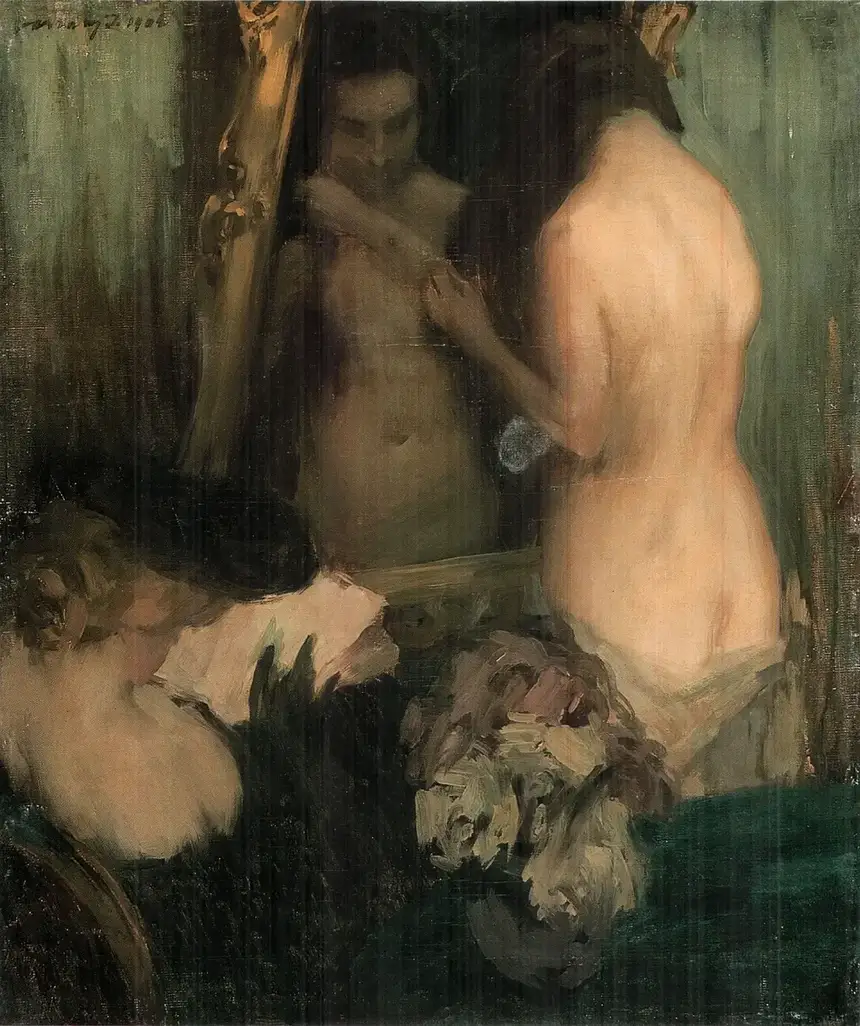
We paint Woman in front of the Mirror from the source image with the same layering a portraitist would use, which is why the skin stays alive.
Scale matters in a portrait: we size it so the head reads at life size or larger, which is when it starts to work.
Skin here is translucent: light goes in, bounces, and comes back warm. That is done with thin paint over a lighter ground.
Every colour in Woman in front of the Mirror has a warm version and a cool version, and the painter chooses between them passage by passage.
The marks have a direction, and the direction follows the form.
The passage that will take longest is the one that looks simplest.
A plain wall is better than a busy one; the painting supplies the interest.
| Artist | János Vaszary |
|---|---|
| Title | Woman in front of the Mirror |
| Created (original) | 1904 |
| Medium | Oil on canvas, hand-painted to order |
| Our version | Oil on canvas, painted by hand to order |
| Original status | Public domain (artist deceased) |
The case for painting it by hand
The difference is not subtle when the two hang side by side. Ink sits on the surface; oil stands off it.
Paint goes on in the original's order — thin first, thick last — so the surface behaves the way the painter intended.
| Aspect | Hand-painted oil | Printed canvas |
|---|---|---|
| The surface | Built up with brushes and knives | Printed flat in one pass |
| Value over time | Can be re-stretched, cleaned and re-framed | Little value beyond the print |
| Colour | Mixed for each passage, warm and cool versions | One flat value per area |
| Texture | Ridges and drag you can see from across a room | None, or a printed imitation of it |
| Corrections | We adjust it and repaint the passage | The file is reprinted or it is not |
The risk with a portrait is overworking, and the way to avoid it is knowing when to stop.
Every canvas is painted to order, so the quote follows your size, frame and destination rather than a fixed list. Tell us what you need on WhatsApp and we reply with an exact figure, usually within the hour. There is no agency in between; the studio that paints your canvas is the one answering your messages.
How the canvas is built
Here is what actually happens between your message and the crate:
- We start with the canvas itself — stretched, sized and left to settle before any colour is mixed.
- A loose underdrawing — proportions checked by eye against the source image.
- Blocking the masses — thin paint, working the whole surface rather than one corner at a time.
- Getting the values right — the stage that decides whether the finished painting holds together.
- Colour is built up — warmer and cooler versions of each passage, laid over the underpainting.
- Finishing passes — the loaded highlights go on at the end and stay there.
- It dries, then gets varnished — and only then is it photographed for you.
The difficulty is restraint: leaving out most of what a photograph would show.
Framing
A frame is a separate line on the quote, not a bundle. You choose it once the painting exists.
Most clients wait for the photographs before choosing a frame, which is the sensible order.
Canvas, paint and varnish
We use a neutral-sized ground so the whites stay warm rather than going blue over time. Oil paint dries by oxidation, not evaporation, which is why a finished canvas needs weeks before it travels.
Stretcher bars are kiln-dried and wedged, so the canvas can be re-tensioned years later. The varnish is removable, so a conservator can clean the painting in fifty years without touching the paint.
Living with it
Do not wipe it with anything wet. Dust lightly, hang it somewhere stable, and forget about it.
Choosing a size
Any size is possible. These are simply the ones that come up most often in quotes:
| Size (inches) | Size (cm) | Best for |
|---|---|---|
| 32 × 24 in | 81 × 61 cm | Living room, above a sideboard |
| 30 × 24 in | 76 × 61 cm | Dining room, bedroom feature wall |
| 24 × 20 in | 60 × 50 cm | Study, home office, above a desk |
| 20 × 16 in | 50 × 40 cm | Bedroom, hallway, above a console |
If your wall is an odd shape, send the measurement and we will work to it. Proportions from the original are kept unless you ask us to change them. Terms are DAP. Import duties and taxes, where they apply, are paid by the buyer on arrival — we never collect them in advance and never guess at the amount.
Given the subject, this sits naturally in a living room or a study rather than a hallway.
Tell us where it will hang and how big it needs to be — we will price it properly.
💬 Get a Quote for Woman in front of the MirrorGetting it to you
The painting takes 9–15 days, and delivery is priced separately on the quote so there is no surprise later.
Transit is usually 7–10 business days, tracked all the way. Unframed canvases are rolled face-out on a tube; framed ones are corner-protected and crated.
You approve the painting from photographs before it is packed — that is the checkpoint. If something is not right, tell us what to adjust and we adjust it.
We sell DAP: the price covers the painting and the freight, and any import duties or taxes are the buyer's to settle with customs. We do not collect them and we do not estimate them.
A deposit starts the canvas and books the painter's time; the balance is due before the crate leaves. Damage in transit should be reported to us within 48 hours, with photographs. We pursue it with the carrier rather than promising a refund.
The practical questions
How do I know what size will look right?
Measure the wall and send a photograph. We will say honestly if the canvas you have in mind is too small for the space, which is the most common mistake.
Do you work from my own photograph?
Yes, though that is a separate service. This page is for a hand-painted version of {title}; for a photo-to-painting commission, send the image on WhatsApp.
What about duties and import taxes?
Those are the buyer's responsibility (DAP). The amounts are set by your customs authority, not by us.
Do you ship to my country?
We export to more than 20 countries. Tell us where you are and we will quote the freight as a separate line.
What if it arrives damaged?
Report damage within 48 hours with photographs. We deal with the carrier rather than leaving you to argue alone.
Is owning a reproduction legal?
Yes. János Vaszary died more than 70 years ago, so the work is in the public domain and owning a hand-painted version is legal anywhere. We never pass ours off as the original.
Can I change the size?
Yes. The canvas is painted to your measurement, not taken from a stock list.
How do I hang it?
Centre it at about 145 cm from the floor, or two-thirds the width of the furniture below it. We will tell you the exact number for your wall.
Can you paint a different work by János Vaszary?
Yes. Send the image and we will quote it, or browse the other paintings we have listed.
Who pays the import duty?
The buyer does. Terms are DAP: duties and taxes, where they apply, are paid on arrival. We never add a tax line of our own.
Does it come framed?
Frames are priced on their own line. Most clients choose after seeing the photographs.
Will I see it before it ships?
Yes — photographs of the actual painting go to you first, and nothing is packed until you have seen them.