Where this painting comes from
Jean-François Portaels died in 1895, so the work has been in the public domain for decades. Reproducing it by hand is legal, and so is owning one.
Every version we make is oil on canvas, painted by one painter from start to finish. No printing is involved at any stage.
The painting was made in the years before 1895, and what we reproduce is the record of it, not the object.
You are buying a painting, not a file. That distinction is the whole business we are in.
Where the painting lives
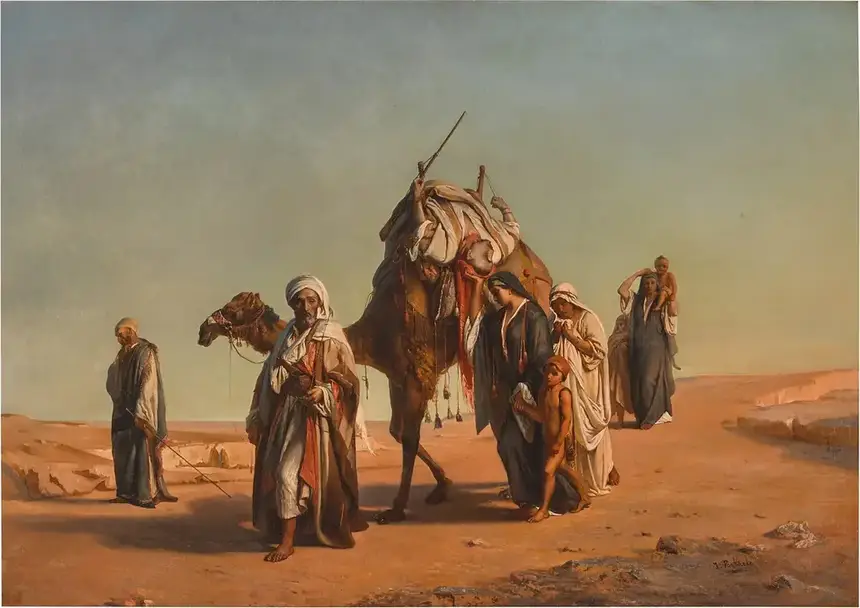
There is a reason a landscape is the hardest thing to print and the easiest thing to paint: the paint itself carries the depth.
Space in a landscape is made with value, not perspective: things that are further away are painted cooler and weaker.
Sunlight and shadow are two different temperatures here, not one colour at two strengths.
The saturation is deliberately uneven: strongest at the focal point, weaker everywhere else.
The last marks are the ones that are left alone. Overworking is the enemy.
Matching the original's degree of finish is harder than matching its colours.
In a bedroom it works above a headboard, sized to about two-thirds of the furniture width.
| Artist | Jean-François Portaels |
|---|---|
| Title | The Procession |
| Medium | Oil on canvas, hand-painted to order |
| Reproduction | Hand-painted oil on canvas, made to order |
| Original status | Public domain (artist deceased) |
The case for painting it by hand
A print reproduces the shapes and drops the substance. It is the substance you are buying.
Paint goes on in the original's order — thin first, thick last — so the surface behaves the way the painter intended.
| Aspect | Hand-painted oil | Printed canvas |
|---|---|---|
| How it ages | Warms and settles; cleanable by a conservator | Fades, then cracks at the stretcher |
| Handling of colour | Mixed on the palette and finished on the canvas | Fixed by the colour profile |
| Value over time | Can be re-stretched, cleaned and re-framed | Little value beyond the print |
| Available sizes | Whatever you need, painted to order | What the printer can output |
| What it takes | One painter, several days, start to finish | A machine, a few minutes |
What takes time here is the number of separate decisions, not the size of the canvas.
Every canvas is painted to order, so the quote follows your size, frame and destination rather than a fixed list. Tell us what you need on WhatsApp and we reply with an exact figure, usually within the hour. You are talking to the people who will actually paint it, not a middleman.
How your painting is made
No two canvases are painted the same way, but the sequence is always this:
- The canvas is stretched and primed — cotton or linen, sized and ready before any paint goes near it.
- A loose underdrawing — proportions checked by eye against the source image.
- Blocking the masses — thin paint, working the whole surface rather than one corner at a time.
- Getting the values right — the stage that decides whether the finished painting holds together.
- The colour passes — each area gets its own mixture rather than one colour used throughout.
- The detail and highlights go on — last, loaded, and left alone once they are down.
- Left to dry before varnish — nothing is photographed or packed until the surface is ready.
The difficult part is not the detail. It is keeping the whole canvas at the same stage of finish.
Whether to frame it
We can supply a simple floater frame, a traditional gilt, or nothing at all. It is your call.
Frames are priced once you have chosen them, not estimated in advance.
Living with it
Dust it with a dry, soft brush. Keep it out of direct sun and away from radiators, and it will outlive you.
Materials
Stretcher bars are kiln-dried and wedged, so the canvas can be re-tensioned years later. We use cotton duck for most sizes and linen where the canvas is large or the client asks for it.
Pigment is artist-grade oil colour, not acrylic and not house paint. It behaves differently and it lasts. Each painter works on one canvas at a time — the painting you ordered is not shared with another order.
Canvas sizes
Because each piece is painted from scratch, you are not limited to stock dimensions. These are the sizes clients ask for most:
| Size (inches) | Size (cm) | Best for |
|---|---|---|
| 30 × 24 in | 76 × 61 cm | Dining room, bedroom feature wall |
| 24 × 20 in | 60 × 50 cm | Study, home office, above a desk |
| 20 × 16 in | 50 × 40 cm | Bedroom, hallway, above a console |
| 16 × 12 in | 40 × 30 cm | A shelf, a small wall, a gallery group |
If your wall is an odd shape, send the measurement and we will work to it. Proportions from the original are kept unless you ask us to change them. Terms are DAP. Import duties and taxes, where they apply, are paid by the buyer on arrival — we never collect them in advance and never guess at the amount.
Given the subject, this sits naturally in a living room or a study rather than a hallway.
Message us the dimensions you have in mind and we will come back with a figure.
💬 Get a Quote for The ProcessionHow it reaches you
The painting takes 9–15 days, and delivery is priced separately on the quote so there is no surprise later.
In transit it is typically 7–10 business days by air, tracked door to door. We send photographs of the finished painting before it is packed, and again once it is boxed.
You approve the painting from photographs before it is packed — that is the checkpoint. Adjustments are part of the process. Say what you want different and it gets done.
Import charges, where they exist, are the buyer's responsibility (DAP). We never add them to the quote and never guess what they will be.
A deposit starts the canvas and books the painter's time; the balance is due before the crate leaves. If a crate arrives damaged, send us photographs within 48 hours and contact us directly — we will sort it out with you.
Before you order
What happens after I message you?
You tell us the painting, size and whether you want a frame. We quote, a painter starts on your canvas, and you get photographs before it ships.
Does it come with a certificate of authenticity?
No, and we would be wary of anyone who issues one for a public-domain reproduction. What you receive is a hand-painted canvas and photographs of it before it ships.
Why not just print it?
A print flattens the surface into a poster: the distance collapses and the highlights turn to grey. Paint keeps the depth and the texture the original was built from.
Can I change the size?
Any size you like. We paint to the number you give us rather than to a standard range.
What if it arrives damaged?
send us photographs within 48 hours and contact us directly — we will sort it out with you.
Can you paint it from a different photograph of the same work?
Yes. If you have a better reference, send it on WhatsApp and we will work from yours.
Is owning a reproduction legal?
Yes. Jean-François Portaels died more than 70 years ago, so the work is in the public domain and owning a hand-painted version is legal anywhere. We never pass ours off as the original.
Will I see it before it ships?
Yes — photographs of the actual painting go to you first, and nothing is packed until you have seen them.
What does it cost?
There is no price list, because the number depends on your size and frame. Message us and we will quote exactly.
Can you change the colours to suit my room?
Sometimes. We will adjust the palette if it can be done without ruining the picture, and say so if it cannot.
What is the canvas made of?
Cotton or linen, oil colour, and varnish. Stretcher bars are wedged so the canvas can be re-tensioned later.
Is it really painted by hand?
Yes. One painter, oil paint, brushes. We do not own a printer that touches canvas.