The original, and why we can paint it
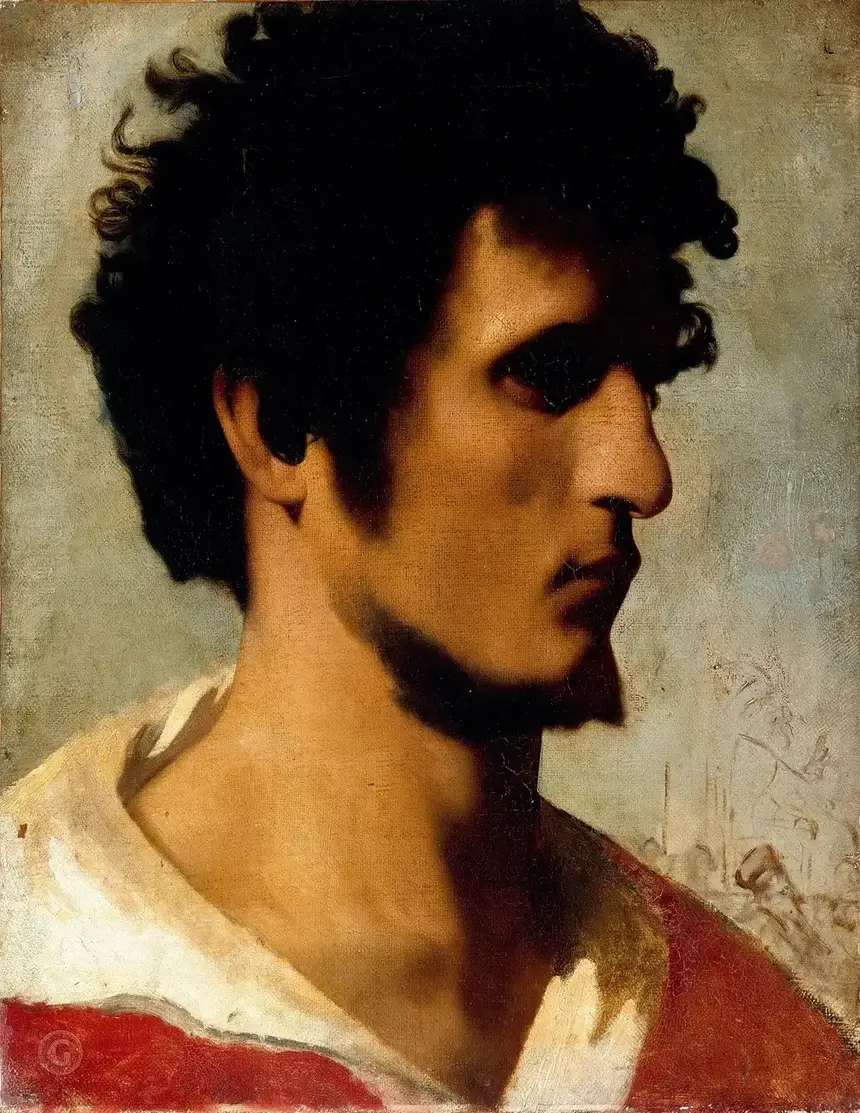
Because Jean-Léon Gérôme died in 1904, this work is in the public domain. We are painting a copy of a painting — we never pass it off as the original, and neither should anyone selling you one.
We paint it in oil on canvas, one at a time, in Dafen Village. Nothing is printed, scanned or transferred.
It is an original composition painted before 1904, and our version is painted from the surviving image of it.
You are buying a painting, not a file. That distinction is the whole business we are in.
What to look at
A copy can be accurate and still be dead. The thing that keeps Head of a Peasant from the alive is that the marks were made in a deliberate order.
Our painter works the whole canvas at once rather than finishing one area at a time, which is what keeps the light consistent.
Light is handled as a value problem: how dark the darkest passage goes decides everything else.
Our painter mixes on the palette but finishes on the canvas, which is where the small variations come from.
Paint is laid on, not pushed around. That is what keeps it fresh.
This one repaints badly, so our painter gets the values right early and leaves them.
This reads well above a sofa or a sideboard, where it will be seen from two to three metres.
| Artist | Jean-Léon Gérôme |
|---|---|
| Title | Head of a Peasant from the |
| Medium | Oil on canvas, hand-painted to order |
| Our version | Oil on canvas, painted by hand to order |
| Public domain | Yes — the artist died over 70 years ago |
Hand-painted, not printed
The difference is not subtle when the two hang side by side. Ink sits on the surface; oil stands off it.
Paint goes on in the original's order — thin first, thick last — so the surface behaves the way the painter intended.
| Aspect | Hand-painted oil | Printed canvas |
|---|---|---|
| Time to make | Days of one painter's working time | Minutes |
| Colour | Mixed for each passage, warm and cool versions | One flat value per area |
| Edge quality | Soft where the form turns, sharp where it does not | Uniformly sharp or uniformly blurred |
| Sense of depth | Real, created by layers of paint | Simulated by darker ink |
| Lifespan | Slow to change; varnish can be refreshed decades later | Fades and cracks sooner |
Matching the original's degree of finish is harder than matching its colours.
Every canvas is painted to order, so the quote follows your size, frame and destination rather than a fixed list. Tell us what you need on WhatsApp and we reply with an exact figure, usually within the hour. There is no agency in between; the studio that paints your canvas is the one answering your messages.
How the canvas is built
Here is what actually happens between your message and the crate:
- We start with the canvas itself — stretched, sized and left to settle before any colour is mixed.
- Laying in the drawing — done by eye from the reference, not traced or projected.
- The big shapes are blocked in — thin paint, one colour at a time, the whole canvas at once.
- The values are established — this is the stage that decides whether the painting works.
- Colour is built up — warmer and cooler versions of each passage, laid over the underpainting.
- Detail and highlights last — put on thickly and then not touched again.
- Drying and varnishing — the final varnish goes on once the paint has set, before we photograph it.
The risk with a portrait is overworking, and the way to avoid it is knowing when to stop.
Care and cleaning
Dust it with a dry, soft brush. Keep it out of direct sun and away from radiators, and it will outlive you.
Materials
We buy pigment in tubes from the same suppliers the village has used for years, not in bulk drums. Stretcher bars are kiln-dried and wedged, so the canvas can be re-tensioned years later.
Brushes, knives and rags. That is the equipment list; there is no machine in the process. Large canvases get a cross-brace; anything over about a metre and a half needs one.
Frames
Framing is quoted separately, so you can decide after you have seen the finished canvas in photographs.
Frames are priced once you have chosen them, not estimated in advance.
Getting the size right
The canvas is cut to your wall, not the other way round. For reference, these are the dimensions most often requested:
| Size (inches) | Size (cm) | Best for |
|---|---|---|
| 16 × 12 in | 40 × 30 cm | A shelf, a small wall, a gallery group |
| 64 × 48 in | 163 × 122 cm | Villa scale, lobby, hospitality wall |
| 48 × 36 in | 122 × 91 cm | Large living room, stairwell, loft |
| 40 × 30 in | 102 × 76 cm | Living room focal wall, above a sofa |
| 32 × 24 in | 81 × 61 cm | Living room, above a sideboard |
Anything outside this table is fine — we paint to the number you give us. Import charges, where they exist, are the buyer's responsibility (DAP). We never add them to the quote and never guess what they will be.
It works best on a wall you pass rather than one you sit and stare at — the paint rewards a moving eye.
Tell us where it will hang and how big it needs to be — we will price it properly.
💬 Get a Quote for Head of a Peasant from the Roman CountrysideTimeline and shipping
Allow 9–15 days for the painting itself. Shipping is a separate line on your quote — you see it before payment, not after.
Transit is usually 7–10 business days, tracked all the way. Unframed canvases are rolled face-out on a tube; framed ones are corner-protected and crated.
You see photographs of the finished painting before it ships, and you tell us what to adjust. Changes are handled by telling us what to change; we change it and send new photographs.
We sell DAP: the price covers the painting and the freight, and any import duties or taxes are the buyer's to settle with customs. We do not collect them and we do not estimate them.
Work begins on a deposit and ships on the balance. Both figures are on the quote. Damage in transit should be reported to us within 48 hours, with photographs. We pursue it with the carrier rather than promising a refund.
The practical questions
How close will it be to the original?
The composition, colour and drawing follow the original closely; the brushwork carries the painter's own hand. The painter works freehand on a blank canvas, following the same logic as the original rather than copying a photograph.
What if my wall is an unusual shape?
That is normal for us. Send the measurements and we will work out a canvas proportion that suits the space.
How do I know what size will look right?
Measure the wall and send a photograph. We will say honestly if the canvas you have in mind is too small for the space, which is the most common mistake.
Can you paint it from a different photograph of the same work?
Send your own reference image and we will paint from that instead.
What does it cost?
There is no price list, because the number depends on your size and frame. Message us and we will quote exactly.
Is it really painted by hand?
Yes. One painter, oil paint, brushes. We do not own a printer that touches canvas.
How long does it take?
Allow 9–15 days for the painting itself, then roughly 7–10 business days in transit.
Can you paint a different work by Jean-Léon Gérôme?
Yes. Send the image and we will quote it, or browse the other paintings we have listed.
Does it come framed?
Frames are priced on their own line. Most clients choose after seeing the photographs.
Do you ship to my country?
We ship to over 20 countries. Give us your city and the freight appears as its own line on the quote.
Will I see it before it ships?
Yes. We send photographs of the finished canvas and wait for your reply before packing.
Can you change the colours to suit my room?
We can shift the palette, but we will tell you honestly when a change would spoil the painting.