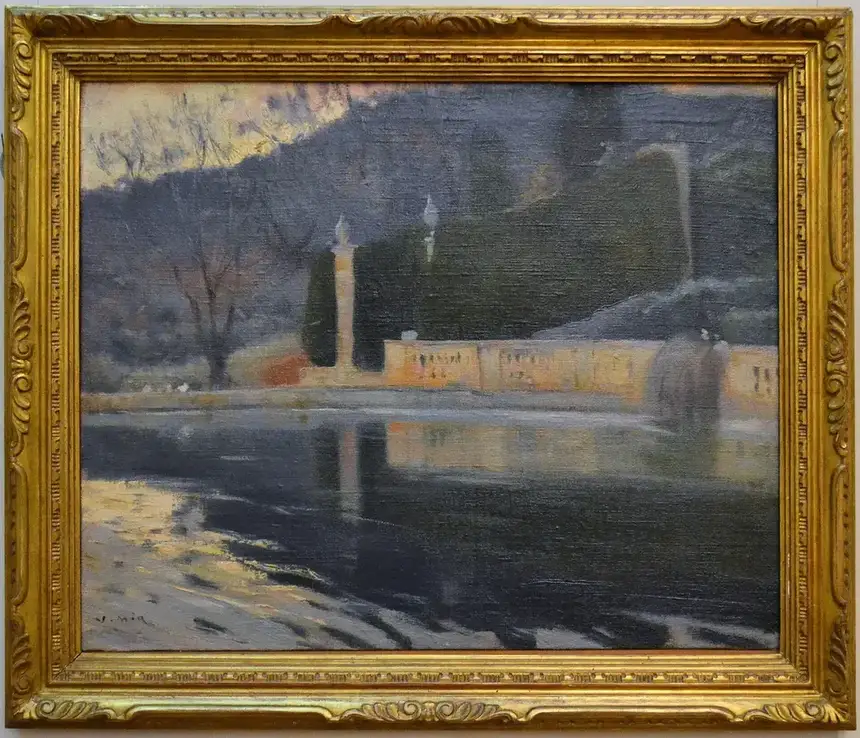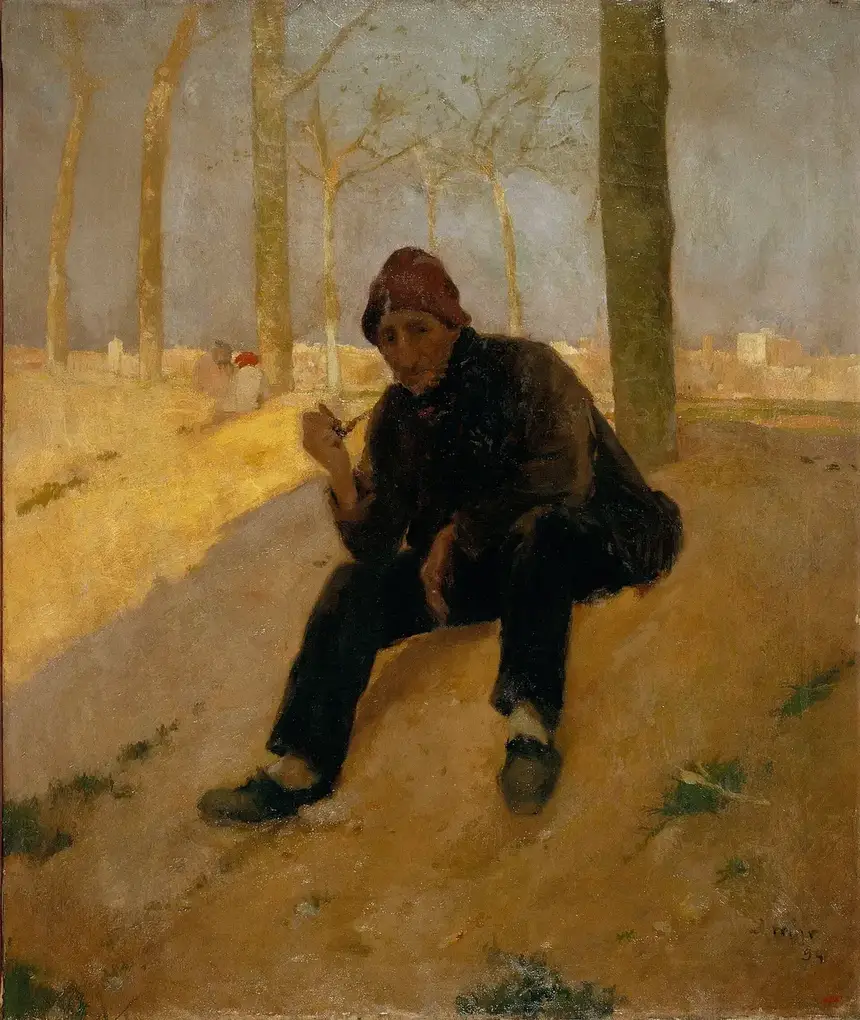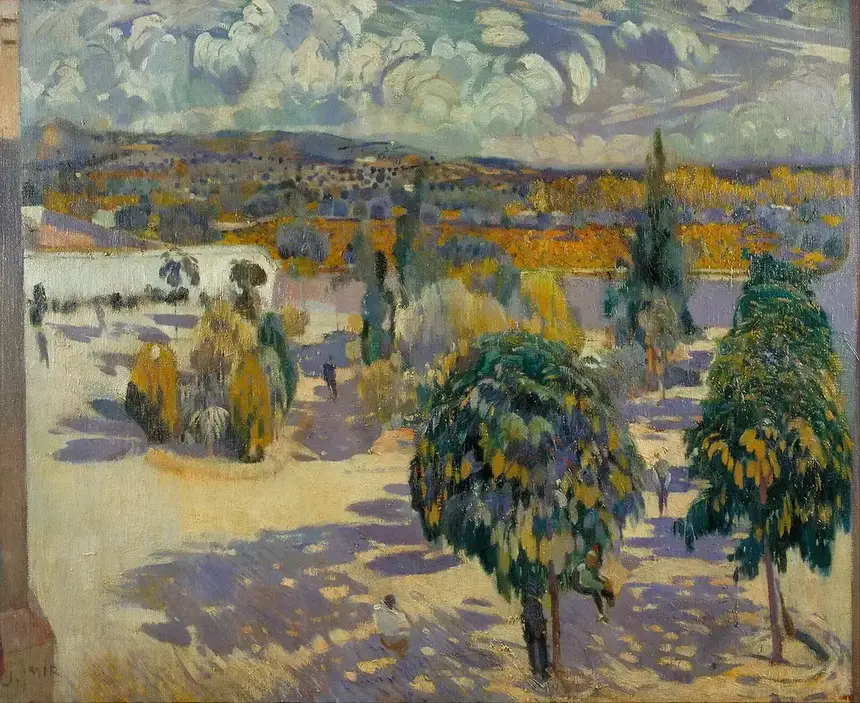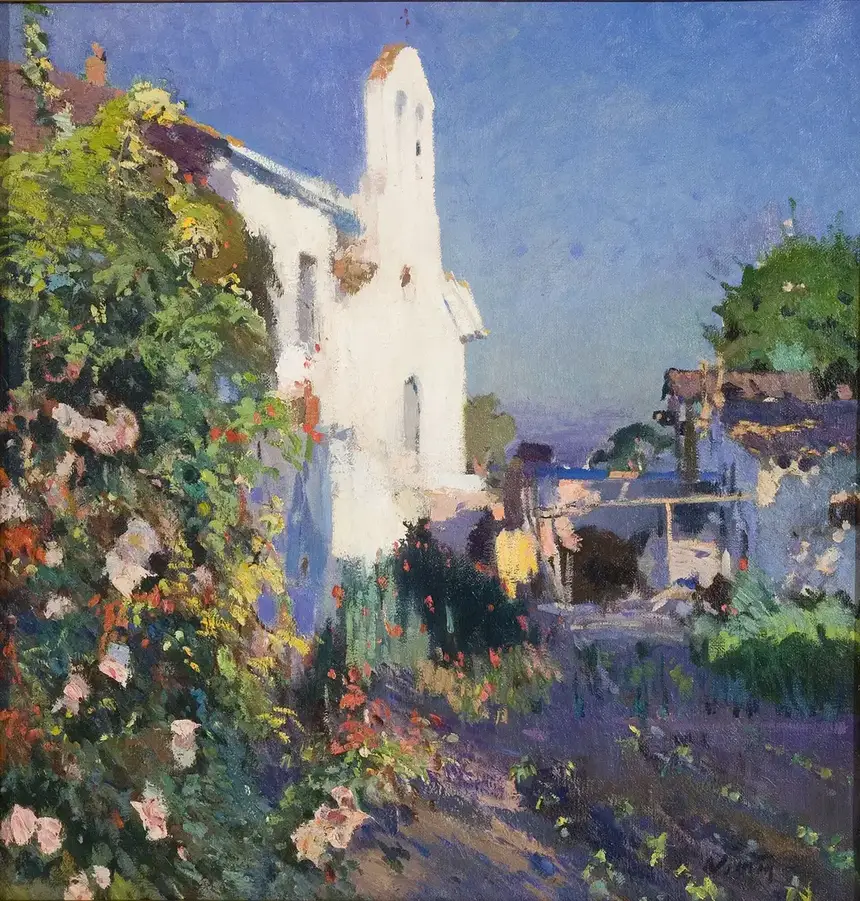
Where this painting comes from
Joaquim Mir died in 1940, so the work has been in the public domain for decades. Reproducing it by hand is legal, and so is owning one.
Ours is a painting made with brushes. There is no giclée, no canvas transfer and no digital underlayer anywhere in the process.
The painting was made in the years before 1940, and what we reproduce is the record of it, not the object.
What arrives is a canvas with paint on it, made by a person. That is the only thing we sell.
What to look at
There is a reason a landscape is the hardest thing to print and the easiest thing to paint: the paint itself carries the depth.
Our painter works freehand on a blank canvas, so the scale of the original survives the enlargement.
Where the source has light coming through the paint, we glaze rather than paint opaque white.
The saturation is deliberately uneven: strongest at the focal point, weaker everywhere else.
The brushwork is left visible, which is the whole argument for painting it by hand.
The risk with a landscape is overworking, and the way to avoid it is knowing when to stop.
It wants a wall where the light rakes across it, because the surface is part of the picture.
| Artist | Joaquim Mir |
|---|---|
| Title | lermita de sant joan |
| Medium | Oil on canvas, hand-painted to order |
| Our version | Oil on canvas, painted by hand to order |
| Public domain | Yes — the artist died over 70 years ago |
Why hand-painting matters here
Prints are good at information and bad at paint. This subject is mostly paint.
Edges are left soft where the form turns away and sharp where it does not. That single habit is what separates a painting from a copy.
| Aspect | Hand-painted oil | Printed canvas |
|---|---|---|
| Surface | Hand-painted oil on canvas | Ink on canvas, flat |
| Available sizes | Whatever you need, painted to order | What the printer can output |
| How it ages | Warms and settles; cleanable by a conservator | Fades, then cracks at the stretcher |
| Edge quality | Soft where the form turns, sharp where it does not | Uniformly sharp or uniformly blurred |
| Depth | Built in layers, catches light from the side | Flat; highlights are printed as pale ink |
What takes time here is the number of separate decisions, not the size of the canvas.
Every canvas is painted to order, so the quote follows your size, frame and destination rather than a fixed list. Tell us what you need on WhatsApp and we reply with an exact figure, usually within the hour. You deal directly with the studio that paints it — no reseller layer.
How the canvas is built
Every canvas is painted to order, so nothing is pulled off a shelf. This is the sequence:
- We start with the canvas itself — stretched, sized and left to settle before any colour is mixed.
- The drawing goes down — charcoal or thin paint, done by eye rather than traced from a printout.
- The first colour pass — thin and simple, establishing the main shapes only.
- Getting the values right — the stage that decides whether the finished painting holds together.
- Colour is built up — warmer and cooler versions of each passage, laid over the underpainting.
- Finishing passes — the loaded highlights go on at the end and stay there.
- Drying and varnishing — the final varnish goes on once the paint has set, before we photograph it.
The passage that will take longest is the one that looks simplest.
Keeping it
Oil paint needs very little: no water, no cleaners, no sprays. A dry brush and a stable room.
What goes into it
The paint is built in layers, fat over lean, which is what stops it cracking later. Large canvases get a cross-brace; anything over about a metre and a half needs one.
We use cotton duck for most sizes and linen where the canvas is large or the client asks for it. The varnish is removable, so a conservator can clean the painting in fifty years without touching the paint.
Framing
Most clients wait for the photographs before choosing a frame, which is the sensible order.
Frames are priced once you have chosen them, not estimated in advance.
Canvas sizes
You are not choosing from a list; you are telling us a measurement. These are the common ones:
| Size (inches) | Size (cm) | Best for |
|---|---|---|
| 16 × 12 in | 40 × 30 cm | A shelf, a small wall, a gallery group |
| 64 × 48 in | 163 × 122 cm | Villa scale, lobby, hospitality wall |
| 48 × 36 in | 122 × 91 cm | Large living room, stairwell, loft |
| 40 × 30 in | 102 × 76 cm | Living room focal wall, above a sofa |
| 32 × 24 in | 81 × 61 cm | Living room, above a sideboard |
If your wall is an odd shape, send the measurement and we will work to it. Proportions from the original are kept unless you ask us to change them. Duties and import taxes are the buyer's account (DAP). Your customs authority sets them; we do not.
It works best on a wall you pass rather than one you sit and stare at — the paint rewards a moving eye.
Send the wall, the size and whether you want a frame, and we will quote.
💬 Get a Quote for lermita de sant joanFrom order to your wall
Painting takes 9–15 days. Freight is quoted as its own line on the quote, agreed before you pay anything, and never added afterwards.
Expect 7–10 business days in transit, with tracking from our door to yours. Every shipment goes out with tracking. We do not send anything untracked.
Before anything is packed, you get photographs of the actual canvas and a chance to ask for changes. Adjustments are part of the process. Say what you want different and it gets done.
Import charges, where they exist, are the buyer's responsibility (DAP). We never add them to the quote and never guess what they will be.
Work begins on a deposit and ships on the balance. Both figures are on the quote. Damage in transit should be reported to us within 48 hours, with photographs. We pursue it with the carrier rather than promising a refund.
The practical questions
Do you work from my own photograph?
Yes, though that is a separate service. This page is for a hand-painted version of {title}; for a photo-to-painting commission, send the image on WhatsApp.
How close will it be to the original?
The composition, colour and drawing follow the original closely; the brushwork carries the painter's own hand. The painter works freehand on a blank canvas, following the same logic as the original rather than copying a photograph.
Is owning a reproduction legal?
Yes. Joaquim Mir died more than 70 years ago, so the work is in the public domain and owning a hand-painted version is legal anywhere. We never pass ours off as the original.
Who pays the import duty?
The buyer does. Terms are DAP: duties and taxes, where they apply, are paid on arrival. We never add a tax line of our own.
What if it arrives damaged?
Report damage within 48 hours with photographs. We deal with the carrier rather than leaving you to argue alone.
Do you take a deposit?
Work begins on a deposit and ships once the balance is paid. Nothing is charged that is not on the quote.
Can I change the size?
Any size you like. We paint to the number you give us rather than to a standard range.
How long does it take?
Painting takes 9–15 days. Air freight is usually 7–10 business days on top of that, tracked.
Can you change the colours to suit my room?
We can shift the palette, but we will tell you honestly when a change would spoil the painting.
Do you sell prints?
No. Hand-painted oil on canvas only. No printing, no giclée, no canvas transfer.
Can you paint a different work by Joaquim Mir?
Yes. Send the image and we will quote it, or browse the other paintings we have listed.