What you are buying into
Because Joaquim Mir died in 1940, this work is in the public domain. We are painting a copy of a painting — we never pass it off as the original, and neither should anyone selling you one.
Ours is a painting made with brushes. There is no giclée, no canvas transfer and no digital underlayer anywhere in the process.
The painting was made in the years before 1940, and what we reproduce is the record of it, not the object.
You are buying a painting, not a file. That distinction is the whole business we are in.
What the painting is doing
Ours is painted from the source image, stroke by stroke, so Onclet Waterwheel keeps the order it was originally built in.
Depth here is a matter of edges: sharp in front, lost at the back. It is the hardest thing to print and the easiest to paint.
Dusk and overcast passages are the hardest and the most rewarding — they are all half-tones.
Every colour in Onclet Waterwheel has a warm version and a cool version, and the painter chooses between them passage by passage.
Edges are made by the brush, not by an outline, and they are the hardest thing to copy.
The difficulty is restraint: leaving out most of what a photograph would show.
In a bedroom it works above a headboard, sized to about two-thirds of the furniture width.
| Artist | Joaquim Mir |
|---|---|
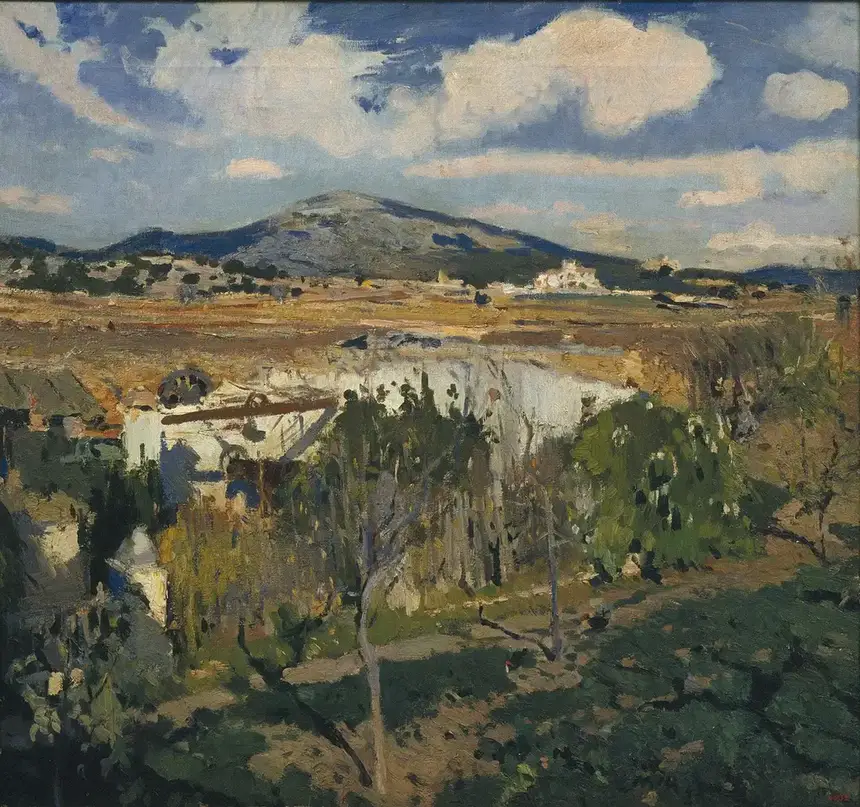
| Title | Onclet Waterwheel |
| Created (original) | 1922 |
| Medium | Oil on canvas, hand-painted to order |
| How it is made | Painted by hand in oil on canvas, to your size |
| Copyright | Public domain; the original is out of copyright |
What a print loses
Prints are good at information and bad at paint. This subject is mostly paint.
Our painter follows the same logic rather than copying a photograph of it: the far distances go down cool and weak, the near ground stays loaded, and nothing is blended flat.
| Aspect | Hand-painted oil | Printed canvas |
|---|---|---|
| Changing something | Tell us and the passage gets repainted | Usually means starting the file again |
| Value over time | Can be re-stretched, cleaned and re-framed | Little value beyond the print |
| Impasto | Real paint standing off the canvas | Flat ink, sometimes embossed to imitate |
| How it ages | Warms and settles; cleanable by a conservator | Fades, then cracks at the stretcher |
| Time to make | Days of one painter's working time | Minutes |
What takes time here is the number of separate decisions, not the size of the canvas.
Every canvas is painted to order, so the quote follows your size, frame and destination rather than a fixed list. Tell us what you need on WhatsApp and we reply with an exact figure, usually within the hour. You are buying from the workshop, not a catalogue.
How your painting is made
No two canvases are painted the same way, but the sequence is always this:
- Stretching and priming the support — cotton duck or linen goes onto the bars and gets its ground.
- The drawing goes down — charcoal or thin paint, done by eye rather than traced from a printout.
- The big shapes are blocked in — thin paint, one colour at a time, the whole canvas at once.
- Getting the values right — the stage that decides whether the finished painting holds together.
- Colour is built up — warmer and cooler versions of each passage, laid over the underpainting.
- The detail and highlights go on — last, loaded, and left alone once they are down.
- It dries, then gets varnished — and only then is it photographed for you.
The passage that will take longest is the one that looks simplest.
Canvas, paint and varnish
The ground is a proper acrylic sizing, so the oil does not rot the fabric over time. We use a neutral-sized ground so the whites stay warm rather than going blue over time.
Varnish goes on only once the paint is properly dry, months after the last stroke, not before. Large canvases get a cross-brace; anything over about a metre and a half needs one.
Keeping it
Do not wipe it with anything wet. Dust lightly, hang it somewhere stable, and forget about it.
Whether to frame it
We can supply a simple floater frame, a traditional gilt, or nothing at all. It is your call.
Frames are priced once you have chosen them, not estimated in advance.
Getting the size right
Any size is possible. These are simply the ones that come up most often in quotes:
| Size (inches) | Size (cm) | Best for |
|---|---|---|
| 40 × 30 in | 102 × 76 cm | Living room focal wall, above a sofa |
| 32 × 24 in | 81 × 61 cm | Living room, above a sideboard |
| 30 × 24 in | 76 × 61 cm | Dining room, bedroom feature wall |
| 24 × 20 in | 60 × 50 cm | Study, home office, above a desk |
| 20 × 16 in | 50 × 40 cm | Bedroom, hallway, above a console |
| 16 × 12 in | 40 × 30 cm | A shelf, a small wall, a gallery group |
Tell us the wall width and we will tell you what looks right rather than what is standard. DAP terms: we pay the freight, you settle any duty or tax your country applies. We do not collect taxes on anyone's behalf.
For a stairwell or a double-height space, go larger than you think — the composition was built for distance.
Tell us the size and frame — exact quote back, usually within the hour.
💬 Get a Quote for Onclet WaterwheelGetting it to you
Painting takes 9–15 days. Freight is quoted as its own line on the quote, agreed before you pay anything, and never added afterwards.
Air freight runs about 7–10 business days, tracked, to your door. Every shipment goes out with tracking. We do not send anything untracked.
You see photographs of the finished painting before it ships, and you tell us what to adjust. If something is not right, tell us what to adjust and we adjust it.
Import charges, where they exist, are the buyer's responsibility (DAP). We never add them to the quote and never guess what they will be.
Work begins on a deposit and ships on the balance. Both figures are on the quote. Damage in transit should be reported to us within 48 hours, with photographs. We pursue it with the carrier rather than promising a refund.
Before you order
Can I change something in the composition?
Often yes — background, cropping, or adapting the proportions to your wall. Tell us what you have in mind and we will say honestly whether it will work.
Is it really painted by hand?
Yes. We hand-paint from public-domain source images, do not sell prints, and never claim the original.
Will it look exactly like the image?
Not exactly, and that is the point — it is a painting, not a scan. Composition, colour and drawing follow the original closely; the surface is where a painter's own decisions show.
What does it cost?
There is no price list, because the number depends on your size and frame. Message us and we will quote exactly.
Do you sell prints?
No. Hand-painted oil on canvas only. No printing, no giclée, no canvas transfer.
Is owning a reproduction legal?
Yes. The painting is out of copyright because Joaquim Mir died more than 70 years ago. We paint copies honestly and never claim they are originals.
Will I see it before it ships?
Yes. We send photographs of the finished canvas and wait for your reply before packing.
Who pays the import duty?
The buyer does. Terms are DAP: duties and taxes, where they apply, are paid on arrival. We never add a tax line of our own.
How do I hang it?
Centre it at about 145 cm from the floor, or two-thirds the width of the furniture below it. We will tell you the exact number for your wall.
Does it come framed?
Frames are priced on their own line. Most clients choose after seeing the photographs.
What is the canvas made of?
Cotton or linen, oil colour, and varnish. Stretcher bars are wedged so the canvas can be re-tensioned later.
Do you take a deposit?
Work begins on a deposit and ships once the balance is paid. Nothing is charged that is not on the quote.