What you are buying into
Johannes Vermeer died in 1675. That puts the painting well outside copyright, which is why we can paint it and you can own it anywhere in the world.
Ours is a painting made with brushes. There is no giclée, no canvas transfer and no digital underlayer anywhere in the process.
It is an original composition painted before 1675, and our version is painted from the surviving image of it.
You are buying a painting, not a file. That distinction is the whole business we are in.
What to look at
There is a reason a landscape is the hardest thing to print and the easiest thing to paint: the paint itself carries the depth.
Depth here is a matter of edges: sharp in front, lost at the back. It is the hardest thing to print and the easiest to paint.
Sunlight and shadow are two different temperatures here, not one colour at two strengths.
Temperature does the work of contrast in the quiet areas, where value differences are small.
Paint is laid on, not pushed around. That is what keeps it fresh.
The difficult part is not the detail. It is keeping the whole canvas at the same stage of finish.
A plain wall is better than a busy one; the painting supplies the interest.
| Artist | Johannes Vermeer |
|---|---|
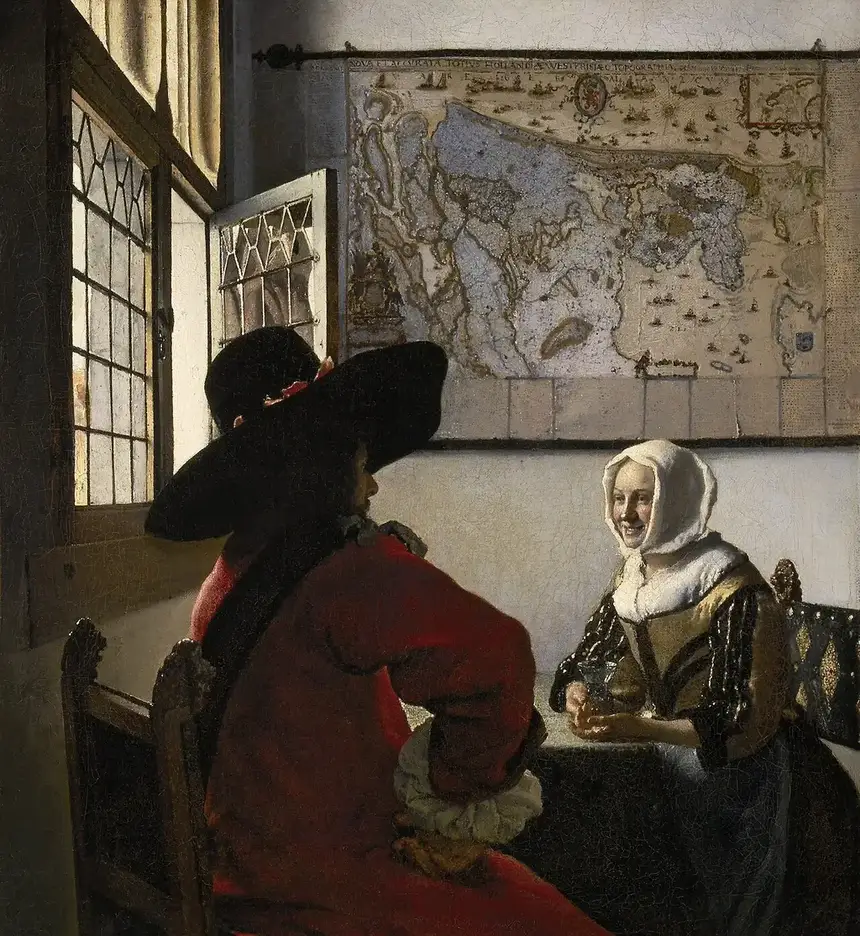
| Title | De Soldaat en het Lachende Meisje |
| Medium | Oil on canvas, hand-painted to order |
| Reproduction | Hand-painted oil on canvas, made to order |
| Original status | Public domain (artist deceased) |
Why this one cannot be printed
What you lose in a print is the air. A press lays ink flat; a painter builds depth in layers, and the depth is what you actually see.
Paint goes on in the original's order — thin first, thick last — so the surface behaves the way the painter intended.
| Aspect | Hand-painted oil | Printed canvas |
|---|---|---|
| How it ages | Warms and settles; cleanable by a conservator | Fades, then cracks at the stretcher |
| Changing something | Tell us and the passage gets repainted | Usually means starting the file again |
| Available sizes | Whatever you need, painted to order | What the printer can output |
| Texture | Ridges and drag you can see from across a room | None, or a printed imitation of it |
| Edge quality | Soft where the form turns, sharp where it does not | Uniformly sharp or uniformly blurred |
The risk with a landscape is overworking, and the way to avoid it is knowing when to stop.
Every canvas is painted to order, so the quote follows your size, frame and destination rather than a fixed list. Tell us what you need on WhatsApp and we reply with an exact figure, usually within the hour. No resellers, no drop-shipper. The painter's studio handles your commission from first message to final crate.
From blank canvas to finished painting
Every canvas is painted to order, so nothing is pulled off a shelf. This is the sequence:
- Stretching and priming the support — cotton duck or linen goes onto the bars and gets its ground.
- Laying in the drawing — done by eye from the reference, not traced or projected.
- The big shapes are blocked in — thin paint, one colour at a time, the whole canvas at once.
- The values are established — this is the stage that decides whether the painting works.
- The colour passes — each area gets its own mixture rather than one colour used throughout.
- The detail and highlights go on — last, loaded, and left alone once they are down.
- It dries, then gets varnished — and only then is it photographed for you.
Matching the original's degree of finish is harder than matching its colours.
Frames
Framing is quoted separately, so you can decide after you have seen the finished canvas in photographs.
A frame is a separate line on the quote, not a bundle. You choose it once the painting exists.
Keeping it
Dust it with a dry, soft brush. Keep it out of direct sun and away from radiators, and it will outlive you.
Canvas, paint and varnish
Oil paint dries by oxidation, not evaporation, which is why a finished canvas needs weeks before it travels. Stretcher bars are kiln-dried and wedged, so the canvas can be re-tensioned years later.
The paint is built in layers, fat over lean, which is what stops it cracking later. We use cotton duck for most sizes and linen where the canvas is large or the client asks for it.
Sizing it
Because each piece is painted from scratch, you are not limited to stock dimensions. These are the sizes clients ask for most:
| Size (inches) | Size (cm) | Best for |
|---|---|---|
| 64 × 48 in | 163 × 122 cm | Villa scale, lobby, hospitality wall |
| 48 × 36 in | 122 × 91 cm | Large living room, stairwell, loft |
| 40 × 30 in | 102 × 76 cm | Living room focal wall, above a sofa |
| 32 × 24 in | 81 × 61 cm | Living room, above a sideboard |
Tell us the wall width and we will tell you what looks right rather than what is standard. Import charges, where they exist, are the buyer's responsibility (DAP). We never add them to the quote and never guess what they will be.
Hang it at eye level — roughly 145 cm from the floor to the centre — and it will hold the wall.
Give us your size and framing preference and you will have a quote shortly.
💬 Get a Quote for De Soldaat en het Lachende MeisjeHow it reaches you
From order to finished canvas is 9–15 days. Freight appears as a separate line on the quote and is fixed before you pay.
Air freight runs about 7–10 business days, tracked, to your door. Unframed canvases are rolled face-out on a tube; framed ones are corner-protected and crated.
You see photographs of the finished painting before it ships, and you tell us what to adjust. Changes are handled by telling us what to change; we change it and send new photographs.
We sell DAP: the price covers the painting and the freight, and any import duties or taxes are the buyer's to settle with customs. We do not collect them and we do not estimate them.
Work begins on a deposit and ships on the balance. Both figures are on the quote. Report any transit damage within 48 hours with photographs and we will deal with the carrier. We will not promise a payout, but we will not leave you to argue alone either.
The practical questions
Does it come with a certificate of authenticity?
No, and we would be wary of anyone who issues one for a public-domain reproduction. What you receive is a hand-painted canvas and photographs of it before it ships.
Is there a rush option?
It depends on the canvas and what else is in the studio. Ask on WhatsApp with your size and we will tell you straight what is possible.
Can I see progress photos while it is being painted?
We send photographs of the finished painting for approval before it ships. Mid-process images are not part of the standard workflow.
Does it come framed?
Framing is quoted separately, so you can decide once you have seen the finished painting in photographs.
Will I see it before it ships?
Yes. We send photographs of the finished canvas and wait for your reply before packing.
Can you paint a different work by Johannes Vermeer?
Yes — send us the image, or look through the other Johannes Vermeer works on the site.
What is the canvas made of?
Cotton duck as standard, linen on request, artist-grade oil paint, and a final varnish once the paint is fully dry.
Who pays the import duty?
The buyer does. Terms are DAP: duties and taxes, where they apply, are paid on arrival. We never add a tax line of our own.
How do I hang it?
Roughly 145 cm from floor to centre works for most rooms. Tell us your wall and we will give you the measurement.
Can I change the size?
Any size you like. We paint to the number you give us rather than to a standard range.
Do you ship to my country?
We ship to over 20 countries. Give us your city and the freight appears as its own line on the quote.
What does it cost?
There is no price list, because the number depends on your size and frame. Message us and we will quote exactly.