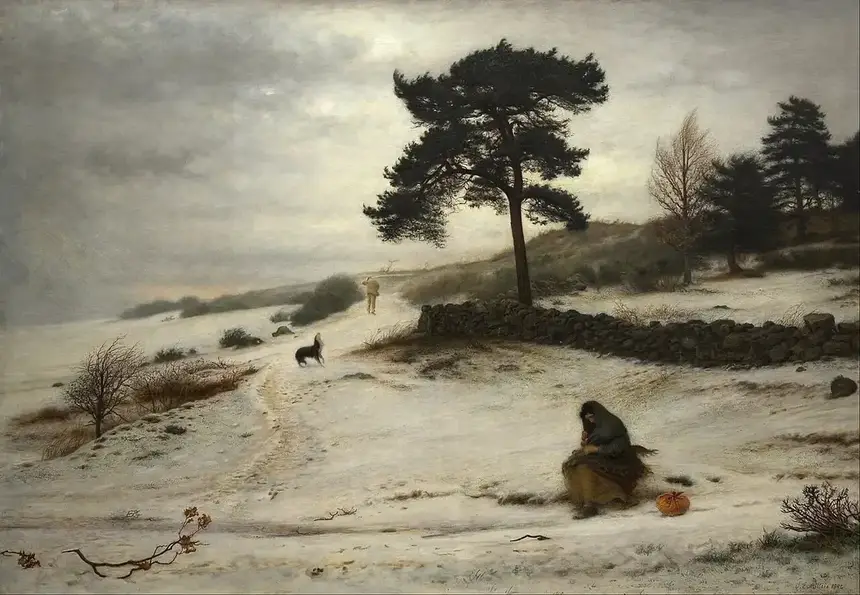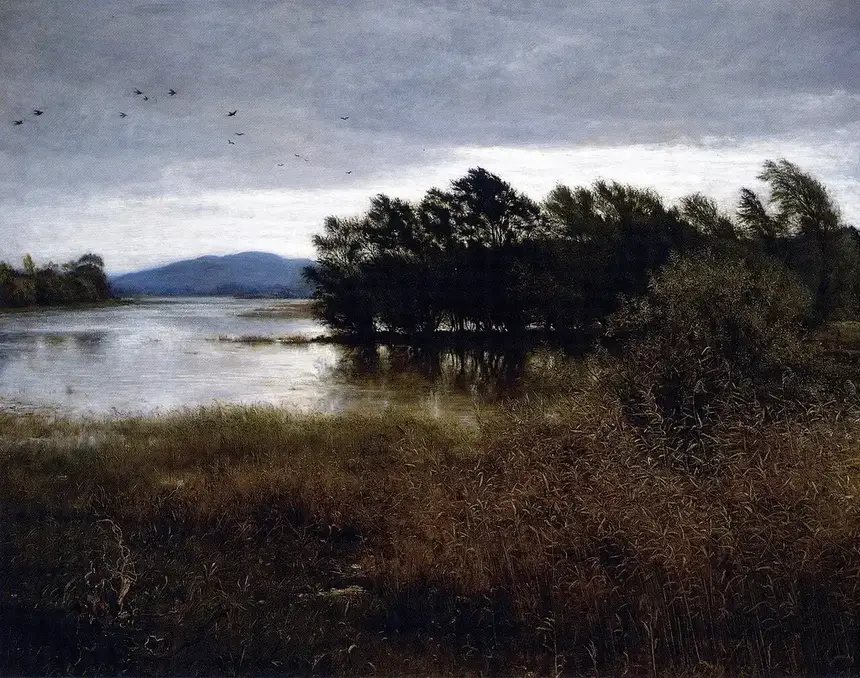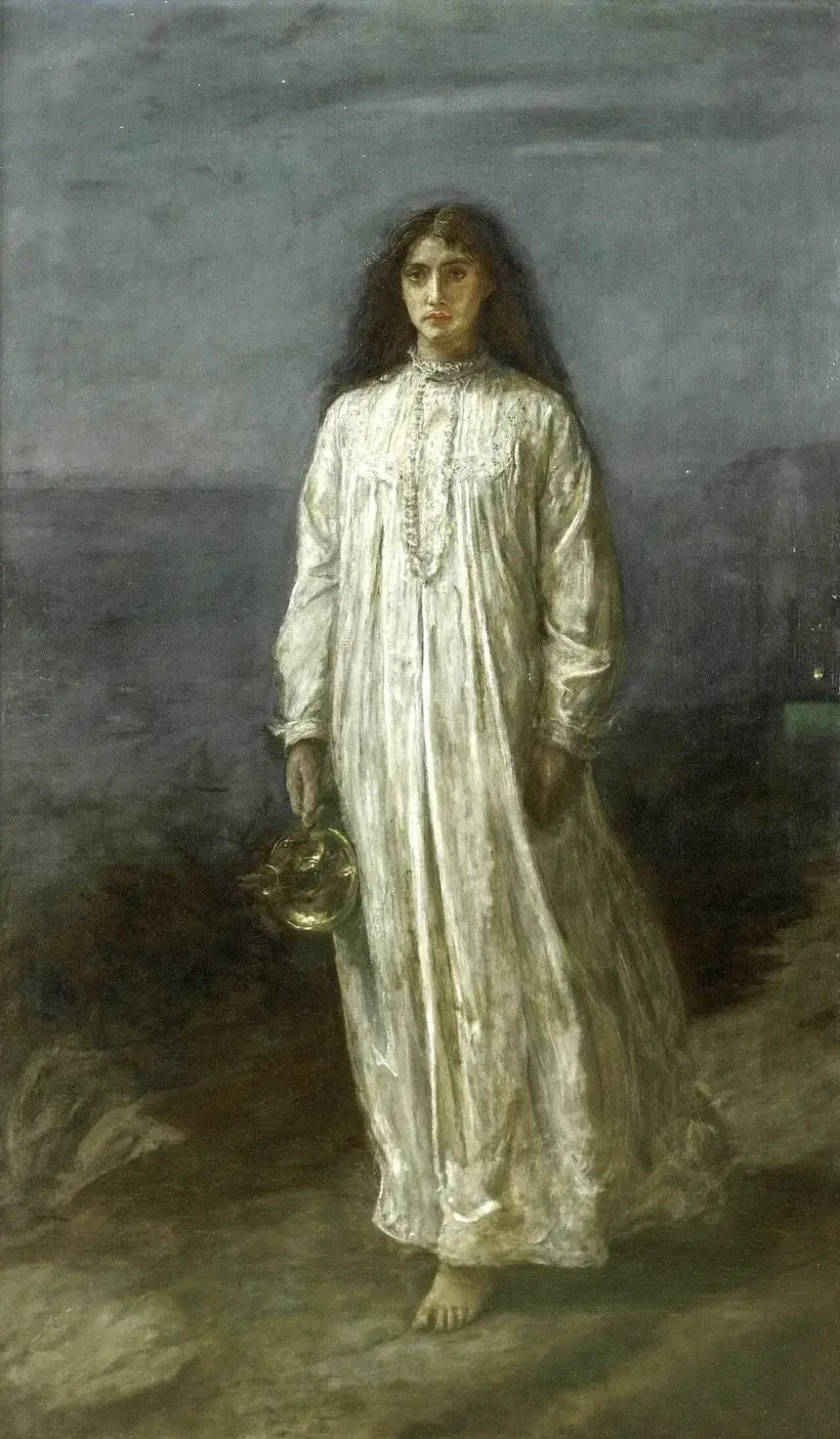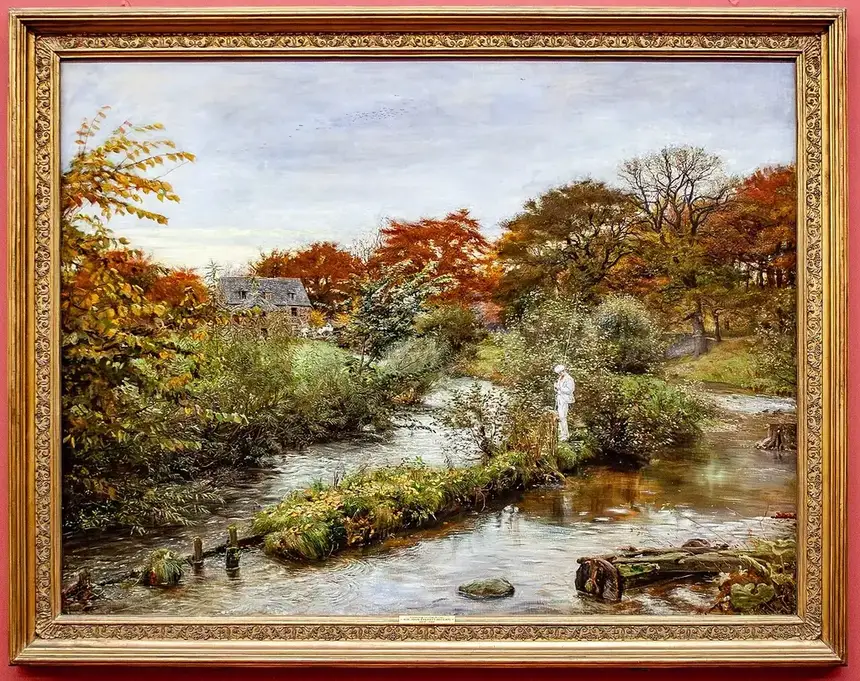
Where this painting comes from
Because John Everett Millais died in 1896, this work is in the public domain. We are painting a copy of a painting — we never pass it off as the original, and neither should anyone selling you one.
Ours is a painting made with brushes. There is no giclée, no canvas transfer and no digital underlayer anywhere in the process.
The painting was made in the years before 1896, and what we reproduce is the record of it, not the object.
If you want something printed, we are the wrong workshop. We do not own a printer that touches canvas.
How to read it
A painted a water subject is an argument about air. Copy the shapes and you still have not copied the argument.
Nothing in Flowing to the River is centred for the sake of being centred; the weight sits where the painter wanted it.
Dusk and overcast passages are the hardest and the most rewarding — they are all half-tones.
Every colour in Flowing to the River has a warm version and a cool version, and the painter chooses between them passage by passage.
The last marks are the ones that are left alone. Overworking is the enemy.
The difficult part is not the detail. It is keeping the whole canvas at the same stage of finish.
This reads well above a sofa or a sideboard, where it will be seen from two to three metres.
| Artist | John Everett Millais |
|---|---|
| Title | Flowing to the River |
| Created (original) | 1871 |
| Medium | Oil on canvas, hand-painted to order |
| How it is made | Painted by hand in oil on canvas, to your size |
| Original status | Public domain (artist deceased) |
What a print loses
What you lose in a print is the air. A press lays ink flat; a painter builds depth in layers, and the depth is what you actually see.
Edges are left soft where the form turns away and sharp where it does not. That single habit is what separates a painting from a copy.
| Aspect | Hand-painted oil | Printed canvas |
|---|---|---|
| What it takes | One painter, several days, start to finish | A machine, a few minutes |
| Edges | Chosen by the painter, passage by passage | Whatever the file happens to contain |
| Corrections | We adjust it and repaint the passage | The file is reprinted or it is not |
| Later on | Can be restored, re-framed, handed on | Replaceable, and usually replaced |
| Lifespan | Slow to change; varnish can be refreshed decades later | Fades and cracks sooner |
Matching the original's degree of finish is harder than matching its colours.
Every canvas is painted to order, so the quote follows your size, frame and destination rather than a fixed list. Tell us what you need on WhatsApp and we reply with an exact figure, usually within the hour. You are buying from the workshop, not a catalogue.
How the canvas is built
The order of work matters as much as the work itself. Ours runs like this:
- We start with the canvas itself — stretched, sized and left to settle before any colour is mixed.
- The drawing goes down — charcoal or thin paint, done by eye rather than traced from a printout.
- Blocking the masses — thin paint, working the whole surface rather than one corner at a time.
- Setting the key — how dark the darks go determines everything that follows.
- Building the colour — a warm and a cool version of each passage, put down in order.
- The detail and highlights go on — last, loaded, and left alone once they are down.
- Drying and varnishing — the final varnish goes on once the paint has set, before we photograph it.
What takes time here is the number of separate decisions, not the size of the canvas.
Materials
Pigment is artist-grade oil colour, not acrylic and not house paint. It behaves differently and it lasts. The paint is built in layers, fat over lean, which is what stops it cracking later.
Each painter works on one canvas at a time — the painting you ordered is not shared with another order. Large canvases get a cross-brace; anything over about a metre and a half needs one.
Framing
A frame is a separate line on the quote, not a bundle. You choose it once the painting exists.
A frame is a separate line on the quote, not a bundle. You choose it once the painting exists.
Care and cleaning
Do not wipe it with anything wet. Dust lightly, hang it somewhere stable, and forget about it.
Sizing it
Because each piece is painted from scratch, you are not limited to stock dimensions. These are the sizes clients ask for most:
| Size (inches) | Size (cm) | Best for |
|---|---|---|
| 40 × 30 in | 102 × 76 cm | Living room focal wall, above a sofa |
| 32 × 24 in | 81 × 61 cm | Living room, above a sideboard |
| 30 × 24 in | 76 × 61 cm | Dining room, bedroom feature wall |
| 24 × 20 in | 60 × 50 cm | Study, home office, above a desk |
If your wall is an odd shape, send the measurement and we will work to it. Proportions from the original are kept unless you ask us to change them. Our terms are DAP, meaning the freight is paid by us and any import charges are yours to settle. We will not estimate them, because the figure is your customs authority's to set.
In a bedroom it works above a headboard, sized to about two-thirds of the furniture width.
Tell us the size and frame — exact quote back, usually within the hour.
💬 Get a Quote for Flowing to the RiverOrder, painting, shipping
Painting takes 9–15 days. Freight is quoted as its own line on the quote, agreed before you pay anything, and never added afterwards.
Transit is usually 7–10 business days, tracked all the way. We send photographs of the finished painting before it is packed, and again once it is boxed.
You approve the painting from photographs before it is packed — that is the checkpoint. Changes are handled by telling us what to change; we change it and send new photographs.
Import charges, where they exist, are the buyer's responsibility (DAP). We never add them to the quote and never guess what they will be.
You pay a deposit to start and the remainder before shipping. Nothing is hidden in between. If a crate arrives damaged, send us photographs within 48 hours and contact us directly — we will sort it out with you.
Before you order
Can I resell the reproduction?
Yes. Because the underlying work is in the public domain, the hand-painted canvas is yours to sell, gift or install commercially.
Is there a rush option?
It depends on the canvas and what else is in the studio. Ask on WhatsApp with your size and we will tell you straight what is possible.
Will it look exactly like the image?
Not exactly, and that is the point — it is a painting, not a scan. Composition, colour and drawing follow the original closely; the surface is where a painter's own decisions show.
Can you paint it from a different photograph of the same work?
Send your own reference image and we will paint from that instead.
Do you ship to my country?
We ship to over 20 countries. Give us your city and the freight appears as its own line on the quote.
What is the canvas made of?
Cotton duck as standard, linen on request, artist-grade oil paint, and a final varnish once the paint is fully dry.
How do I hang it?
Roughly 145 cm from floor to centre works for most rooms. Tell us your wall and we will give you the measurement.
Can you paint a different work by John Everett Millais?
Yes — send us the image, or look through the other John Everett Millais works on the site.
Is it really painted by hand?
Yes. One painter, oil paint, brushes. We do not own a printer that touches canvas.
What does it cost?
There is no price list, because the number depends on your size and frame. Message us and we will quote exactly.
Is owning a reproduction legal?
Yes. The painting is out of copyright because John Everett Millais died more than 70 years ago. We paint copies honestly and never claim they are originals.
Will I see it before it ships?
Yes — photographs of the actual painting go to you first, and nothing is packed until you have seen them.