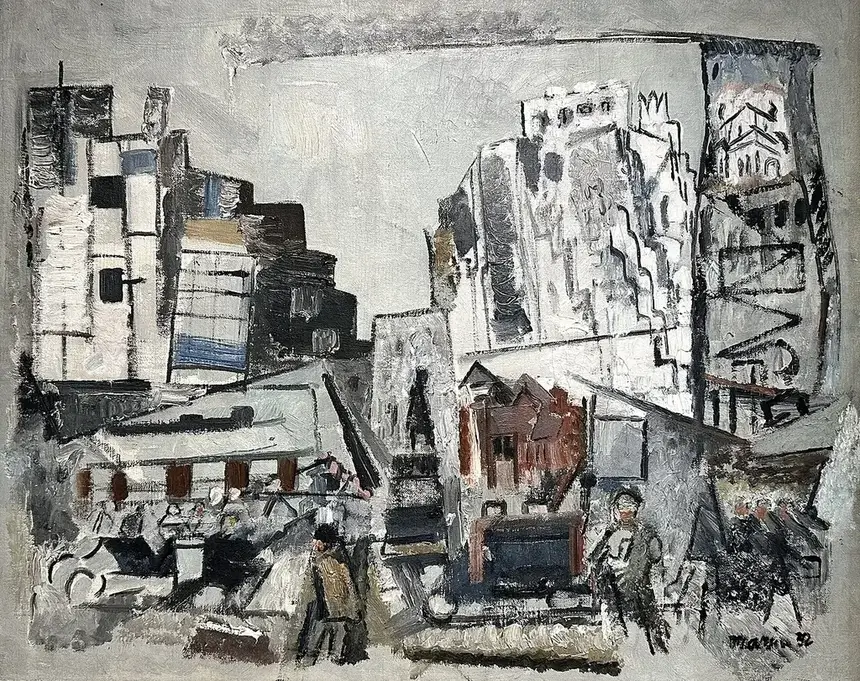
Where this painting comes from
Because John Marin died in 1953, this work is in the public domain. We are painting a copy of a painting — we never pass it off as the original, and neither should anyone selling you one.
We paint it in oil on canvas, one at a time, in Dafen Village. Nothing is printed, scanned or transferred.
It is an original composition painted before 1953, and our version is painted from the surviving image of it.
You are buying a painting, not a file. That distinction is the whole business we are in.
Looking at it properly
The stone, the water, the sky in Bryant Square are three different paint treatments. A press gives you one.
We keep the soft edges at the top of buildings, where the source has them, instead of sharpening everything.
We do not correct the exposure. The original's key is part of the picture.
Saturated colour is kept for a small area; the rest is deliberately knocked back.
Our painter uses a larger brush than you would expect, which is why the passages stay simple.
The difficult part is not the detail. It is keeping the whole canvas at the same stage of finish.
It suits a room with warm, low light. Strong downlighting flattens the surface.
| Artist | John Marin |
|---|---|
| Title | Bryant Square |
| Created (original) | 1932 |
| Medium | Oil on canvas, hand-painted to order |
| What you receive | A hand-painted oil painting on canvas |
| Public domain | Yes — the artist died over 70 years ago |
What a print loses
What you lose in a print is the air. A press lays ink flat; a painter builds depth in layers, and the depth is what you actually see.
Edges are left soft where the form turns away and sharp where it does not. That single habit is what separates a painting from a copy.
| Aspect | Hand-painted oil | Printed canvas |
|---|---|---|
| How it ages | Warms and settles; cleanable by a conservator | Fades, then cracks at the stretcher |
| What it takes | One painter, several days, start to finish | A machine, a few minutes |
| Changing something | Tell us and the passage gets repainted | Usually means starting the file again |
| Edge quality | Soft where the form turns, sharp where it does not | Uniformly sharp or uniformly blurred |
| Surface | Hand-painted oil on canvas | Ink on canvas, flat |
Getting Bryant Square right means painting it in the right order, and the order is not obvious.
Every canvas is painted to order, so the quote follows your size, frame and destination rather than a fixed list. Tell us what you need on WhatsApp and we reply with an exact figure, usually within the hour. You are talking to the people who will actually paint it, not a middleman.
The sequence on our floor
Every canvas is painted to order, so nothing is pulled off a shelf. This is the sequence:
- We start with the canvas itself — stretched, sized and left to settle before any colour is mixed.
- The drawing goes down — charcoal or thin paint, done by eye rather than traced from a printout.
- Blocking the masses — thin paint, working the whole surface rather than one corner at a time.
- Setting the key — how dark the darks go determines everything that follows.
- Colour is built up — warmer and cooler versions of each passage, laid over the underpainting.
- The detail and highlights go on — last, loaded, and left alone once they are down.
- Drying and varnishing — the final varnish goes on once the paint has set, before we photograph it.
The risk with a city view is overworking, and the way to avoid it is knowing when to stop.
Care and cleaning
Once the varnish has cured the surface can be cleaned by a conservator, but in a normal house it will not need it for decades.
Canvas, paint and varnish
Large canvases get a cross-brace; anything over about a metre and a half needs one. Each painter works on one canvas at a time — the painting you ordered is not shared with another order.
We buy pigment in tubes from the same suppliers the village has used for years, not in bulk drums. Varnish goes on only once the paint is properly dry, months after the last stroke, not before.
On framing
We can supply a simple floater frame, a traditional gilt, or nothing at all. It is your call.
A frame is a separate line on the quote, not a bundle. You choose it once the painting exists.
Sizing it
Because each piece is painted from scratch, you are not limited to stock dimensions. These are the sizes clients ask for most:
| Size (inches) | Size (cm) | Best for |
|---|---|---|
| 24 × 20 in | 60 × 50 cm | Study, home office, above a desk |
| 20 × 16 in | 50 × 40 cm | Bedroom, hallway, above a console |
| 16 × 12 in | 40 × 30 cm | A shelf, a small wall, a gallery group |
| 64 × 48 in | 163 × 122 cm | Villa scale, lobby, hospitality wall |
| 48 × 36 in | 122 × 91 cm | Large living room, stairwell, loft |
We will size the canvas to the room, not to a stock list. Send us the measurement. Duties and import taxes are the buyer's account (DAP). Your customs authority sets them; we do not.
It is a picture for a room you use, not a corridor you walk through.
Message us the dimensions you have in mind and we will come back with a figure.
💬 Get a Quote for Bryant SquareFrom order to your wall
Painting takes 9–15 days. Freight is quoted as its own line on the quote, agreed before you pay anything, and never added afterwards.
Transit is usually 7–10 business days, tracked all the way. Rolled in a tube it travels cheaper and safer than framed; most overseas clients take it that way.
Nothing ships before you have seen it. Photographs of the finished painting go to you first. Adjustments are part of the process. Say what you want different and it gets done.
Our terms are DAP, meaning the freight is paid by us and any import charges are yours to settle. We will not estimate them, because the figure is your customs authority's to set.
You pay a deposit to start and the remainder before shipping. Nothing is hidden in between. Damage in transit should be reported to us within 48 hours, with photographs. We pursue it with the carrier rather than promising a refund.
What people ask us
Do you frame it?
Framing is quoted separately, so you can decide once you have seen the finished canvas in photographs.
How long does a hand-painted version take?
9–15 days of studio time, depending mostly on size and how much impasto the surface carries, then several more days for the oil to set before we photograph, pack and send.
How do I clean and care for it?
Dust lightly with a dry, soft brush and keep it out of direct sun. Nothing else is needed for decades; oil paint is slow to change and easy to live with.
What does it cost?
Every canvas is quoted on size, frame and destination rather than a fixed list. Tell us what you need and we reply with an exact figure.
Can you paint a different work by John Marin?
Yes — send us the image, or look through the other John Marin works on the site.
Is owning a reproduction legal?
Yes. The painting is out of copyright because John Marin died more than 70 years ago. We paint copies honestly and never claim they are originals.
Can you paint it from a different photograph of the same work?
Send your own reference image and we will paint from that instead.
Do you take a deposit?
A deposit starts the canvas and the balance falls due before it ships. Both figures appear on the quote.
Do you sell prints?
No prints at all — no giclée, no canvas transfer, nothing machine-made.
Will I see it before it ships?
Yes — photographs of the actual painting go to you first, and nothing is packed until you have seen them.
Is it really painted by hand?
Yes. One painter, oil paint, brushes. We do not own a printer that touches canvas.
How do I hang it?
Roughly 145 cm from floor to centre works for most rooms. Tell us your wall and we will give you the measurement.