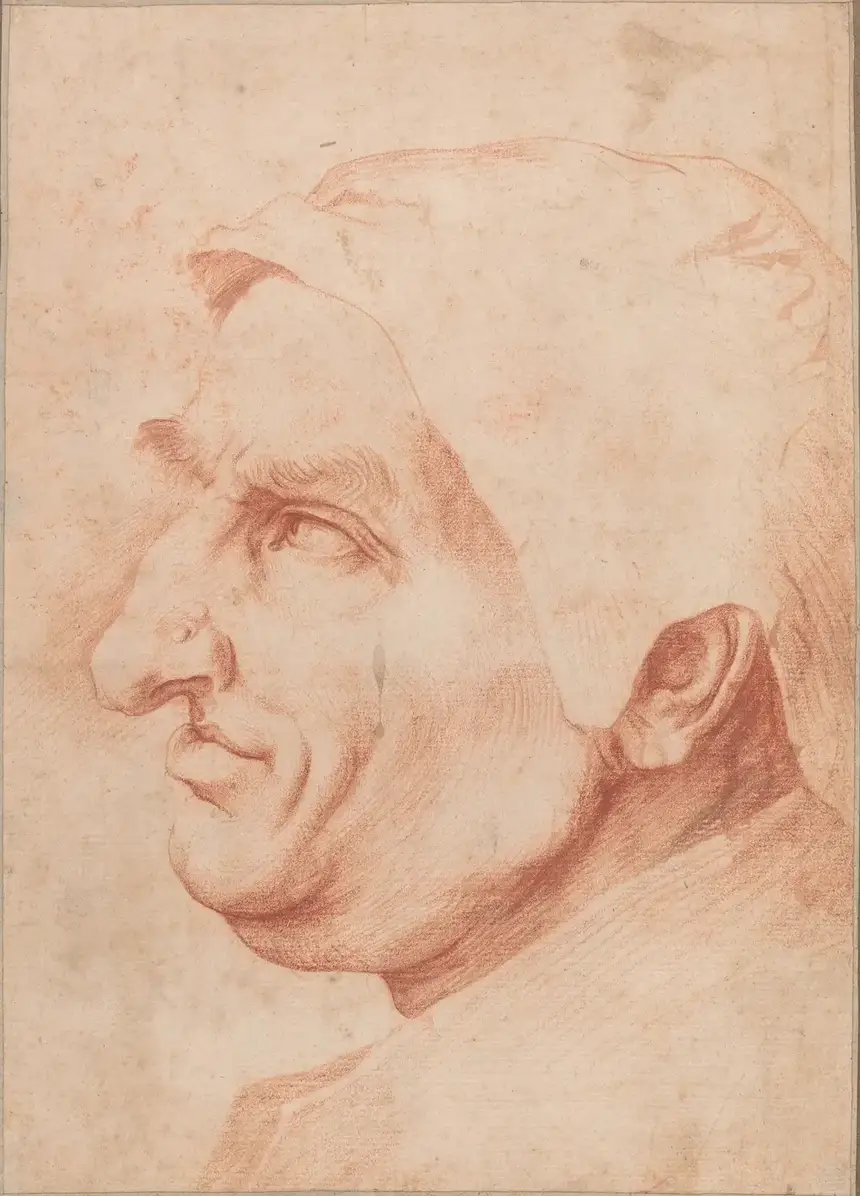
About Head of a Man, early 1620s
Jusepe de Ribera died in 1652, so the work has been in the public domain for decades. Reproducing it by hand is legal, and so is owning one.
We paint it in oil on canvas, one at a time, in Dafen Village. Nothing is printed, scanned or transferred.
It is an original composition painted before 1652, and our version is painted from the surviving image of it.
If you want something printed, we are the wrong workshop. We do not own a printer that touches canvas.
How to read it
A face is the hardest thing to fake. Head of a Man, early 1620s is painted by hand precisely because a machine cannot do the skin.
The composition is a pyramid — shoulders, head, and the turn — and it holds however large the canvas gets.
Skin here is translucent: light goes in, bounces, and comes back warm. That is done with thin paint over a lighter ground.
Temperature does the work of contrast in the quiet areas, where value differences are small.
Edges are made by the brush, not by an outline, and they are the hardest thing to copy.
Anyone can copy the shapes. The skill is in the transitions, and that is what takes the days.
In a bedroom it works above a headboard, sized to about two-thirds of the furniture width.
| Artist | Jusepe de Ribera |
|---|---|
| Title | Head of a Man, early 1620s |
| Medium | Oil on canvas, hand-painted to order |
| Our version | Oil on canvas, painted by hand to order |
| Copyright | Public domain; the original is out of copyright |
The case for painting it by hand
Prints are good at information and bad at paint. This subject is mostly paint.
Paint goes on in the original's order — thin first, thick last — so the surface behaves the way the painter intended.
| Aspect | Hand-painted oil | Printed canvas |
|---|---|---|
| Value over time | Can be re-stretched, cleaned and re-framed | Little value beyond the print |
| Lifespan | Slow to change; varnish can be refreshed decades later | Fades and cracks sooner |
| Impasto | Real paint standing off the canvas | Flat ink, sometimes embossed to imitate |
| The surface | Built up with brushes and knives | Printed flat in one pass |
| Depth | Built in layers, catches light from the side | Flat; highlights are printed as pale ink |
The difficult part is not the detail. It is keeping the whole canvas at the same stage of finish.
Every canvas is painted to order, so the quote follows your size, frame and destination rather than a fixed list. Tell us what you need on WhatsApp and we reply with an exact figure, usually within the hour. You are talking to the people who will actually paint it, not a middleman.
From blank canvas to finished painting
Here is what actually happens between your message and the crate:
- Stretching and priming the support — cotton duck or linen goes onto the bars and gets its ground.
- The drawing goes down — charcoal or thin paint, done by eye rather than traced from a printout.
- The first colour pass — thin and simple, establishing the main shapes only.
- Getting the values right — the stage that decides whether the finished painting holds together.
- Colour is built up — warmer and cooler versions of each passage, laid over the underpainting.
- The detail and highlights go on — last, loaded, and left alone once they are down.
- Left to dry before varnish — nothing is photographed or packed until the surface is ready.
The passage that will take longest is the one that looks simplest.
Whether to frame it
We can supply a simple floater frame, a traditional gilt, or nothing at all. It is your call.
We can supply a simple floater frame, a traditional gilt, or nothing at all. It is your call.
What goes into it
Oil paint dries by oxidation, not evaporation, which is why a finished canvas needs weeks before it travels. Brushes, knives and rags. That is the equipment list; there is no machine in the process.
Nothing is sprayed, sealed or laminated. The surface you see is paint and varnish, and that is all. Pigment is artist-grade oil colour, not acrylic and not house paint. It behaves differently and it lasts.
Care and cleaning
Do not wipe it with anything wet. Dust lightly, hang it somewhere stable, and forget about it.
Canvas sizes
The canvas is cut to your wall, not the other way round. For reference, these are the dimensions most often requested:
| Size (inches) | Size (cm) | Best for |
|---|---|---|
| 16 × 12 in | 40 × 30 cm | A shelf, a small wall, a gallery group |
| 64 × 48 in | 163 × 122 cm | Villa scale, lobby, hospitality wall |
| 48 × 36 in | 122 × 91 cm | Large living room, stairwell, loft |
| 40 × 30 in | 102 × 76 cm | Living room focal wall, above a sofa |
| 32 × 24 in | 81 × 61 cm | Living room, above a sideboard |
| 30 × 24 in | 76 × 61 cm | Dining room, bedroom feature wall |
If your wall is an odd shape, send the measurement and we will work to it. Proportions from the original are kept unless you ask us to change them. DAP terms: we pay the freight, you settle any duty or tax your country applies. We do not collect taxes on anyone's behalf.
It works best on a wall you pass rather than one you sit and stare at — the paint rewards a moving eye.
Message us the dimensions you have in mind and we will come back with a figure.
💬 Get a Quote for Head of a Man, early 1620sGetting it to you
Allow 9–15 days for the painting itself. Shipping is a separate line on your quote — you see it before payment, not after.
Air freight runs about 7–10 business days, tracked, to your door. Rolled in a tube it travels cheaper and safer than framed; most overseas clients take it that way.
You approve the painting from photographs before it is packed — that is the checkpoint. If something is not right, tell us what to adjust and we adjust it.
Duties and import taxes are the buyer's account (DAP). Your customs authority sets them; we do not.
Work begins on a deposit and ships on the balance. Both figures are on the quote. Report any transit damage within 48 hours with photographs and we will deal with the carrier. We will not promise a payout, but we will not leave you to argue alone either.
The practical questions
How close will it be to the original?
The composition, colour and drawing follow the original closely; the brushwork carries the painter's own hand. The painter works freehand on a blank canvas, following the same logic as the original rather than copying a photograph.
Do you work from my own photograph?
Yes, though that is a separate service. This page is for a hand-painted version of {title}; for a photo-to-painting commission, send the image on WhatsApp.
When will it actually arrive?
Studio time is 9–15 days, then a few more days for the oil to set before we can photograph and pack it. We tell you where your canvas is at each stage.
How do I hang it?
Centre it at about 145 cm from the floor, or two-thirds the width of the furniture below it. We will tell you the exact number for your wall.
Can I change the size?
Yes. The canvas is painted to your measurement, not taken from a stock list.
Can you change the colours to suit my room?
We can shift the palette, but we will tell you honestly when a change would spoil the painting.
Does it come framed?
Frames are priced on their own line. Most clients choose after seeing the photographs.
How long does it take?
From order to finished canvas is 9–15 days; delivery adds about 7–10 business days by air.
What is the canvas made of?
Cotton or linen, oil colour, and varnish. Stretcher bars are wedged so the canvas can be re-tensioned later.
Who pays the import duty?
The buyer does. Terms are DAP: duties and taxes, where they apply, are paid on arrival. We never add a tax line of our own.
Will I see it before it ships?
Yes. We send photographs of the finished canvas and wait for your reply before packing.
Can you paint a different work by Jusepe de Ribera?
Yes — send us the image, or look through the other Jusepe de Ribera works on the site.