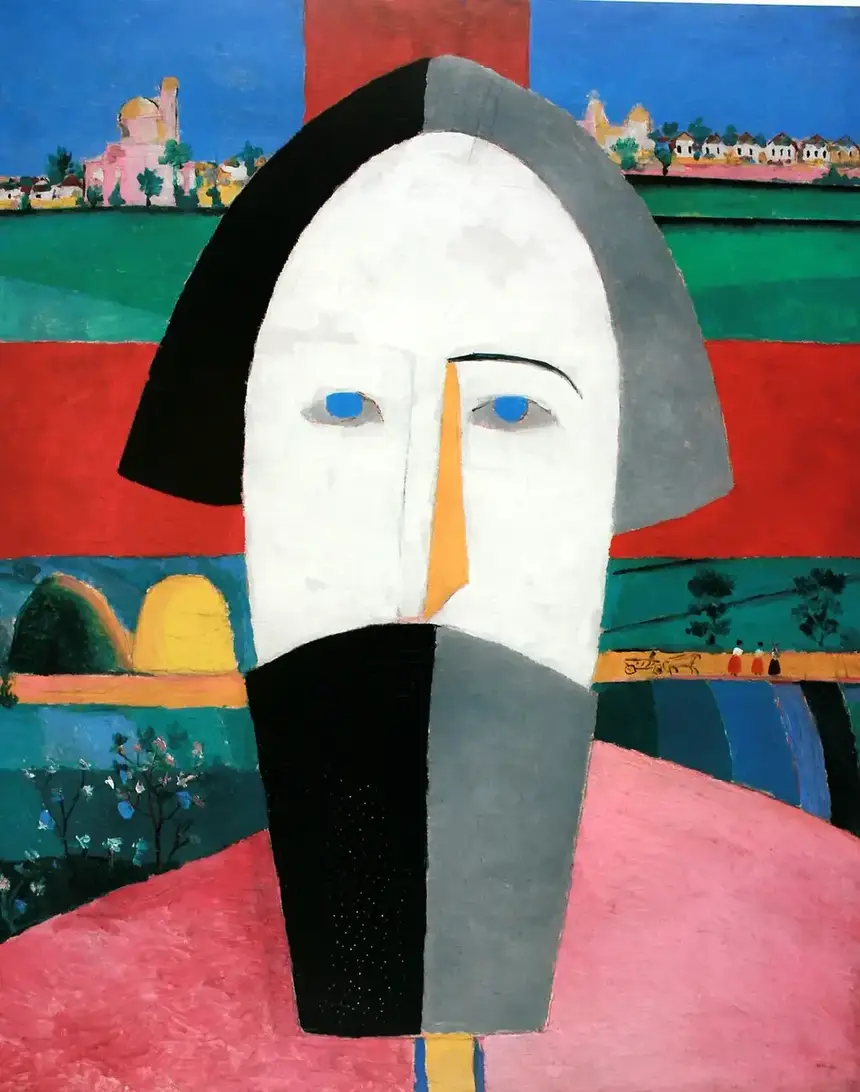
Where this painting comes from
Kazimir Malevich died in 1935, so the work has been in the public domain for decades. Reproducing it by hand is legal, and so is owning one.
Ours is a painting made with brushes. There is no giclée, no canvas transfer and no digital underlayer anywhere in the process.
It is an original composition painted before 1935, and our version is painted from the surviving image of it.
What arrives is a canvas with paint on it, made by a person. That is the only thing we sell.
Looking at it properly
What survives from the original into a hand-painted copy is the order it was built in, and you can read that order in ours.
Nothing is traced or projected. The drawing is done by eye, which is what keeps the proportions related.
The brightest area is kept small, which is what makes it read as bright rather than as pale.
Every colour in Head of a Peasant, Orthodox II, 1928-29 has a warm version and a cool version, and the painter chooses between them passage by passage.
Paint is laid on, not pushed around. That is what keeps it fresh.
Getting Head of a Peasant, Orthodox II, 1928-29 right means painting it in the right order, and the order is not obvious.
This reads well above a sofa or a sideboard, where it will be seen from two to three metres.
| Artist | Kazimir Malevich |
|---|---|
| Title | Head of a Peasant, Orthodox II, 1928-29 |
| Created (original) | 1928 |
| Medium | Oil on canvas, hand-painted to order |
| Year | 1928 |
| What you receive | A hand-painted oil painting on canvas |
| Copyright | Public domain; the original is out of copyright |
What a print loses
What you lose in a print is the air. A press lays ink flat; a painter builds depth in layers, and the depth is what you actually see.
Our painter follows the same logic rather than copying a photograph of it: the far distances go down cool and weak, the near ground stays loaded, and nothing is blended flat.
| Aspect | Hand-painted oil | Printed canvas |
|---|---|---|
| Lifespan | Slow to change; varnish can be refreshed decades later | Fades and cracks sooner |
| Changing something | Tell us and the passage gets repainted | Usually means starting the file again |
| What it takes | One painter, several days, start to finish | A machine, a few minutes |
| Handling of colour | Mixed on the palette and finished on the canvas | Fixed by the colour profile |
| The surface | Built up with brushes and knives | Printed flat in one pass |
Anyone can copy the shapes. The skill is in the transitions, and that is what takes the days.
Every canvas is painted to order, so the quote follows your size, frame and destination rather than a fixed list. Tell us what you need on WhatsApp and we reply with an exact figure, usually within the hour. There is no agency in between; the studio that paints your canvas is the one answering your messages.
How the canvas is built
Every canvas is painted to order, so nothing is pulled off a shelf. This is the sequence:
- The canvas is stretched and primed — cotton or linen, sized and ready before any paint goes near it.
- A loose underdrawing — proportions checked by eye against the source image.
- The first colour pass — thin and simple, establishing the main shapes only.
- The values are established — this is the stage that decides whether the painting works.
- Colour is built up — warmer and cooler versions of each passage, laid over the underpainting.
- Finishing passes — the loaded highlights go on at the end and stay there.
- It dries, then gets varnished — and only then is it photographed for you.
The difficulty is restraint: leaving out most of what a photograph would show.
What it is made of
We use a neutral-sized ground so the whites stay warm rather than going blue over time. Each painter works on one canvas at a time — the painting you ordered is not shared with another order.
The varnish is removable, so a conservator can clean the painting in fifty years without touching the paint. We use cotton duck for most sizes and linen where the canvas is large or the client asks for it.
Care and cleaning
Once the varnish has cured the surface can be cleaned by a conservator, but in a normal house it will not need it for decades.
On framing
We can supply a simple floater frame, a traditional gilt, or nothing at all. It is your call.
Frames are priced once you have chosen them, not estimated in advance.
Getting the size right
Any size is possible. These are simply the ones that come up most often in quotes:
| Size (inches) | Size (cm) | Best for |
|---|---|---|
| 48 × 36 in | 122 × 91 cm | Large living room, stairwell, loft |
| 40 × 30 in | 102 × 76 cm | Living room focal wall, above a sofa |
| 32 × 24 in | 81 × 61 cm | Living room, above a sideboard |
| 30 × 24 in | 76 × 61 cm | Dining room, bedroom feature wall |
| 24 × 20 in | 60 × 50 cm | Study, home office, above a desk |
| 20 × 16 in | 50 × 40 cm | Bedroom, hallway, above a console |
If your wall is an odd shape, send the measurement and we will work to it. Proportions from the original are kept unless you ask us to change them. Duties and import taxes are the buyer's account (DAP). Your customs authority sets them; we do not.
Hang it at eye level — roughly 145 cm from the floor to the centre — and it will hold the wall.
Tell us where it will hang and how big it needs to be — we will price it properly.
💬 Get a Quote for Head of a Peasant, Orthodox II, 1928-29Timeline and shipping
Painting takes 9–15 days. Freight is quoted as its own line on the quote, agreed before you pay anything, and never added afterwards.
Expect 7–10 business days in transit, with tracking from our door to yours. Unframed canvases are rolled face-out on a tube; framed ones are corner-protected and crated.
Before anything is packed, you get photographs of the actual canvas and a chance to ask for changes. Changes are handled by telling us what to change; we change it and send new photographs.
We sell DAP: the price covers the painting and the freight, and any import duties or taxes are the buyer's to settle with customs. We do not collect them and we do not estimate them.
A deposit starts the canvas and books the painter's time; the balance is due before the crate leaves. Damage in transit should be reported to us within 48 hours, with photographs. We pursue it with the carrier rather than promising a refund.
The practical questions
How do I clean and care for it?
Dust lightly with a dry, soft brush and keep it out of direct sun. Nothing else is needed for decades; oil paint is slow to change and easy to live with.
What if it does not look right to me?
We send photographs of the actual painting for your approval before anything ships. That is the moment to tell us what to adjust.
What is the canvas made of?
Cotton or linen, oil colour, and varnish. Stretcher bars are wedged so the canvas can be re-tensioned later.
What does it cost?
Every canvas is quoted on size, frame and destination rather than a fixed list. Tell us what you need and we reply with an exact figure.
How do I hang it?
Centre it at about 145 cm from the floor, or two-thirds the width of the furniture below it. We will tell you the exact number for your wall.
Can I change the size?
Yes. The canvas is painted to your measurement, not taken from a stock list.
How long does it take?
Allow 9–15 days for the painting itself, then roughly 7–10 business days in transit.
Does it come framed?
Frames are priced on their own line. Most clients choose after seeing the photographs.
Can you paint a different work by Kazimir Malevich?
Yes — send us the image, or look through the other Kazimir Malevich works on the site.
Can you change the colours to suit my room?
We can shift the palette, but we will tell you honestly when a change would spoil the painting.
Is owning a reproduction legal?
Yes. Kazimir Malevich died more than 70 years ago, so the work is in the public domain and owning a hand-painted version is legal anywhere. We never pass ours off as the original.