What you are buying into
Kitagawa Utamaro died in 1806. That puts the painting well outside copyright, which is why we can paint it and you can own it anywhere in the world.
Ours is a painting made with brushes. There is no giclée, no canvas transfer and no digital underlayer anywhere in the process.
The painting was made in the years before 1806, and what we reproduce is the record of it, not the object.
If you want something printed, we are the wrong workshop. We do not own a printer that touches canvas.
What the painting is doing
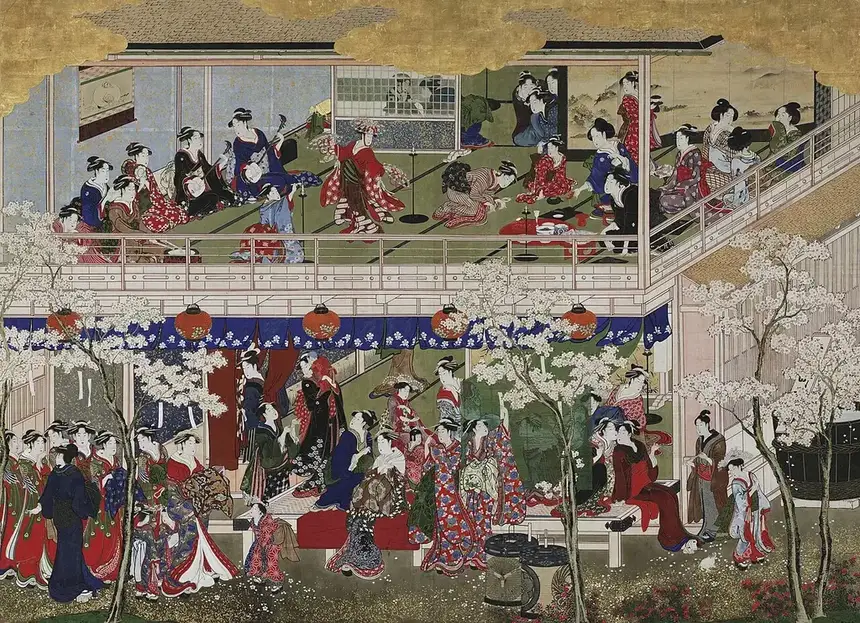
Ours is painted from the source image, stroke by stroke, so Yoshiwara no Hana keeps the order it was originally built in.
Where the original has an awkward crop, we keep it. Correcting it would be painting a different picture.
Dusk and overcast passages are the hardest and the most rewarding — they are all half-tones.
Our painter mixes on the palette but finishes on the canvas, which is where the small variations come from.
The marks have a direction, and the direction follows the form.
The difficult part is not the detail. It is keeping the whole canvas at the same stage of finish.
It works best on a wall you pass rather than one you sit and stare at — the paint rewards a moving eye.
| Artist | Kitagawa Utamaro |
|---|---|
| Title | Yoshiwara no Hana |
| Medium | Oil on canvas, hand-painted to order |
| Year | 1788 |
| What you receive | A hand-painted oil painting on canvas |
| Public domain | Yes — the artist died over 70 years ago |
What a print loses
What you lose in a print is the air. A press lays ink flat; a painter builds depth in layers, and the depth is what you actually see.
Where the original is loaded, ours is loaded. Where it is thin, ours is thin. Matching the weight of the paint matters more than matching the colour.
| Aspect | Hand-painted oil | Printed canvas |
|---|---|---|
| Edge quality | Soft where the form turns, sharp where it does not | Uniformly sharp or uniformly blurred |
| Colour | Mixed for each passage, warm and cool versions | One flat value per area |
| Later on | Can be restored, re-framed, handed on | Replaceable, and usually replaced |
| Time to make | Days of one painter's working time | Minutes |
| Depth | Built in layers, catches light from the side | Flat; highlights are printed as pale ink |
Getting Yoshiwara no Hana right means painting it in the right order, and the order is not obvious.
Every canvas is painted to order, so the quote follows your size, frame and destination rather than a fixed list. Tell us what you need on WhatsApp and we reply with an exact figure, usually within the hour. No resellers, no drop-shipper. The painter's studio handles your commission from first message to final crate.
From blank canvas to finished painting
The order of work matters as much as the work itself. Ours runs like this:
- The canvas is stretched and primed — cotton or linen, sized and ready before any paint goes near it.
- A loose underdrawing — proportions checked by eye against the source image.
- The big shapes are blocked in — thin paint, one colour at a time, the whole canvas at once.
- Getting the values right — the stage that decides whether the finished painting holds together.
- Colour is built up — warmer and cooler versions of each passage, laid over the underpainting.
- Detail and highlights last — put on thickly and then not touched again.
- Left to dry before varnish — nothing is photographed or packed until the surface is ready.
This one repaints badly, so our painter gets the values right early and leaves them.
Frames
Most clients wait for the photographs before choosing a frame, which is the sensible order.
If you are shipping, an unframed canvas rolled in a tube is considerably cheaper to move than a framed one.
Keeping it
Once the varnish has cured the surface can be cleaned by a conservator, but in a normal house it will not need it for decades.
What it is made of
We use cotton duck for most sizes and linen where the canvas is large or the client asks for it. We use a neutral-sized ground so the whites stay warm rather than going blue over time.
The ground is a proper acrylic sizing, so the oil does not rot the fabric over time. We do not use a printer at any stage. There is no giclée, no canvas transfer, no digital underlayer.
Sizing it
The canvas is cut to your wall, not the other way round. For reference, these are the dimensions most often requested:
| Size (inches) | Size (cm) | Best for |
|---|---|---|
| 48 × 36 in | 122 × 91 cm | Large living room, stairwell, loft |
| 40 × 30 in | 102 × 76 cm | Living room focal wall, above a sofa |
| 32 × 24 in | 81 × 61 cm | Living room, above a sideboard |
| 30 × 24 in | 76 × 61 cm | Dining room, bedroom feature wall |
| 24 × 20 in | 60 × 50 cm | Study, home office, above a desk |
If your wall is an odd shape, send the measurement and we will work to it. Proportions from the original are kept unless you ask us to change them. Shipments go out DAP. If your customs office charges duty or tax on arrival, that is between you and them — we do not collect it and we do not put a number on it.
A plain wall is better than a busy one; the painting supplies the interest.
Give us your size and framing preference and you will have a quote shortly.
💬 Get a Quote for (c. 1788–91) Yoshiwara no HanaTimeline and shipping
From order to finished canvas is 9–15 days. Freight appears as a separate line on the quote and is fixed before you pay.
Expect 7–10 business days in transit, with tracking from our door to yours. Rolled in a tube it travels cheaper and safer than framed; most overseas clients take it that way.
Nothing ships before you have seen it. Photographs of the finished painting go to you first. If something is not right, tell us what to adjust and we adjust it.
Our terms are DAP, meaning the freight is paid by us and any import charges are yours to settle. We will not estimate them, because the figure is your customs authority's to set.
You pay a deposit to start and the remainder before shipping. Nothing is hidden in between. If a crate arrives damaged, send us photographs within 48 hours and contact us directly — we will sort it out with you.
Questions worth asking
Do you frame it?
Framing is quoted separately, so you can decide once you have seen the finished canvas in photographs.
What is the canvas made of?
Cotton or linen, oil colour, and varnish. Stretcher bars are wedged so the canvas can be re-tensioned later.
How do I hang it?
Roughly 145 cm from floor to centre works for most rooms. Tell us your wall and we will give you the measurement.
Can I change the size?
Yes. The canvas is painted to your measurement, not taken from a stock list.
Do you ship to my country?
We export to more than 20 countries. Tell us where you are and we will quote the freight as a separate line.
Is owning a reproduction legal?
Yes. The painting is out of copyright because Kitagawa Utamaro died more than 70 years ago. We paint copies honestly and never claim they are originals.
Do you take a deposit?
Work begins on a deposit and ships once the balance is paid. Nothing is charged that is not on the quote.
Who pays the import duty?
You do. We sell DAP, so any duty or tax your customs authority charges is settled by you at import. We do not collect it and we do not estimate it.
Can you paint it from a different photograph of the same work?
Send your own reference image and we will paint from that instead.
How long does it take?
Painting takes 9–15 days. Air freight is usually 7–10 business days on top of that, tracked.