The original, and why we can paint it
Because Konstantin Gorbatov died in 1945, this work is in the public domain. We are painting a copy of a painting — we never pass it off as the original, and neither should anyone selling you one.
Every version we make is oil on canvas, painted by one painter from start to finish. No printing is involved at any stage.
It is an original composition painted before 1945, and our version is painted from the surviving image of it.
What arrives is a canvas with paint on it, made by a person. That is the only thing we sell.
Where the painting lives
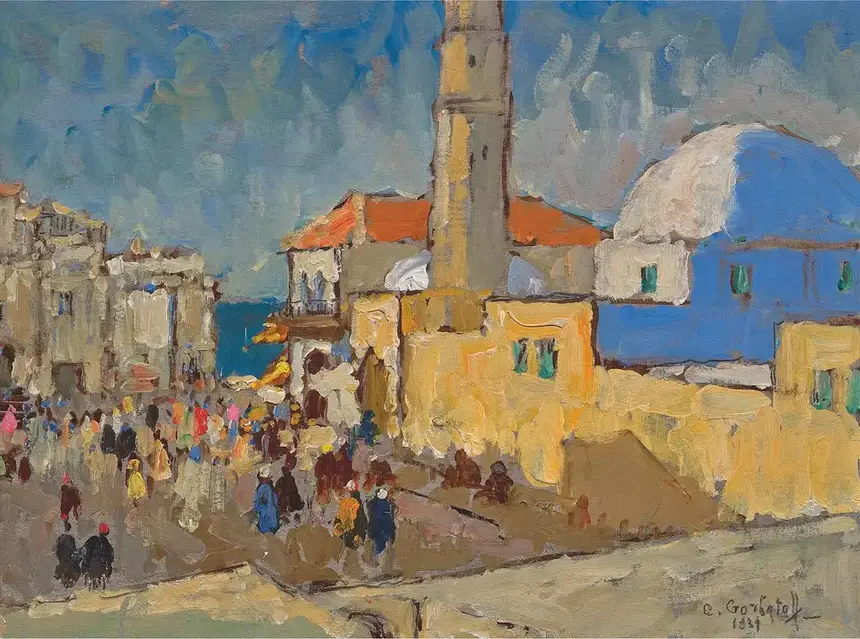
Mosque in Jaffa is not a postcard. There is a decision in every zone of the canvas, and the decision is visible.
Our painter blocks the big shapes first and lets the detail come last, so the composition holds at any size.
We do not brighten the picture for reproduction. The original's key is kept as it is.
Every colour in Mosque in Jaffa has a warm version and a cool version, and the painter chooses between them passage by passage.
The brushwork is left visible, which is the whole argument for painting it by hand.
The hardest passage is the quiet one, where a small mistake has nowhere to hide.
For a stairwell or a double-height space, go larger than you think — the composition was built for distance.
| Artist | Konstantin Gorbatov |
|---|---|
| Title | Mosque in Jaffa |
| Medium | Oil on canvas, hand-painted to order |
| Reproduction | Hand-painted oil on canvas, made to order |
| Public domain | Yes — the artist died over 70 years ago |
Why hand-painting matters here
Prints are good at information and bad at paint. This subject is mostly paint.
Edges are left soft where the form turns away and sharp where it does not. That single habit is what separates a painting from a copy.
| Aspect | Hand-painted oil | Printed canvas |
|---|---|---|
| Impasto | Real paint standing off the canvas | Flat ink, sometimes embossed to imitate |
| The surface | Built up with brushes and knives | Printed flat in one pass |
| What it takes | One painter, several days, start to finish | A machine, a few minutes |
| Available sizes | Whatever you need, painted to order | What the printer can output |
| Value over time | Can be re-stretched, cleaned and re-framed | Little value beyond the print |
The difficulty is restraint: leaving out most of what a photograph would show.
Every canvas is painted to order, so the quote follows your size, frame and destination rather than a fixed list. Tell us what you need on WhatsApp and we reply with an exact figure, usually within the hour. You deal directly with the studio that paints it — no reseller layer.
The sequence on our floor
No two canvases are painted the same way, but the sequence is always this:
- Stretching and priming the support — cotton duck or linen goes onto the bars and gets its ground.
- The drawing goes down — charcoal or thin paint, done by eye rather than traced from a printout.
- Blocking the masses — thin paint, working the whole surface rather than one corner at a time.
- Getting the values right — the stage that decides whether the finished painting holds together.
- The colour passes — each area gets its own mixture rather than one colour used throughout.
- The detail and highlights go on — last, loaded, and left alone once they are down.
- It dries, then gets varnished — and only then is it photographed for you.
Getting Mosque in Jaffa right means painting it in the right order, and the order is not obvious.
Canvas, paint and varnish
The ground is a proper acrylic sizing, so the oil does not rot the fabric over time. Nothing is sprayed, sealed or laminated. The surface you see is paint and varnish, and that is all.
Each painter works on one canvas at a time — the painting you ordered is not shared with another order. We use cotton duck for most sizes and linen where the canvas is large or the client asks for it.
Whether to frame it
Framing is quoted separately, so you can decide after you have seen the finished canvas in photographs.
Most clients wait for the photographs before choosing a frame, which is the sensible order.
Living with it
Once the varnish has cured the surface can be cleaned by a conservator, but in a normal house it will not need it for decades.
What size works
The canvas is cut to your wall, not the other way round. For reference, these are the dimensions most often requested:
| Size (inches) | Size (cm) | Best for |
|---|---|---|
| 30 × 24 in | 76 × 61 cm | Dining room, bedroom feature wall |
| 24 × 20 in | 60 × 50 cm | Study, home office, above a desk |
| 20 × 16 in | 50 × 40 cm | Bedroom, hallway, above a console |
| 16 × 12 in | 40 × 30 cm | A shelf, a small wall, a gallery group |
| 64 × 48 in | 163 × 122 cm | Villa scale, lobby, hospitality wall |
If your wall is an odd shape, send the measurement and we will work to it. Proportions from the original are kept unless you ask us to change them. Shipments go out DAP. If your customs office charges duty or tax on arrival, that is between you and them — we do not collect it and we do not put a number on it.
A plain wall is better than a busy one; the painting supplies the interest.
Send the wall, the size and whether you want a frame, and we will quote.
💬 Get a Quote for Mosque in JaffaOrder, painting, shipping
Allow 9–15 days for the painting itself. Shipping is a separate line on your quote — you see it before payment, not after.
Expect 7–10 business days in transit, with tracking from our door to yours. Unframed canvases are rolled face-out on a tube; framed ones are corner-protected and crated.
You see photographs of the finished painting before it ships, and you tell us what to adjust. If something is not right, tell us what to adjust and we adjust it.
Terms are DAP. Import duties and taxes, where they apply, are paid by the buyer on arrival — we never collect them in advance and never guess at the amount.
A deposit starts the canvas and books the painter's time; the balance is due before the crate leaves. If a crate arrives damaged, send us photographs within 48 hours and contact us directly — we will sort it out with you.
Questions worth asking
Can I get this in a size that is not listed?
Yes — the listed sizes are the common requests, not a limit. Very wide or unusually tall proportions are routine for us.
Why not just print it?
A print flattens the surface into a poster: the distance collapses and the highlights turn to grey. Paint keeps the depth and the texture the original was built from.
What happens after I message you?
You tell us the painting, size and whether you want a frame. We quote, a painter starts on your canvas, and you get photographs before it ships.
Can I change the size?
Yes. The canvas is painted to your measurement, not taken from a stock list.
Who pays the import duty?
You do. We sell DAP, so any duty or tax your customs authority charges is settled by you at import. We do not collect it and we do not estimate it.
What does it cost?
Every canvas is quoted on size, frame and destination rather than a fixed list. Tell us what you need and we reply with an exact figure.
What if it arrives damaged?
Report damage within 48 hours with photographs. We deal with the carrier rather than leaving you to argue alone.
Can you paint it from a different photograph of the same work?
Send your own reference image and we will paint from that instead.
How long does it take?
Allow 9–15 days for the painting itself, then roughly 7–10 business days in transit.
Will I see it before it ships?
Yes — photographs of the actual painting go to you first, and nothing is packed until you have seen them.
Do you take a deposit?
A deposit starts the canvas and the balance falls due before it ships. Both figures appear on the quote.
Can you paint a different work by Konstantin Gorbatov?
Yes. Send the image and we will quote it, or browse the other paintings we have listed.