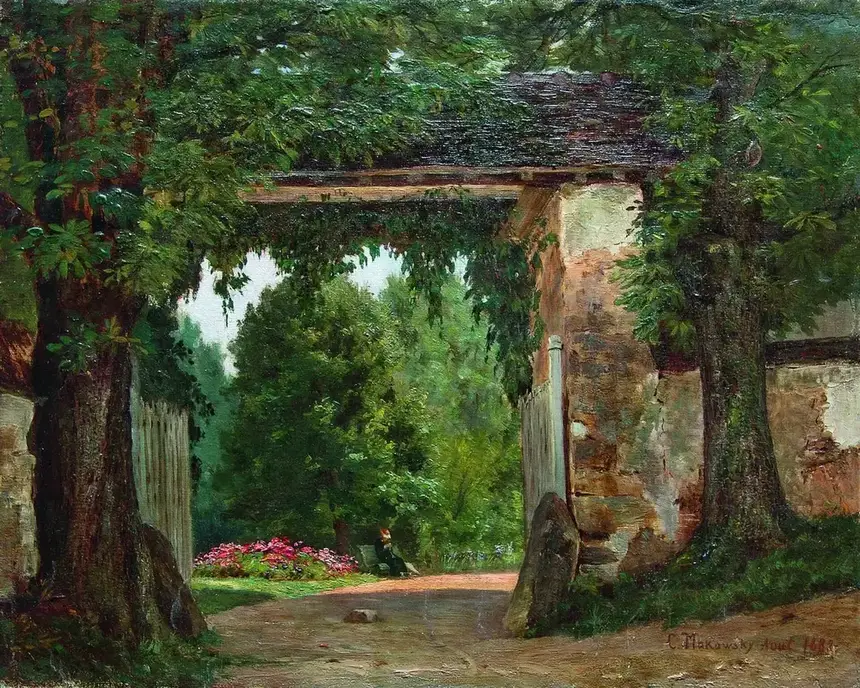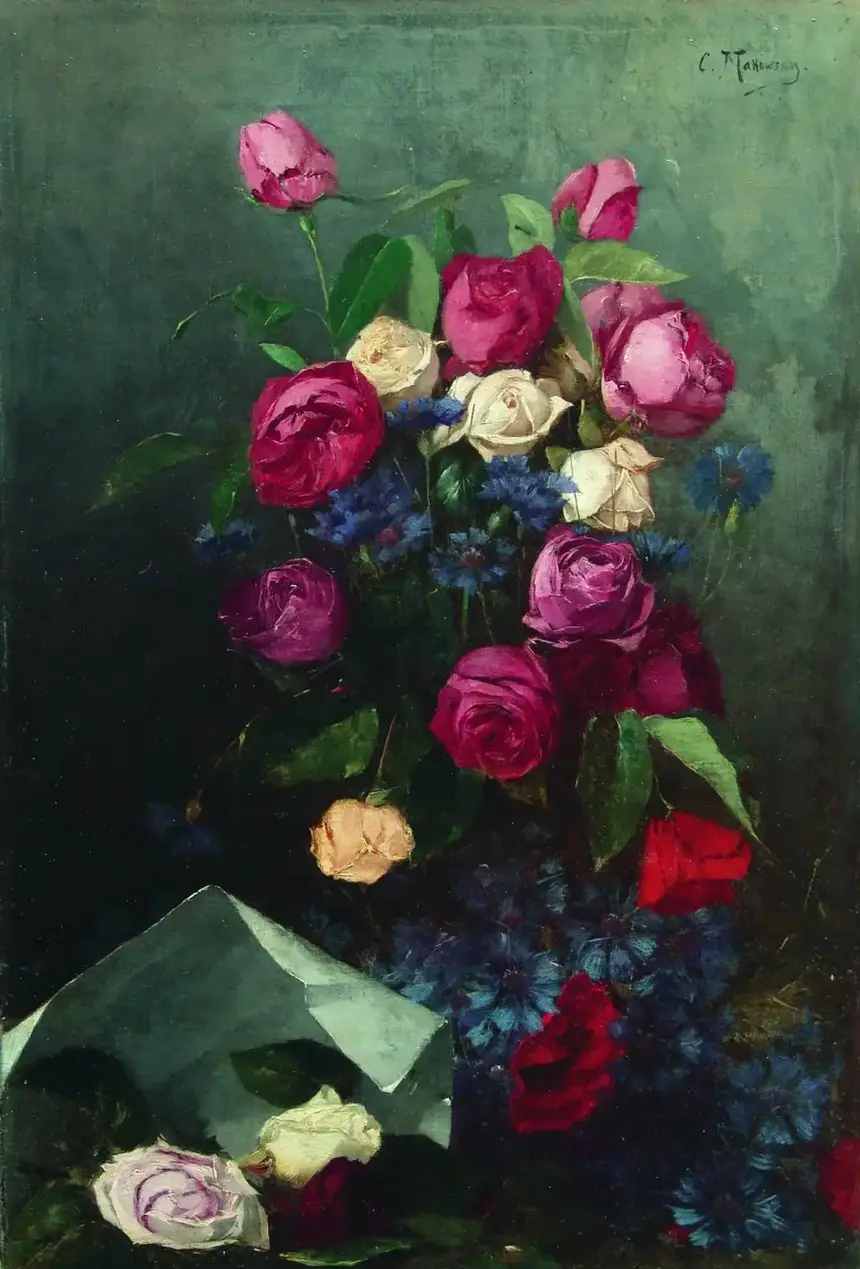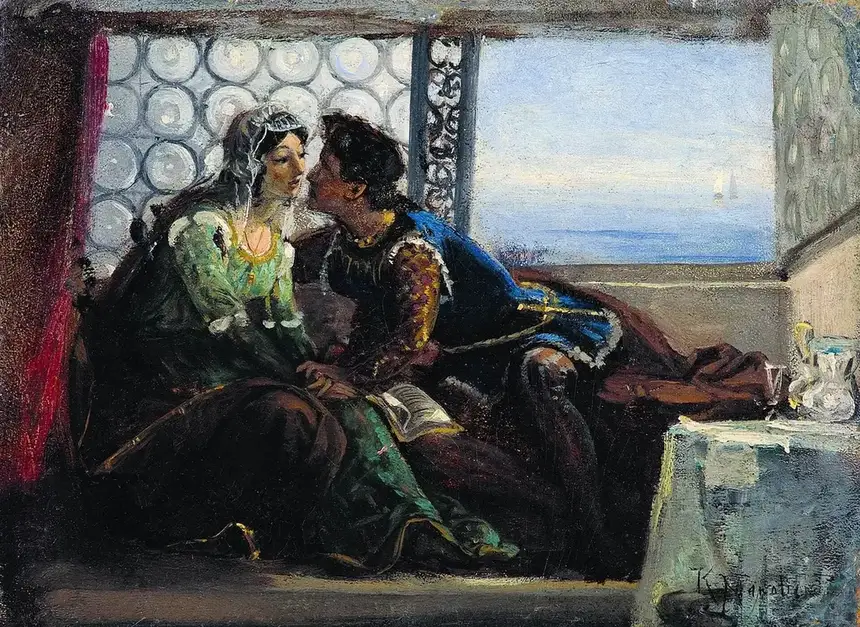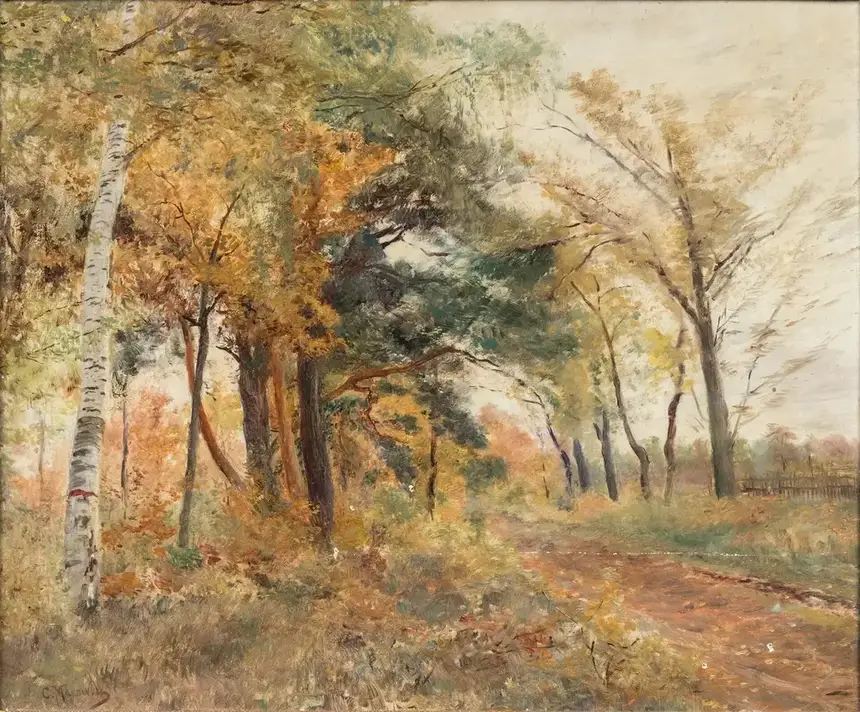
Where this painting comes from
Konstantin Makovsky died in 1915. That puts the painting well outside copyright, which is why we can paint it and you can own it anywhere in the world.
We paint it in oil on canvas, one at a time, in Dafen Village. Nothing is printed, scanned or transferred.
It is an original composition painted before 1915, and our version is painted from the surviving image of it.
If you want something printed, we are the wrong workshop. We do not own a printer that touches canvas.
Looking at it properly
There is a reason a landscape is the hardest thing to print and the easiest thing to paint: the paint itself carries the depth.
Where the original has an awkward crop, we keep it. Correcting it would be painting a different picture.
Light is handled as a value problem: how dark the darkest dark is determines the whole picture.
Saturated colour is kept for a small area; the rest is deliberately knocked back.
Our painter uses a larger brush than you would expect, which is why the passages stay simple.
This one repaints badly, so our painter gets the values right early and leaves them.
It suits a room with warm, low light. Strong downlighting flattens the surface.
| Artist | Konstantin Makovsky |
|---|---|
| Title | Un chemin dans un bois |
| Medium | Oil on canvas, hand-painted to order |
| Reproduction | Hand-painted oil on canvas, made to order |
| Public domain | Yes — the artist died over 70 years ago |
The case for painting it by hand
What you lose in a print is the air. A press lays ink flat; a painter builds depth in layers, and the depth is what you actually see.
Where the original is loaded, ours is loaded. Where it is thin, ours is thin. Matching the weight of the paint matters more than matching the colour.
| Aspect | Hand-painted oil | Printed canvas |
|---|---|---|
| Colour | Mixed for each passage, warm and cool versions | One flat value per area |
| Depth | Built in layers, catches light from the side | Flat; highlights are printed as pale ink |
| Corrections | We adjust it and repaint the passage | The file is reprinted or it is not |
| Available sizes | Whatever you need, painted to order | What the printer can output |
| Value over time | Can be re-stretched, cleaned and re-framed | Little value beyond the print |
The difficult part is not the detail. It is keeping the whole canvas at the same stage of finish.
Every canvas is painted to order, so the quote follows your size, frame and destination rather than a fixed list. Tell us what you need on WhatsApp and we reply with an exact figure, usually within the hour. You are buying from the workshop, not a catalogue.
How the canvas is built
Here is what actually happens between your message and the crate:
- The canvas is stretched and primed — cotton or linen, sized and ready before any paint goes near it.
- A loose underdrawing — proportions checked by eye against the source image.
- The first colour pass — thin and simple, establishing the main shapes only.
- The values are established — this is the stage that decides whether the painting works.
- The colour passes — each area gets its own mixture rather than one colour used throughout.
- Finishing passes — the loaded highlights go on at the end and stay there.
- Left to dry before varnish — nothing is photographed or packed until the surface is ready.
Matching the original's degree of finish is harder than matching its colours.
Frames
A frame is a separate line on the quote, not a bundle. You choose it once the painting exists.
Most clients wait for the photographs before choosing a frame, which is the sensible order.
Care and cleaning
Dust it with a dry, soft brush. Keep it out of direct sun and away from radiators, and it will outlive you.
What goes into it
Each painter works on one canvas at a time — the painting you ordered is not shared with another order. Varnish goes on only once the paint is properly dry, months after the last stroke, not before.
Stretcher bars are kiln-dried and wedged, so the canvas can be re-tensioned years later. We do not use a printer at any stage. There is no giclée, no canvas transfer, no digital underlayer.
What size works
You are not choosing from a list; you are telling us a measurement. These are the common ones:
| Size (inches) | Size (cm) | Best for |
|---|---|---|
| 30 × 24 in | 76 × 61 cm | Dining room, bedroom feature wall |
| 24 × 20 in | 60 × 50 cm | Study, home office, above a desk |
| 20 × 16 in | 50 × 40 cm | Bedroom, hallway, above a console |
| 16 × 12 in | 40 × 30 cm | A shelf, a small wall, a gallery group |
| 64 × 48 in | 163 × 122 cm | Villa scale, lobby, hospitality wall |
Tell us the wall width and we will tell you what looks right rather than what is standard. We quote DAP, so any duty or tax your country charges is settled by you at import. We do not add a tax line of our own.
Hang it at eye level — roughly 145 cm from the floor to the centre — and it will hold the wall.
Tell us the size and frame — exact quote back, usually within the hour.
💬 Get a Quote for Un chemin dans un boisFrom order to your wall
Allow 9–15 days for the painting itself. Shipping is a separate line on your quote — you see it before payment, not after.
Expect 7–10 business days in transit, with tracking from our door to yours. We send photographs of the finished painting before it is packed, and again once it is boxed.
Nothing ships before you have seen it. Photographs of the finished painting go to you first. Changes are handled by telling us what to change; we change it and send new photographs.
Duties and import taxes are the buyer's account (DAP). Your customs authority sets them; we do not.
A deposit starts the canvas and books the painter's time; the balance is due before the crate leaves. Report any transit damage within 48 hours with photographs and we will deal with the carrier. We will not promise a payout, but we will not leave you to argue alone either.
Before you order
Can I get this in a size that is not listed?
Yes — the listed sizes are the common requests, not a limit. Very wide or unusually tall proportions are routine for us.
Can I see progress photos while it is being painted?
We send photographs of the finished painting for approval before it ships. Mid-process images are not part of the standard workflow.
Will I see it before it ships?
Yes. We send photographs of the finished canvas and wait for your reply before packing.
How long does it take?
Painting takes 9–15 days. Air freight is usually 7–10 business days on top of that, tracked.
What is the canvas made of?
Cotton or linen, oil colour, and varnish. Stretcher bars are wedged so the canvas can be re-tensioned later.
What does it cost?
Every canvas is quoted on size, frame and destination rather than a fixed list. Tell us what you need and we reply with an exact figure.
Can you paint it from a different photograph of the same work?
Yes. If you have a better reference, send it on WhatsApp and we will work from yours.
Who pays the import duty?
You do. We sell DAP, so any duty or tax your customs authority charges is settled by you at import. We do not collect it and we do not estimate it.
Can you change the colours to suit my room?
We can shift the palette, but we will tell you honestly when a change would spoil the painting.
Can I change the size?
Any size you like. We paint to the number you give us rather than to a standard range.
Is it really painted by hand?
Yes. One painter, oil paint, brushes. We do not own a printer that touches canvas.