Where this painting comes from
Louis Valtat died in 1952. That puts the painting well outside copyright, which is why we can paint it and you can own it anywhere in the world.
Ours is a painting made with brushes. There is no giclée, no canvas transfer and no digital underlayer anywhere in the process.
The painting was made in the years before 1952, and what we reproduce is the record of it, not the object.
If you want something printed, we are the wrong workshop. We do not own a printer that touches canvas.
What to look at
What makes a landscape worth painting by hand is the distance in it — the space between the near ground and the far one.
Where the original has an awkward crop, we keep it. Correcting it would be painting a different picture.
Light is handled as a value problem: how dark the darkest dark is determines the whole picture.
We keep the original's palette rather than brightening it, even where a modern eye would.
Where the source has a loaded passage, ours is loaded too — you will feel it from the side.
The difficulty is restraint: leaving out most of what a photograph would show.
Hang it at eye level — roughly 145 cm from the floor to the centre — and it will hold the wall.
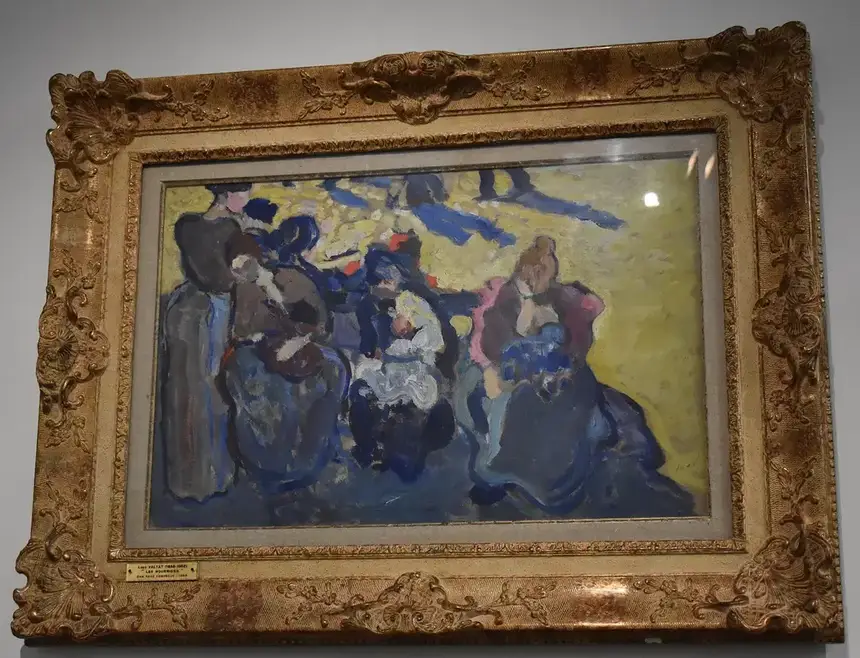
| Artist | Louis Valtat |
|---|---|
| Title | Les nourrices 01 |
| Created (original) | 1895 |
| Medium | Oil on canvas, hand-painted to order |
| Reproduction | Hand-painted oil on canvas, made to order |
| Original status | Public domain (artist deceased) |
Why this one cannot be printed
Prints are good at information and bad at paint. This subject is mostly paint.
Edges are left soft where the form turns away and sharp where it does not. That single habit is what separates a painting from a copy.
| Aspect | Hand-painted oil | Printed canvas |
|---|---|---|
| Sense of depth | Real, created by layers of paint | Simulated by darker ink |
| Time to make | Days of one painter's working time | Minutes |
| Lifespan | Slow to change; varnish can be refreshed decades later | Fades and cracks sooner |
| Texture | Ridges and drag you can see from across a room | None, or a printed imitation of it |
| Value over time | Can be re-stretched, cleaned and re-framed | Little value beyond the print |
The hardest passage is the quiet one, where a small mistake has nowhere to hide.
Every canvas is painted to order, so the quote follows your size, frame and destination rather than a fixed list. Tell us what you need on WhatsApp and we reply with an exact figure, usually within the hour. You are buying from the workshop, not a catalogue.
The sequence on our floor
The order of work matters as much as the work itself. Ours runs like this:
- The canvas is stretched and primed — cotton or linen, sized and ready before any paint goes near it.
- The drawing goes down — charcoal or thin paint, done by eye rather than traced from a printout.
- The first colour pass — thin and simple, establishing the main shapes only.
- Getting the values right — the stage that decides whether the finished painting holds together.
- Colour is built up — warmer and cooler versions of each passage, laid over the underpainting.
- Detail and highlights last — put on thickly and then not touched again.
- It dries, then gets varnished — and only then is it photographed for you.
Anyone can copy the shapes. The skill is in the transitions, and that is what takes the days.
Frames
If you are shipping, an unframed canvas rolled in a tube is considerably cheaper to move than a framed one.
A frame is a separate line on the quote, not a bundle. You choose it once the painting exists.
Care and cleaning
Dust it with a dry, soft brush. Keep it out of direct sun and away from radiators, and it will outlive you.
What it is made of
We do not use a printer at any stage. There is no giclée, no canvas transfer, no digital underlayer. Brushes, knives and rags. That is the equipment list; there is no machine in the process.
We use cotton duck for most sizes and linen where the canvas is large or the client asks for it. Pigment is artist-grade oil colour, not acrylic and not house paint. It behaves differently and it lasts.
Sizing it
The canvas is cut to your wall, not the other way round. For reference, these are the dimensions most often requested:
| Size (inches) | Size (cm) | Best for |
|---|---|---|
| 30 × 24 in | 76 × 61 cm | Dining room, bedroom feature wall |
| 24 × 20 in | 60 × 50 cm | Study, home office, above a desk |
| 20 × 16 in | 50 × 40 cm | Bedroom, hallway, above a console |
| 16 × 12 in | 40 × 30 cm | A shelf, a small wall, a gallery group |
If your wall is an odd shape, send the measurement and we will work to it. Proportions from the original are kept unless you ask us to change them. Terms are DAP. Import duties and taxes, where they apply, are paid by the buyer on arrival — we never collect them in advance and never guess at the amount.
It works best on a wall you pass rather than one you sit and stare at — the paint rewards a moving eye.
Tell us the size and frame — exact quote back, usually within the hour.
💬 Get a Quote for Les nourrices 01How it reaches you
The painting takes 9–15 days, and delivery is priced separately on the quote so there is no surprise later.
In transit it is typically 7–10 business days by air, tracked door to door. Rolled in a tube it travels cheaper and safer than framed; most overseas clients take it that way.
You see photographs of the finished painting before it ships, and you tell us what to adjust. Changes are handled by telling us what to change; we change it and send new photographs.
We quote DAP, so any duty or tax your country charges is settled by you at import. We do not add a tax line of our own.
Work begins on a deposit and ships on the balance. Both figures are on the quote. Damage in transit should be reported to us within 48 hours, with photographs. We pursue it with the carrier rather than promising a refund.
Questions worth asking
Does it come with a certificate of authenticity?
No, and we would be wary of anyone who issues one for a public-domain reproduction. What you receive is a hand-painted canvas and photographs of it before it ships.
Can I get this in a size that is not listed?
Yes — the listed sizes are the common requests, not a limit. Very wide or unusually tall proportions are routine for us.
Is there a rush option?
It depends on the canvas and what else is in the studio. Ask on WhatsApp with your size and we will tell you straight what is possible.
Is it really painted by hand?
Yes. One painter, oil paint, brushes. We do not own a printer that touches canvas.
Can you paint a different work by Louis Valtat?
Yes — send us the image, or look through the other Louis Valtat works on the site.
What is the canvas made of?
Cotton or linen, oil colour, and varnish. Stretcher bars are wedged so the canvas can be re-tensioned later.
Who pays the import duty?
You do. We sell DAP, so any duty or tax your customs authority charges is settled by you at import. We do not collect it and we do not estimate it.
What if it arrives damaged?
send us photographs within 48 hours and contact us directly — we will sort it out with you.
What does it cost?
Every canvas is quoted on size, frame and destination rather than a fixed list. Tell us what you need and we reply with an exact figure.
How do I hang it?
Centre it at about 145 cm from the floor, or two-thirds the width of the furniture below it. We will tell you the exact number for your wall.
Can you change the colours to suit my room?
Sometimes. We will adjust the palette if it can be done without ruining the picture, and say so if it cannot.
Does it come framed?
Frames are priced on their own line. Most clients choose after seeing the photographs.