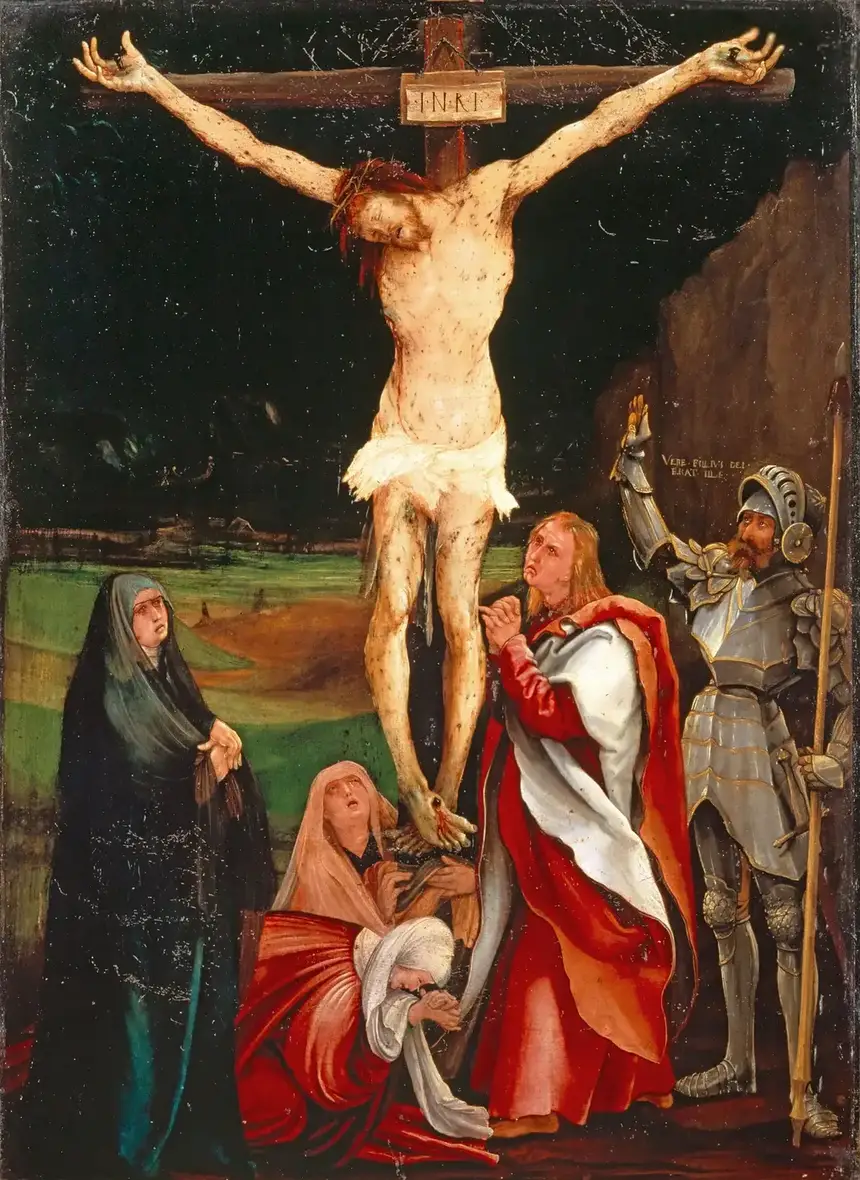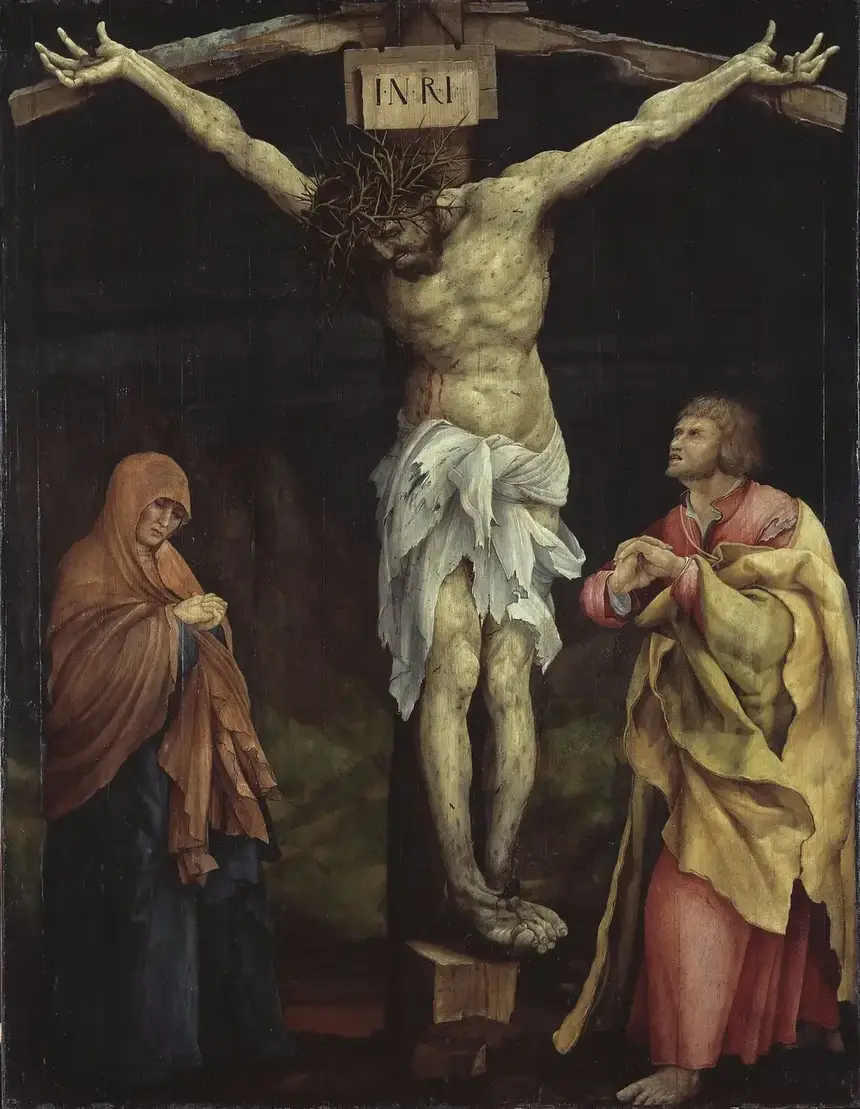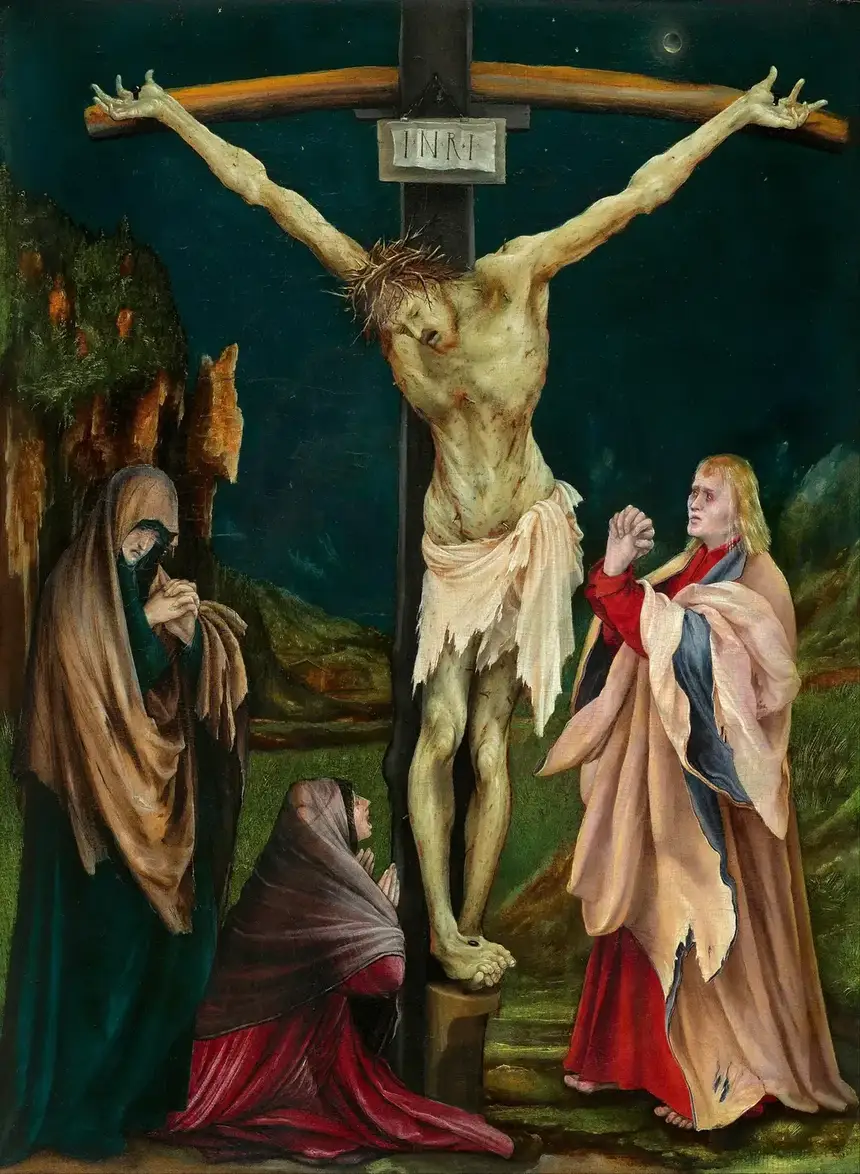
About The Small Crucifixion
Matthias Grünewald died in 1528, so the work has been in the public domain for decades. Reproducing it by hand is legal, and so is owning one.
Every version we make is oil on canvas, painted by one painter from start to finish. No printing is involved at any stage.
It is an original composition painted before 1528, and our version is painted from the surviving image of it.
What arrives is a canvas with paint on it, made by a person. That is the only thing we sell.
Looking at it properly
The Small Crucifixion rewards a bigger canvas than you think, because the detail is painted rather than reproduced.
The composition is hieratic — the important figures are larger and placed centrally — and we keep that.
The brightest passages are reserved for the important figures, and we keep that hierarchy.
Our painter mixes on the palette but finishes on the canvas, which is where the small variations come from.
Our painter uses a larger brush than you would expect, which is why the passages stay simple.
The risk with a religious subject is overworking, and the way to avoid it is knowing when to stop.
Hang it at eye level — roughly 145 cm from the floor to the centre — and it will hold the wall.
| Artist | Matthias Grünewald |
|---|---|
| Title | The Small Crucifixion |
| Medium | Oil on canvas, hand-painted to order |
| How it is made | Painted by hand in oil on canvas, to your size |
| Public domain | Yes — the artist died over 70 years ago |
The case for painting it by hand
The difference is not subtle when the two hang side by side. Ink sits on the surface; oil stands off it.
Edges are left soft where the form turns away and sharp where it does not. That single habit is what separates a painting from a copy.
| Aspect | Hand-painted oil | Printed canvas |
|---|---|---|
| Time to make | Days of one painter's working time | Minutes |
| Surface | Hand-painted oil on canvas | Ink on canvas, flat |
| Edge quality | Soft where the form turns, sharp where it does not | Uniformly sharp or uniformly blurred |
| Texture | Ridges and drag you can see from across a room | None, or a printed imitation of it |
| Handling of colour | Mixed on the palette and finished on the canvas | Fixed by the colour profile |
The hardest passage is the quiet one, where a small mistake has nowhere to hide.
Every canvas is painted to order, so the quote follows your size, frame and destination rather than a fixed list. Tell us what you need on WhatsApp and we reply with an exact figure, usually within the hour. No resellers, no drop-shipper. The painter's studio handles your commission from first message to final crate.
From blank canvas to finished painting
Every canvas is painted to order, so nothing is pulled off a shelf. This is the sequence:
- We start with the canvas itself — stretched, sized and left to settle before any colour is mixed.
- A loose underdrawing — proportions checked by eye against the source image.
- The first colour pass — thin and simple, establishing the main shapes only.
- The values are established — this is the stage that decides whether the painting works.
- Building the colour — a warm and a cool version of each passage, put down in order.
- Detail and highlights last — put on thickly and then not touched again.
- Drying and varnishing — the final varnish goes on once the paint has set, before we photograph it.
Matching the original's degree of finish is harder than matching its colours.
Whether to frame it
If you are shipping, an unframed canvas rolled in a tube is considerably cheaper to move than a framed one.
Framing is quoted separately, so you can decide after you have seen the finished canvas in photographs.
What it is made of
Large canvases get a cross-brace; anything over about a metre and a half needs one. Nothing is sprayed, sealed or laminated. The surface you see is paint and varnish, and that is all.
Linen is worth the extra cost above about a metre across, because it holds tension better in humid rooms. Varnish goes on only once the paint is properly dry, months after the last stroke, not before.
Keeping it
Once the varnish has cured the surface can be cleaned by a conservator, but in a normal house it will not need it for decades.
What size works
Any size is possible. These are simply the ones that come up most often in quotes:
| Size (inches) | Size (cm) | Best for |
|---|---|---|
| 20 × 16 in | 50 × 40 cm | Bedroom, hallway, above a console |
| 16 × 12 in | 40 × 30 cm | A shelf, a small wall, a gallery group |
| 64 × 48 in | 163 × 122 cm | Villa scale, lobby, hospitality wall |
| 48 × 36 in | 122 × 91 cm | Large living room, stairwell, loft |
| 40 × 30 in | 102 × 76 cm | Living room focal wall, above a sofa |
Anything outside this table is fine — we paint to the number you give us. We quote DAP, so any duty or tax your country charges is settled by you at import. We do not add a tax line of our own.
It is a picture for a room you use, not a corridor you walk through.
Give us your size and framing preference and you will have a quote shortly.
💬 Get a Quote for The Small CrucifixionOrder, painting, shipping
Allow 9–15 days for the painting itself. Shipping is a separate line on your quote — you see it before payment, not after.
Air freight runs about 7–10 business days, tracked, to your door. Every shipment goes out with tracking. We do not send anything untracked.
You approve the painting from photographs before it is packed — that is the checkpoint. Changes are handled by telling us what to change; we change it and send new photographs.
Shipments go out DAP. If your customs office charges duty or tax on arrival, that is between you and them — we do not collect it and we do not put a number on it.
You pay a deposit to start and the remainder before shipping. Nothing is hidden in between. Damage in transit should be reported to us within 48 hours, with photographs. We pursue it with the carrier rather than promising a refund.
What people ask us
Will it look exactly like the image?
Not exactly, and that is the point — it is a painting, not a scan. Composition, colour and drawing follow the original closely; the surface is where a painter's own decisions show.
Can I change something in the composition?
Often yes — background, cropping, or adapting the proportions to your wall. Tell us what you have in mind and we will say honestly whether it will work.
Is owning a reproduction legal?
Yes. The painting is out of copyright because Matthias Grünewald died more than 70 years ago. We paint copies honestly and never claim they are originals.
Can you paint it from a different photograph of the same work?
Yes. If you have a better reference, send it on WhatsApp and we will work from yours.
Will I see it before it ships?
Yes — photographs of the actual painting go to you first, and nothing is packed until you have seen them.
Can I change the size?
Yes. The canvas is painted to your measurement, not taken from a stock list.
Do you sell prints?
No. Hand-painted oil on canvas only. No printing, no giclée, no canvas transfer.
Does it come framed?
Frames are priced on their own line. Most clients choose after seeing the photographs.
Do you ship to my country?
We ship to over 20 countries. Give us your city and the freight appears as its own line on the quote.
What does it cost?
Every canvas is quoted on size, frame and destination rather than a fixed list. Tell us what you need and we reply with an exact figure.
What if it arrives damaged?
Report damage within 48 hours with photographs. We deal with the carrier rather than leaving you to argue alone.