Where this painting comes from
Maurice Denis died in 1943, so the work has been in the public domain for decades. Reproducing it by hand is legal, and so is owning one.
Ours is a painting made with brushes. There is no giclée, no canvas transfer and no digital underlayer anywhere in the process.
The painting was made in the years before 1943, and what we reproduce is the record of it, not the object.
You are buying a painting, not a file. That distinction is the whole business we are in.
What to look at
There is a reason a landscape is the hardest thing to print and the easiest thing to paint: the paint itself carries the depth.
Our painter works freehand on a blank canvas, so the scale of the original survives the enlargement.
We do not brighten the picture for reproduction. The original's key is kept as it is.
Colour here is mixed for the passage, not for the object, which is why nothing looks like it was filled in.
Edges are made by the brush, not by an outline, and they are the hardest thing to copy.
What takes time here is the number of separate decisions, not the size of the canvas.
For a stairwell or a double-height space, go larger than you think — the composition was built for distance.
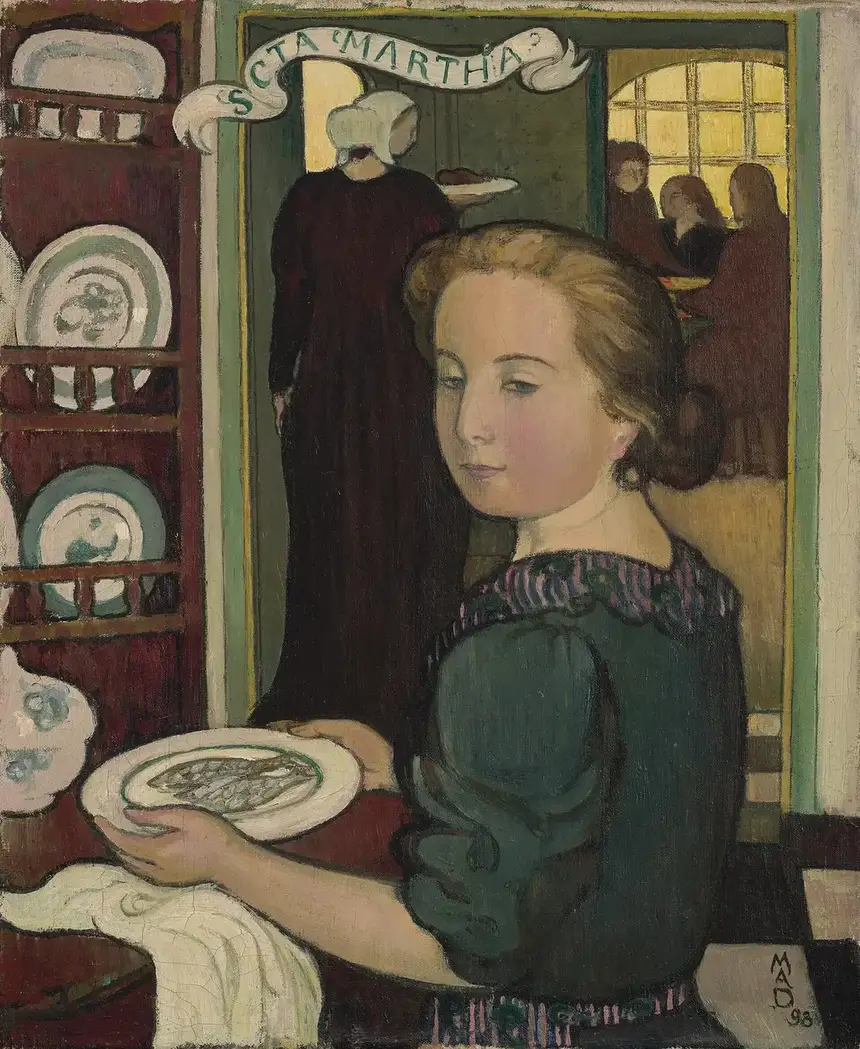
| Artist | Maurice Denis |
|---|---|
| Title | Sancta Martha |
| Medium | Oil on canvas, hand-painted to order |
| Our version | Oil on canvas, painted by hand to order |
| Copyright | Public domain; the original is out of copyright |
Why hand-painting matters here
The difference is not subtle when the two hang side by side. Ink sits on the surface; oil stands off it.
Our painter follows the same logic rather than copying a photograph of it: the far distances go down cool and weak, the near ground stays loaded, and nothing is blended flat.
| Aspect | Hand-painted oil | Printed canvas |
|---|---|---|
| Size | Any size, painted to your wall | Limited by the printer |
| Time to make | Days of one painter's working time | Minutes |
| Sense of depth | Real, created by layers of paint | Simulated by darker ink |
| Texture | Ridges and drag you can see from across a room | None, or a printed imitation of it |
| Colour | Mixed for each passage, warm and cool versions | One flat value per area |
The risk with a landscape is overworking, and the way to avoid it is knowing when to stop.
Every canvas is painted to order, so the quote follows your size, frame and destination rather than a fixed list. Tell us what you need on WhatsApp and we reply with an exact figure, usually within the hour. You are talking to the people who will actually paint it, not a middleman.
How the canvas is built
Here is what actually happens between your message and the crate:
- Stretching and priming the support — cotton duck or linen goes onto the bars and gets its ground.
- The drawing goes down — charcoal or thin paint, done by eye rather than traced from a printout.
- The first colour pass — thin and simple, establishing the main shapes only.
- The values are established — this is the stage that decides whether the painting works.
- The colour passes — each area gets its own mixture rather than one colour used throughout.
- Detail and highlights last — put on thickly and then not touched again.
- Left to dry before varnish — nothing is photographed or packed until the surface is ready.
The hardest passage is the quiet one, where a small mistake has nowhere to hide.
Keeping it
Dust it with a dry, soft brush. Keep it out of direct sun and away from radiators, and it will outlive you.
Canvas, paint and varnish
Stretcher bars are kiln-dried and wedged, so the canvas can be re-tensioned years later. The paint is built in layers, fat over lean, which is what stops it cracking later.
We do not use a printer at any stage. There is no giclée, no canvas transfer, no digital underlayer. Nothing is sprayed, sealed or laminated. The surface you see is paint and varnish, and that is all.
On framing
A frame is a separate line on the quote, not a bundle. You choose it once the painting exists.
We can supply a simple floater frame, a traditional gilt, or nothing at all. It is your call.
Getting the size right
Any size is possible. These are simply the ones that come up most often in quotes:
| Size (inches) | Size (cm) | Best for |
|---|---|---|
| 32 × 24 in | 81 × 61 cm | Living room, above a sideboard |
| 30 × 24 in | 76 × 61 cm | Dining room, bedroom feature wall |
| 24 × 20 in | 60 × 50 cm | Study, home office, above a desk |
| 20 × 16 in | 50 × 40 cm | Bedroom, hallway, above a console |
| 16 × 12 in | 40 × 30 cm | A shelf, a small wall, a gallery group |
| 64 × 48 in | 163 × 122 cm | Villa scale, lobby, hospitality wall |
Tell us the wall width and we will tell you what looks right rather than what is standard. Duties and import taxes are the buyer's account (DAP). Your customs authority sets them; we do not.
It works best on a wall you pass rather than one you sit and stare at — the paint rewards a moving eye.
Message us the dimensions you have in mind and we will come back with a figure.
💬 Get a Quote for Sancta MarthaFrom order to your wall
Allow 9–15 days for the painting itself. Shipping is a separate line on your quote — you see it before payment, not after.
In transit it is typically 7–10 business days by air, tracked door to door. Rolled in a tube it travels cheaper and safer than framed; most overseas clients take it that way.
You approve the painting from photographs before it is packed — that is the checkpoint. Adjustments are part of the process. Say what you want different and it gets done.
Terms are DAP. Import duties and taxes, where they apply, are paid by the buyer on arrival — we never collect them in advance and never guess at the amount.
You pay a deposit to start and the remainder before shipping. Nothing is hidden in between. If a crate arrives damaged, send us photographs within 48 hours and contact us directly — we will sort it out with you.
Questions worth asking
What about duties and import taxes?
Those are the buyer's responsibility (DAP). The amounts are set by your customs authority, not by us.
How do I know what size will look right?
Measure the wall and send a photograph. We will say honestly if the canvas you have in mind is too small for the space, which is the most common mistake.
What if my wall is an unusual shape?
That is normal for us. Send the measurements and we will work out a canvas proportion that suits the space.
Is owning a reproduction legal?
Yes. Maurice Denis died more than 70 years ago, so the work is in the public domain and owning a hand-painted version is legal anywhere. We never pass ours off as the original.
Do you sell prints?
No. Hand-painted oil on canvas only. No printing, no giclée, no canvas transfer.
What if it arrives damaged?
Report damage within 48 hours with photographs. We deal with the carrier rather than leaving you to argue alone.
Can you change the colours to suit my room?
We can shift the palette, but we will tell you honestly when a change would spoil the painting.
What does it cost?
There is no price list, because the number depends on your size and frame. Message us and we will quote exactly.
Will I see it before it ships?
Yes. We send photographs of the finished canvas and wait for your reply before packing.
Who pays the import duty?
You do. We sell DAP, so any duty or tax your customs authority charges is settled by you at import. We do not collect it and we do not estimate it.
Is it really painted by hand?
Yes — oil on canvas, brush and knife. There is no printing, no giclée and no canvas transfer at any stage.
Can you paint a different work by Maurice Denis?
Yes — send us the image, or look through the other Maurice Denis works on the site.