The original, and why we can paint it
Because Nasreddine Dinet died in 1929, this work is in the public domain. We are painting a copy of a painting — we never pass it off as the original, and neither should anyone selling you one.
We paint it in oil on canvas, one at a time, in Dafen Village. Nothing is printed, scanned or transferred.
The painting was made in the years before 1929, and what we reproduce is the record of it, not the object.
If you want something printed, we are the wrong workshop. We do not own a printer that touches canvas.
Where the painting lives
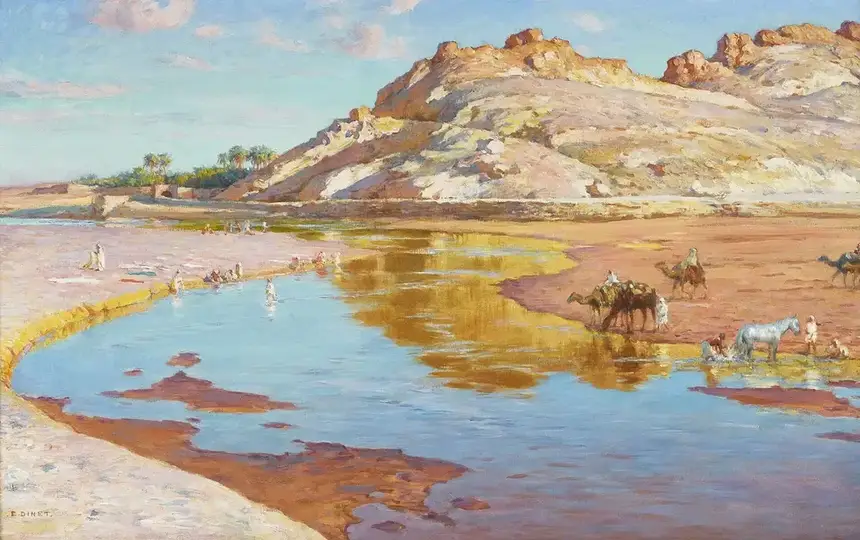
There is a reason a landscape is the hardest thing to print and the easiest thing to paint: the paint itself carries the depth.
The near ground is painted loaded and the far ground thin. That single decision creates the whole space.
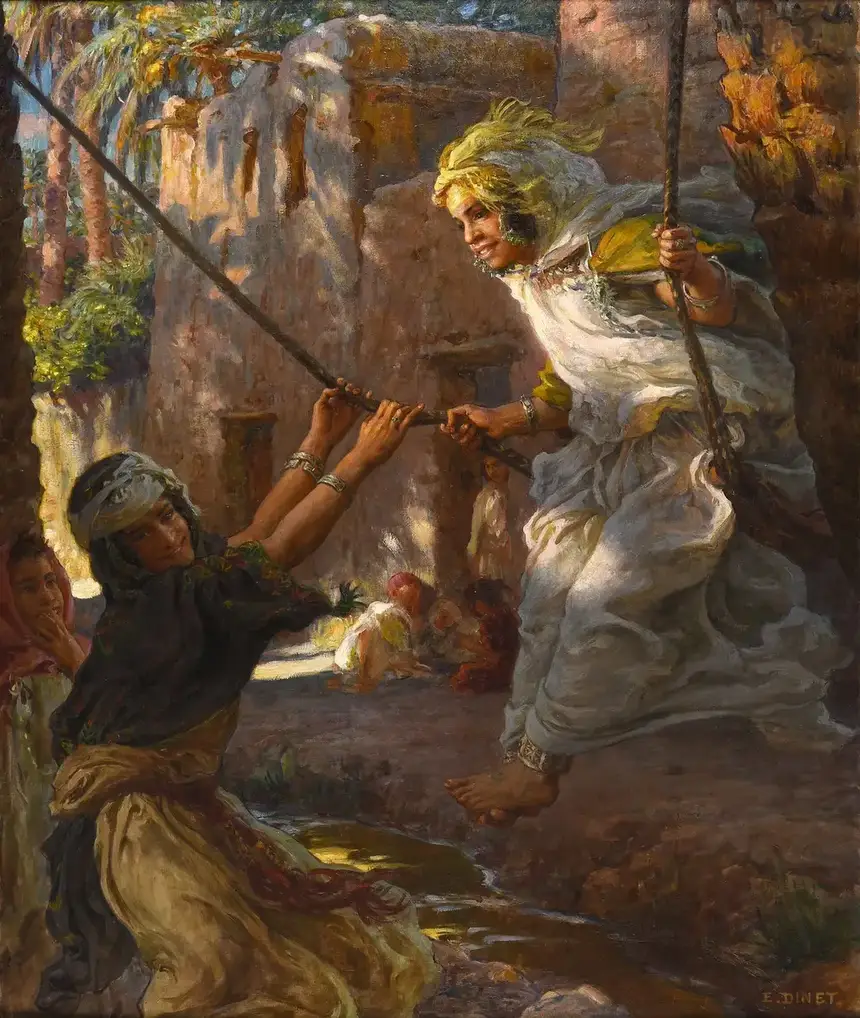
The light in laveuses has a direction, and the painter keeps it consistent across every object in the picture.
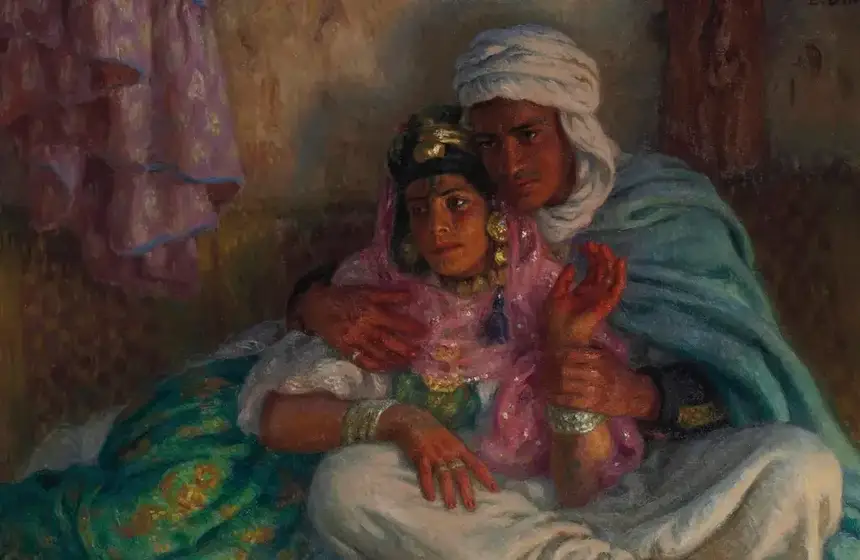
Saturated colour is kept for a small area; the rest is deliberately knocked back.
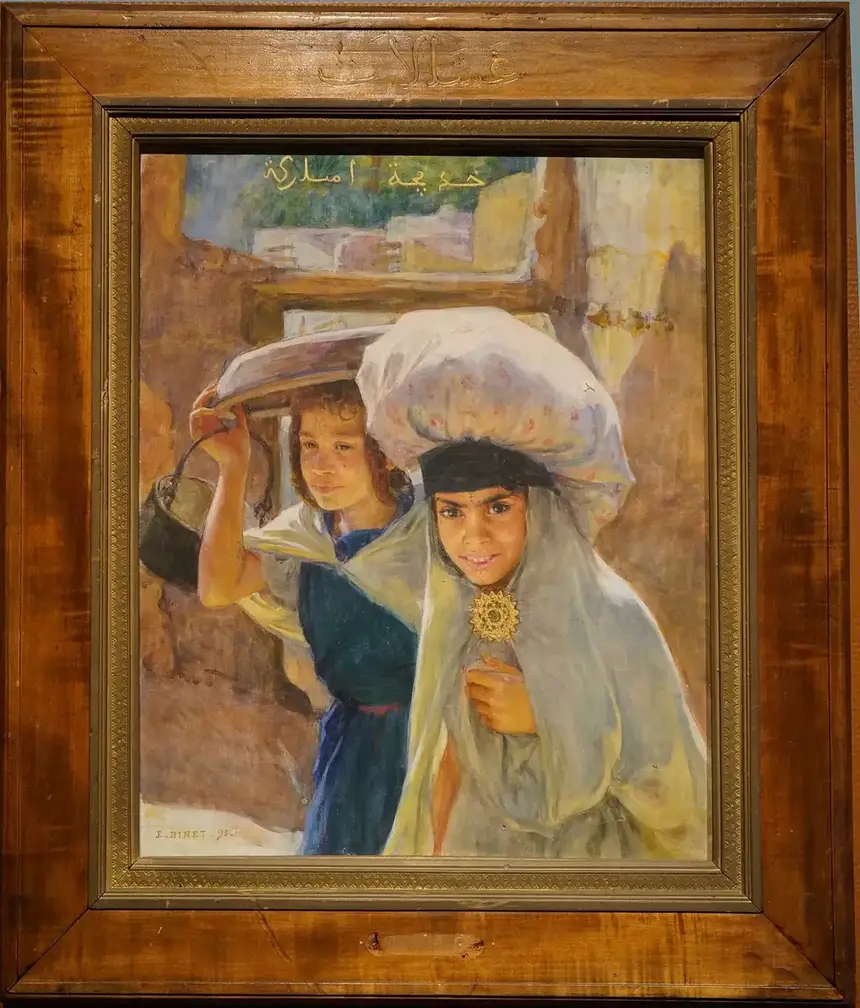
Edges are made by the brush, not by an outline, and they are the hardest thing to copy.
Getting laveuses right means painting it in the right order, and the order is not obvious.
It suits a room with warm, low light. Strong downlighting flattens the surface.
| Artist | Nasreddine Dinet |
|---|---|
| Title | laveuses |
| Created (original) | 2017 |
| Medium | Oil on canvas, hand-painted to order |
| Reproduction | Hand-painted oil on canvas, made to order |
| Copyright | Public domain; the original is out of copyright |
Why hand-painting matters here
Prints are good at information and bad at paint. This subject is mostly paint.
Paint goes on in the original's order — thin first, thick last — so the surface behaves the way the painter intended.
| Aspect | Hand-painted oil | Printed canvas |
|---|---|---|
| Sense of depth | Real, created by layers of paint | Simulated by darker ink |
| Texture | Ridges and drag you can see from across a room | None, or a printed imitation of it |
| Lifespan | Slow to change; varnish can be refreshed decades later | Fades and cracks sooner |
| Colour | Mixed for each passage, warm and cool versions | One flat value per area |
| Edge quality | Soft where the form turns, sharp where it does not | Uniformly sharp or uniformly blurred |
The difficult part is not the detail. It is keeping the whole canvas at the same stage of finish.
Rather than publish rates we would rather look at your wall first. Send the size and any frame preference on WhatsApp for a firm quote. There is no agency in between; the studio that paints your canvas is the one answering your messages.
The sequence on our floor
The order of work matters as much as the work itself. Ours runs like this:
- We start with the canvas itself — stretched, sized and left to settle before any colour is mixed.
- The drawing goes down — charcoal or thin paint, done by eye rather than traced from a printout.
- The first colour pass — thin and simple, establishing the main shapes only.
- Getting the values right — the stage that decides whether the finished painting holds together.
- The colour passes — each area gets its own mixture rather than one colour used throughout.
- Detail and highlights last — put on thickly and then not touched again.
- Drying and varnishing — the final varnish goes on once the paint has set, before we photograph it.
This one repaints badly, so our painter gets the values right early and leaves them.
Framing
A frame is a separate line on the quote, not a bundle. You choose it once the painting exists.
Framing is quoted separately, so you can decide after you have seen the finished canvas in photographs.
Keeping it
Do not wipe it with anything wet. Dust lightly, hang it somewhere stable, and forget about it.
What goes into it
Large canvases get a cross-brace; anything over about a metre and a half needs one. Pigment is artist-grade oil colour, not acrylic and not house paint. It behaves differently and it lasts.
We use a neutral-sized ground so the whites stay warm rather than going blue over time. The ground is a proper acrylic sizing, so the oil does not rot the fabric over time.
Choosing a size
Because each piece is painted from scratch, you are not limited to stock dimensions. These are the sizes clients ask for most:
| Size (inches) | Size (cm) | Best for |
|---|---|---|
| 64 × 48 in | 163 × 122 cm | Villa scale, lobby, hospitality wall |
| 48 × 36 in | 122 × 91 cm | Large living room, stairwell, loft |
| 40 × 30 in | 102 × 76 cm | Living room focal wall, above a sofa |
| 32 × 24 in | 81 × 61 cm | Living room, above a sideboard |
| 30 × 24 in | 76 × 61 cm | Dining room, bedroom feature wall |
| 24 × 20 in | 60 × 50 cm | Study, home office, above a desk |
Tell us the wall width and we will tell you what looks right rather than what is standard. We quote DAP, so any duty or tax your country charges is settled by you at import. We do not add a tax line of our own.
In a bedroom it works above a headboard, sized to about two-thirds of the furniture width.
Tell us where it will hang and how big it needs to be — we will price it properly.
💬 Get a Quote for laveusesHow it reaches you
The painting takes 9–15 days, and delivery is priced separately on the quote so there is no surprise later.
Air freight runs about 7–10 business days, tracked, to your door. Every shipment goes out with tracking. We do not send anything untracked.
Before anything is packed, you get photographs of the actual canvas and a chance to ask for changes. Changes are handled by telling us what to change; we change it and send new photographs.
Our terms are DAP, meaning the freight is paid by us and any import charges are yours to settle. We will not estimate them, because the figure is your customs authority's to set.
Work begins on a deposit and ships on the balance. Both figures are on the quote. Damage in transit should be reported to us within 48 hours, with photographs. We pursue it with the carrier rather than promising a refund.
Questions worth asking
Does it come with a certificate of authenticity?
No, and we would be wary of anyone who issues one for a public-domain reproduction. What you receive is a hand-painted canvas and photographs of it before it ships.
Can I see progress photos while it is being painted?
We send photographs of the finished painting for approval before it ships. Mid-process images are not part of the standard workflow.
Can I get this in a size that is not listed?
Yes — the listed sizes are the common requests, not a limit. Very wide or unusually tall proportions are routine for us.
Can I change the size?
Any size you like. We paint to the number you give us rather than to a standard range.
Do you sell prints?
No. Hand-painted oil on canvas only. No printing, no giclée, no canvas transfer.
Can you paint it from a different photograph of the same work?
Yes. If you have a better reference, send it on WhatsApp and we will work from yours.
Can you paint a different work by Nasreddine Dinet?
Yes — send us the image, or look through the other Nasreddine Dinet works on the site.
Is it really painted by hand?
Yes. One painter, oil paint, brushes. We do not own a printer that touches canvas.
Do you take a deposit?
Work begins on a deposit and ships once the balance is paid. Nothing is charged that is not on the quote.
Who pays the import duty?
You do. We sell DAP, so any duty or tax your customs authority charges is settled by you at import. We do not collect it and we do not estimate it.
Is owning a reproduction legal?
Yes. Nasreddine Dinet died more than 70 years ago, so the work is in the public domain and owning a hand-painted version is legal anywhere. We never pass ours off as the original.
How long does it take?
Painting takes 9–15 days. Air freight is usually 7–10 business days on top of that, tracked.