Where this painting comes from
Nicholas Roerich died in 1947, so the work has been in the public domain for decades. Reproducing it by hand is legal, and so is owning one.
Ours is a painting made with brushes. There is no giclée, no canvas transfer and no digital underlayer anywhere in the process.
The painting was made in the years before 1947, and what we reproduce is the record of it, not the object.
If you want something printed, we are the wrong workshop. We do not own a printer that touches canvas.
What to look at
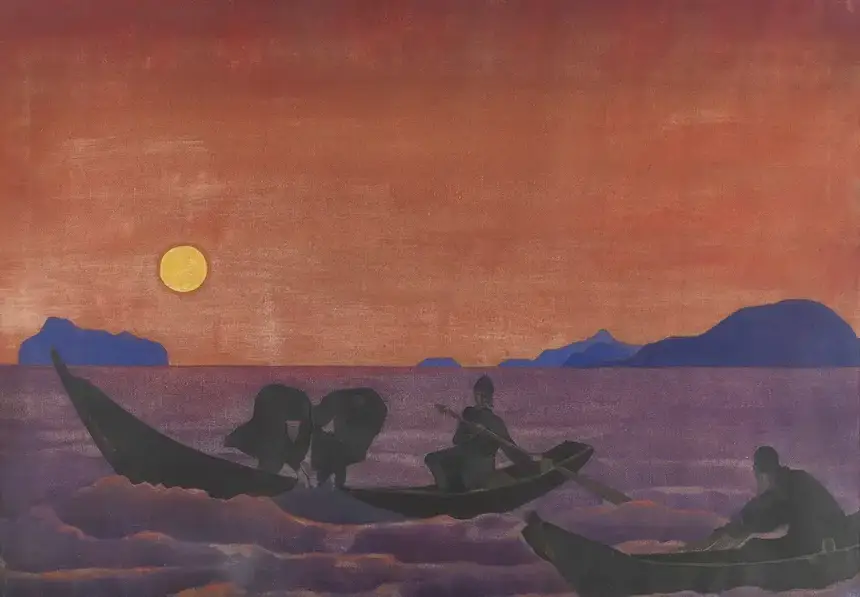
What makes a seascape worth painting by hand is the distance in it — the space between the near ground and the far one.
We keep the original proportions rather than cropping to a standard frame, so an unusually wide composition stays honest.
Our painter leaves the highlights until last and puts them on thickly, so they stand off the surface.
The darks are mixed, not blackened — black straight from the tube would kill the passage.
The last marks are the ones that are left alone. Overworking is the enemy.
Anyone can copy the shapes. The skill is in the transitions, and that is what takes the days.
Given the subject, this sits naturally in a living room or a study rather than a hallway.
| Artist | Nicholas Roerich |
|---|---|
| Title | And We Continue Fishing |
| Created (original) | 1922 |
| Medium | Oil on canvas, hand-painted to order |
| How it is made | Painted by hand in oil on canvas, to your size |
| Copyright | Public domain; the original is out of copyright |
Why hand-painting matters here
A print reproduces the shapes and drops the substance. It is the substance you are buying.
Paint goes on in the original's order — thin first, thick last — so the surface behaves the way the painter intended.
| Aspect | Hand-painted oil | Printed canvas |
|---|---|---|
| Changing something | Tell us and the passage gets repainted | Usually means starting the file again |
| Colour | Mixed for each passage, warm and cool versions | One flat value per area |
| Value over time | Can be re-stretched, cleaned and re-framed | Little value beyond the print |
| Texture | Ridges and drag you can see from across a room | None, or a printed imitation of it |
| What it takes | One painter, several days, start to finish | A machine, a few minutes |
The difficult part is not the detail. It is keeping the whole canvas at the same stage of finish.
Every canvas is painted to order, so the quote follows your size, frame and destination rather than a fixed list. Tell us what you need on WhatsApp and we reply with an exact figure, usually within the hour. You are buying from the workshop, not a catalogue.
How the canvas is built
Every canvas is painted to order, so nothing is pulled off a shelf. This is the sequence:
- Stretching and priming the support — cotton duck or linen goes onto the bars and gets its ground.
- Laying in the drawing — done by eye from the reference, not traced or projected.
- Blocking the masses — thin paint, working the whole surface rather than one corner at a time.
- The values are established — this is the stage that decides whether the painting works.
- Colour is built up — warmer and cooler versions of each passage, laid over the underpainting.
- The detail and highlights go on — last, loaded, and left alone once they are down.
- Left to dry before varnish — nothing is photographed or packed until the surface is ready.
What takes time here is the number of separate decisions, not the size of the canvas.
Canvas, paint and varnish
Each painter works on one canvas at a time — the painting you ordered is not shared with another order. We use cotton duck for most sizes and linen where the canvas is large or the client asks for it.
Large canvases get a cross-brace; anything over about a metre and a half needs one. Pigment is artist-grade oil colour, not acrylic and not house paint. It behaves differently and it lasts.
On framing
A frame is a separate line on the quote, not a bundle. You choose it once the painting exists.
Frames are priced once you have chosen them, not estimated in advance.
Living with it
Once the varnish has cured the surface can be cleaned by a conservator, but in a normal house it will not need it for decades.
Getting the size right
The canvas is cut to your wall, not the other way round. For reference, these are the dimensions most often requested:
| Size (inches) | Size (cm) | Best for |
|---|---|---|
| 20 × 16 in | 50 × 40 cm | Bedroom, hallway, above a console |
| 16 × 12 in | 40 × 30 cm | A shelf, a small wall, a gallery group |
| 64 × 48 in | 163 × 122 cm | Villa scale, lobby, hospitality wall |
| 48 × 36 in | 122 × 91 cm | Large living room, stairwell, loft |
| 40 × 30 in | 102 × 76 cm | Living room focal wall, above a sofa |
| 32 × 24 in | 81 × 61 cm | Living room, above a sideboard |
Tell us the wall width and we will tell you what looks right rather than what is standard. Our terms are DAP, meaning the freight is paid by us and any import charges are yours to settle. We will not estimate them, because the figure is your customs authority's to set.
It works best on a wall you pass rather than one you sit and stare at — the paint rewards a moving eye.
Tell us the size and frame — exact quote back, usually within the hour.
💬 Get a Quote for And We Continue FishingTimeline and shipping
Allow 9–15 days for the painting itself. Shipping is a separate line on your quote — you see it before payment, not after.
Air freight runs about 7–10 business days, tracked, to your door. Rolled in a tube it travels cheaper and safer than framed; most overseas clients take it that way.
You approve the painting from photographs before it is packed — that is the checkpoint. Adjustments are part of the process. Say what you want different and it gets done.
DAP terms: we pay the freight, you settle any duty or tax your country applies. We do not collect taxes on anyone's behalf.
A deposit starts the canvas and books the painter's time; the balance is due before the crate leaves. If a crate arrives damaged, send us photographs within 48 hours and contact us directly — we will sort it out with you.
Questions worth asking
Can I resell the reproduction?
Yes. Because the underlying work is in the public domain, the hand-painted canvas is yours to sell, gift or install commercially.
Can I change something in the composition?
Often yes — background, cropping, or adapting the proportions to your wall. Tell us what you have in mind and we will say honestly whether it will work.
Can you paint a different work by Nicholas Roerich?
Yes. Send the image and we will quote it, or browse the other paintings we have listed.
Does it come framed?
Framing is quoted separately, so you can decide once you have seen the finished painting in photographs.
What is the canvas made of?
Cotton or linen, oil colour, and varnish. Stretcher bars are wedged so the canvas can be re-tensioned later.
Can you paint it from a different photograph of the same work?
Send your own reference image and we will paint from that instead.
How long does it take?
From order to finished canvas is 9–15 days; delivery adds about 7–10 business days by air.
Do you take a deposit?
Work begins on a deposit and ships once the balance is paid. Nothing is charged that is not on the quote.
What if it arrives damaged?
Report damage within 48 hours with photographs. We deal with the carrier rather than leaving you to argue alone.
Can I change the size?
Yes. The canvas is painted to your measurement, not taken from a stock list.
Do you sell prints?
No. Hand-painted oil on canvas only. No printing, no giclée, no canvas transfer.