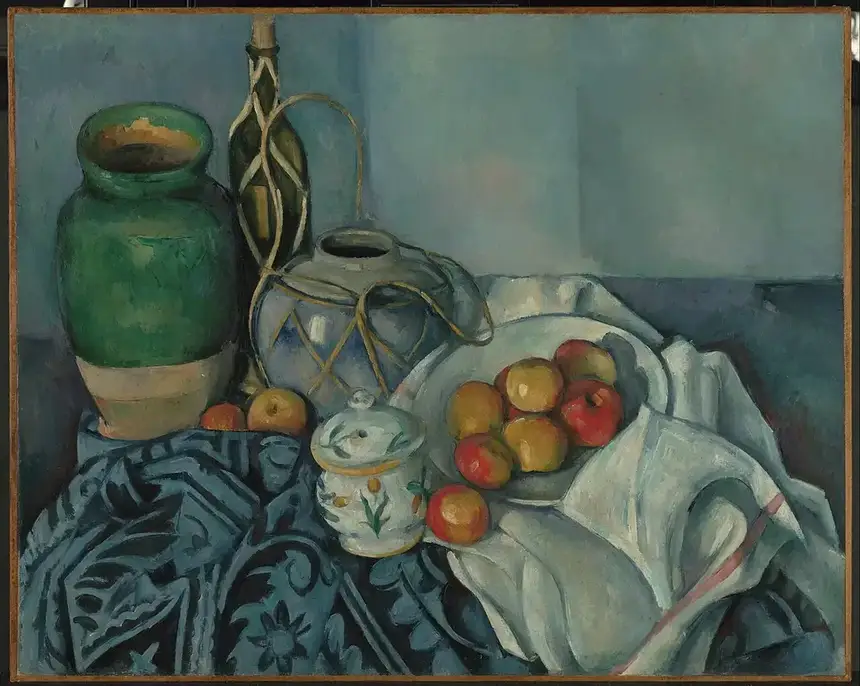
About Still Life with Apples
Paul Cézanne died in 1906, so the work has been in the public domain for decades. Reproducing it by hand is legal, and so is owning one.
Every version we make is oil on canvas, painted by one painter from start to finish. No printing is involved at any stage.
It is an original composition painted before 1906, and our version is painted from the surviving image of it.
You are buying a painting, not a file. That distinction is the whole business we are in.
How to read it
The difficulty in Still Life with Apples is restraint — knowing how much to leave out — and that is a painter's judgement, not a setting.
Our painter keeps the background thin and worked wet, so it stays behind the objects.
The darkest dark is kept warm, never black, which is what keeps the shadow transparent.
Every colour in Still Life with Apples has a warm version and a cool version, and the painter chooses between them passage by passage.
The brushwork is left visible, which is the whole argument for painting it by hand.
The risk with a still life is overworking, and the way to avoid it is knowing when to stop.
It suits a room with warm, low light. Strong downlighting flattens the surface.
| Artist | Paul Cézanne |
|---|---|
| Title | Still Life with Apples |
| Created (original) | 1893 |
| Medium | Oil on canvas, hand-painted to order |
| How it is made | Painted by hand in oil on canvas, to your size |
| Public domain | Yes — the artist died over 70 years ago |
The case for painting it by hand
The difference is not subtle when the two hang side by side. Ink sits on the surface; oil stands off it.
Where the original is loaded, ours is loaded. Where it is thin, ours is thin. Matching the weight of the paint matters more than matching the colour.
| Aspect | Hand-painted oil | Printed canvas |
|---|---|---|
| Colour | Mixed for each passage, warm and cool versions | One flat value per area |
| Time to make | Days of one painter's working time | Minutes |
| Impasto | Real paint standing off the canvas | Flat ink, sometimes embossed to imitate |
| Lifespan | Slow to change; varnish can be refreshed decades later | Fades and cracks sooner |
| Corrections | We adjust it and repaint the passage | The file is reprinted or it is not |
What takes time here is the number of separate decisions, not the size of the canvas.
Every canvas is painted to order, so the quote follows your size, frame and destination rather than a fixed list. Tell us what you need on WhatsApp and we reply with an exact figure, usually within the hour. You deal directly with the studio that paints it — no reseller layer.
From blank canvas to finished painting
Here is what actually happens between your message and the crate:
- Stretching and priming the support — cotton duck or linen goes onto the bars and gets its ground.
- Laying in the drawing — done by eye from the reference, not traced or projected.
- The first colour pass — thin and simple, establishing the main shapes only.
- Getting the values right — the stage that decides whether the finished painting holds together.
- The colour passes — each area gets its own mixture rather than one colour used throughout.
- Finishing passes — the loaded highlights go on at the end and stay there.
- It dries, then gets varnished — and only then is it photographed for you.
The hardest passage is the quiet one, where a small mistake has nowhere to hide.
Care and cleaning
Oil paint needs very little: no water, no cleaners, no sprays. A dry brush and a stable room.
Materials
Brushes, knives and rags. That is the equipment list; there is no machine in the process. We use cotton duck for most sizes and linen where the canvas is large or the client asks for it.
Nothing is sprayed, sealed or laminated. The surface you see is paint and varnish, and that is all. We do not use a printer at any stage. There is no giclée, no canvas transfer, no digital underlayer.
On framing
A frame is a separate line on the quote, not a bundle. You choose it once the painting exists.
Frames are priced once you have chosen them, not estimated in advance.
Getting the size right
Any size is possible. These are simply the ones that come up most often in quotes:
| Size (inches) | Size (cm) | Best for |
|---|---|---|
| 20 × 16 in | 50 × 40 cm | Bedroom, hallway, above a console |
| 16 × 12 in | 40 × 30 cm | A shelf, a small wall, a gallery group |
| 64 × 48 in | 163 × 122 cm | Villa scale, lobby, hospitality wall |
| 48 × 36 in | 122 × 91 cm | Large living room, stairwell, loft |
| 40 × 30 in | 102 × 76 cm | Living room focal wall, above a sofa |
Tell us the wall width and we will tell you what looks right rather than what is standard. DAP terms: we pay the freight, you settle any duty or tax your country applies. We do not collect taxes on anyone's behalf.
In a bedroom it works above a headboard, sized to about two-thirds of the furniture width.
Send the wall, the size and whether you want a frame, and we will quote.
💬 Get a Quote for Still Life with ApplesFrom order to your wall
Painting takes 9–15 days. Freight is quoted as its own line on the quote, agreed before you pay anything, and never added afterwards.
Expect 7–10 business days in transit, with tracking from our door to yours. Every shipment goes out with tracking. We do not send anything untracked.
You approve the painting from photographs before it is packed — that is the checkpoint. If something is not right, tell us what to adjust and we adjust it.
Shipments go out DAP. If your customs office charges duty or tax on arrival, that is between you and them — we do not collect it and we do not put a number on it.
You pay a deposit to start and the remainder before shipping. Nothing is hidden in between. Damage in transit should be reported to us within 48 hours, with photographs. We pursue it with the carrier rather than promising a refund.
Questions worth asking
Does changing the size change the composition?
No — we keep the original's proportions and scale from there, rather than cropping the image to fit a standard frame.
Is it really painted by hand?
Yes. We hand-paint from public-domain source images, do not sell prints, and never claim the original.
Can I resell the reproduction?
Yes. Because the underlying work is in the public domain, the hand-painted canvas is yours to sell, gift or install commercially.
Can you paint a different work by Paul Cézanne?
Yes. Send the image and we will quote it, or browse the other paintings we have listed.
Does it come framed?
Framing is quoted separately, so you can decide once you have seen the finished painting in photographs.
Will I see it before it ships?
Yes. We send photographs of the finished canvas and wait for your reply before packing.
Is owning a reproduction legal?
Yes. Paul Cézanne died more than 70 years ago, so the work is in the public domain and owning a hand-painted version is legal anywhere. We never pass ours off as the original.
Can you change the colours to suit my room?
Sometimes. We will adjust the palette if it can be done without ruining the picture, and say so if it cannot.
How long does it take?
From order to finished canvas is 9–15 days; delivery adds about 7–10 business days by air.
What is the canvas made of?
Cotton duck as standard, linen on request, artist-grade oil paint, and a final varnish once the paint is fully dry.
Who pays the import duty?
You do. We sell DAP, so any duty or tax your customs authority charges is settled by you at import. We do not collect it and we do not estimate it.
What does it cost?
There is no price list, because the number depends on your size and frame. Message us and we will quote exactly.