The original, and why we can paint it
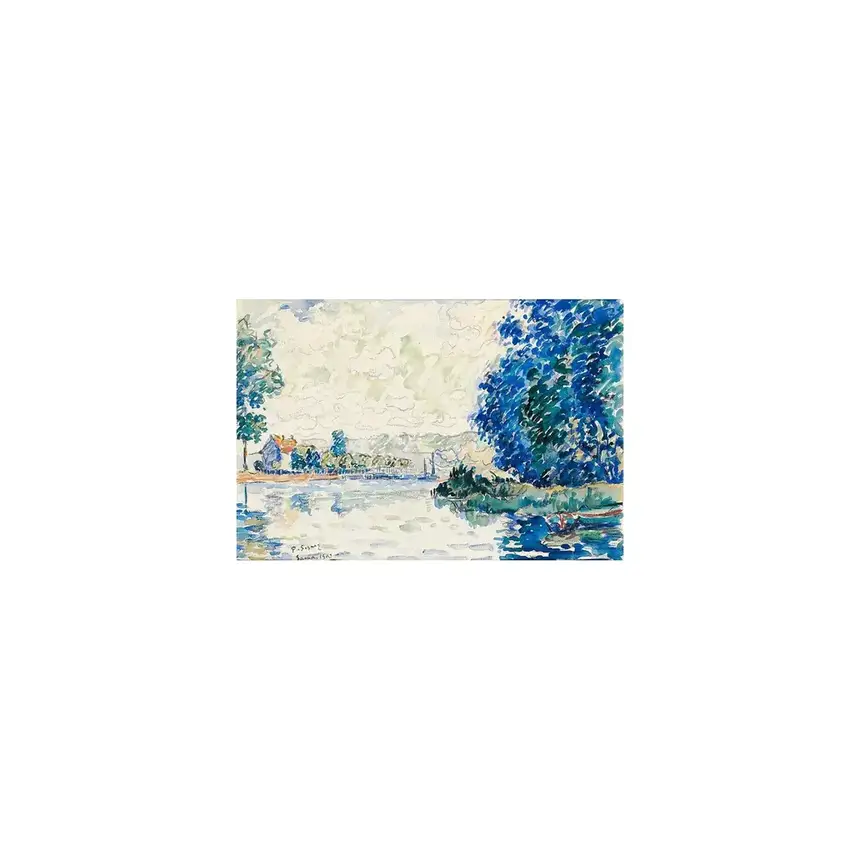
Because Paul Signac died in 1935, this work is in the public domain. We are painting a copy of a painting — we never pass it off as the original, and neither should anyone selling you one.
Every version we make is oil on canvas, painted by one painter from start to finish. No printing is involved at any stage.
The painting was made in the years before 1935, and what we reproduce is the record of it, not the object.
If you want something printed, we are the wrong workshop. We do not own a printer that touches canvas.
What the painting is doing
A painted a landscape is an argument about air. Copy the shapes and you still have not copied the argument.
Our painter blocks the big shapes first and lets the detail come last, so the composition holds at any size.
Light is handled as a value problem: how dark the darkest dark is determines the whole picture.
Our painter mixes on the palette but finishes on the canvas, which is where the small variations come from.
Paint is laid on, not pushed around. That is what keeps it fresh.
Matching the original's degree of finish is harder than matching its colours.
This reads well above a sofa or a sideboard, where it will be seen from two to three metres.
| Artist | Paul Signac |
|---|---|
| Title | EFFET DE CONTRE JOUR À SAMOIS, 1900, lot |
| Medium | Oil on canvas, hand-painted to order |
| Year | 1900 |
| What you receive | A hand-painted oil painting on canvas |
| Public domain | Yes — the artist died over 70 years ago |
Why this one cannot be printed
The difference is not subtle when the two hang side by side. Ink sits on the surface; oil stands off it.
Edges are left soft where the form turns away and sharp where it does not. That single habit is what separates a painting from a copy.
| Aspect | Hand-painted oil | Printed canvas |
|---|---|---|
| What it takes | One painter, several days, start to finish | A machine, a few minutes |
| Corrections | We adjust it and repaint the passage | The file is reprinted or it is not |
| Available sizes | Whatever you need, painted to order | What the printer can output |
| Colour | Mixed for each passage, warm and cool versions | One flat value per area |
| Edges | Chosen by the painter, passage by passage | Whatever the file happens to contain |
The passage that will take longest is the one that looks simplest.
Every canvas is painted to order, so the quote follows your size, frame and destination rather than a fixed list. Tell us what you need on WhatsApp and we reply with an exact figure, usually within the hour. No resellers, no drop-shipper. The painter's studio handles your commission from first message to final crate.
How it gets painted
Here is what actually happens between your message and the crate:
- The canvas is stretched and primed — cotton or linen, sized and ready before any paint goes near it.
- Laying in the drawing — done by eye from the reference, not traced or projected.
- The big shapes are blocked in — thin paint, one colour at a time, the whole canvas at once.
- Getting the values right — the stage that decides whether the finished painting holds together.
- Building the colour — a warm and a cool version of each passage, put down in order.
- Finishing passes — the loaded highlights go on at the end and stay there.
- Left to dry before varnish — nothing is photographed or packed until the surface is ready.
The difficulty is restraint: leaving out most of what a photograph would show.
Canvas, paint and varnish
The paint is built in layers, fat over lean, which is what stops it cracking later. Varnish goes on only once the paint is properly dry, months after the last stroke, not before.
The ground is a proper acrylic sizing, so the oil does not rot the fabric over time. We use cotton duck for most sizes and linen where the canvas is large or the client asks for it.
Whether to frame it
We can supply a simple floater frame, a traditional gilt, or nothing at all. It is your call.
Framing is quoted separately, so you can decide after you have seen the finished canvas in photographs.
Looking after it
Oil paint needs very little: no water, no cleaners, no sprays. A dry brush and a stable room.
What size works
Because each piece is painted from scratch, you are not limited to stock dimensions. These are the sizes clients ask for most:
| Size (inches) | Size (cm) | Best for |
|---|---|---|
| 48 × 36 in | 122 × 91 cm | Large living room, stairwell, loft |
| 40 × 30 in | 102 × 76 cm | Living room focal wall, above a sofa |
| 32 × 24 in | 81 × 61 cm | Living room, above a sideboard |
| 30 × 24 in | 76 × 61 cm | Dining room, bedroom feature wall |
| 24 × 20 in | 60 × 50 cm | Study, home office, above a desk |
Tell us the wall width and we will tell you what looks right rather than what is standard. We quote DAP, so any duty or tax your country charges is settled by you at import. We do not add a tax line of our own.
It wants a wall where the light rakes across it, because the surface is part of the picture.
Give us your size and framing preference and you will have a quote shortly.
💬 Get a Quote for EFFET DE CONTRE JOUR À SAMOIS, 1900, lotHow it reaches you
Allow 9–15 days for the painting itself. Shipping is a separate line on your quote — you see it before payment, not after.
Expect 7–10 business days in transit, with tracking from our door to yours. We send photographs of the finished painting before it is packed, and again once it is boxed.
Nothing ships before you have seen it. Photographs of the finished painting go to you first. Changes are handled by telling us what to change; we change it and send new photographs.
We sell DAP: the price covers the painting and the freight, and any import duties or taxes are the buyer's to settle with customs. We do not collect them and we do not estimate them.
You pay a deposit to start and the remainder before shipping. Nothing is hidden in between. If a crate arrives damaged, send us photographs within 48 hours and contact us directly — we will sort it out with you.
What people ask us
How do I clean and care for it?
Dust lightly with a dry, soft brush and keep it out of direct sun. Nothing else is needed for decades; oil paint is slow to change and easy to live with.
What size should I order?
You choose the size. Each canvas is cut to your measurements rather than pulled from stock, so tell us the wall dimensions and we will tell you what proportion works.
Is it legal to own a reproduction?
Yes. The painting is in the public domain, so reproducing it is legal and owning one is legal anywhere in the world. We never pass ours off as the original.
Do you sell prints?
No prints at all — no giclée, no canvas transfer, nothing machine-made.
What is the canvas made of?
Cotton duck as standard, linen on request, artist-grade oil paint, and a final varnish once the paint is fully dry.
Can I change the size?
Any size you like. We paint to the number you give us rather than to a standard range.
Is it really painted by hand?
Yes. One painter, oil paint, brushes. We do not own a printer that touches canvas.
Can you paint a different work by Paul Signac?
Yes — send us the image, or look through the other Paul Signac works on the site.
What does it cost?
Every canvas is quoted on size, frame and destination rather than a fixed list. Tell us what you need and we reply with an exact figure.
Does it come framed?
Framing is quoted separately, so you can decide once you have seen the finished painting in photographs.
Do you ship to my country?
We ship to over 20 countries. Give us your city and the freight appears as its own line on the quote.
What if it arrives damaged?
send us photographs within 48 hours and contact us directly — we will sort it out with you.