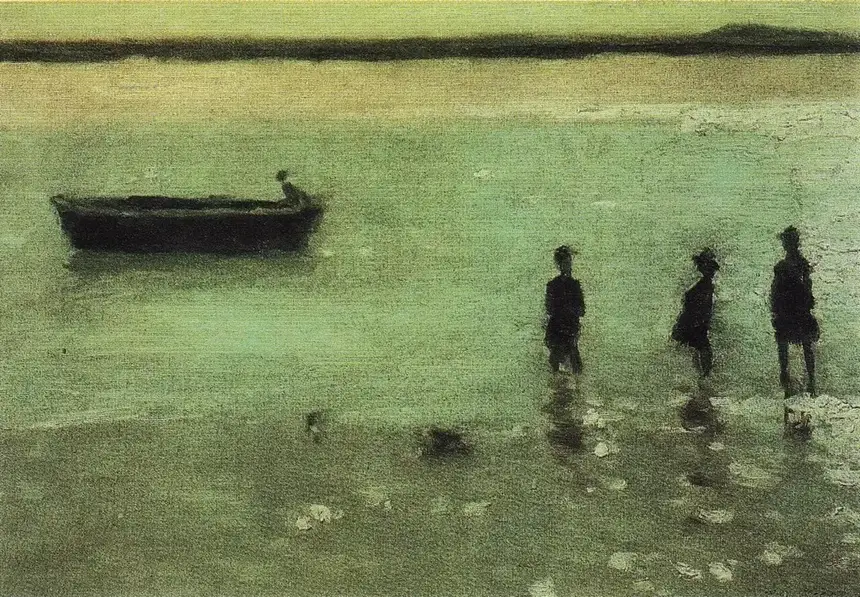
What you are buying into
Philip Wilson Steer died in 1942. That puts the painting well outside copyright, which is why we can paint it and you can own it anywhere in the world.
Ours is a painting made with brushes. There is no giclée, no canvas transfer and no digital underlayer anywhere in the process.
It is an original composition painted before 1942, and our version is painted from the surviving image of it.
You are buying a painting, not a file. That distinction is the whole business we are in.
What to look at
The reason Beach at etaples still works as a painting is that it was built as paint, not as a picture of a place.
Where the original has an awkward crop, we keep it. Correcting it would be painting a different picture.
The light in Beach at etaples has a direction, and the painter keeps it consistent across every object in the picture.
Colour here is mixed for the passage, not for the object, which is why nothing looks like it was filled in.
The last marks are the ones that are left alone. Overworking is the enemy.
This one repaints badly, so our painter gets the values right early and leaves them.
It is a picture for a room you use, not a corridor you walk through.
| Artist | Philip Wilson Steer |
|---|---|
| Title | Beach at etaples |
| Created (original) | 1887 |
| Medium | Oil on canvas, hand-painted to order |
| What you receive | A hand-painted oil painting on canvas |
| Copyright | Public domain; the original is out of copyright |
Why this one cannot be printed
The difference is not subtle when the two hang side by side. Ink sits on the surface; oil stands off it.
Where the original is loaded, ours is loaded. Where it is thin, ours is thin. Matching the weight of the paint matters more than matching the colour.
| Aspect | Hand-painted oil | Printed canvas |
|---|---|---|
| What it takes | One painter, several days, start to finish | A machine, a few minutes |
| Depth | Built in layers, catches light from the side | Flat; highlights are printed as pale ink |
| Edge quality | Soft where the form turns, sharp where it does not | Uniformly sharp or uniformly blurred |
| Available sizes | Whatever you need, painted to order | What the printer can output |
| How it ages | Warms and settles; cleanable by a conservator | Fades, then cracks at the stretcher |
The difficulty is restraint: leaving out most of what a photograph would show.
Every canvas is painted to order, so the quote follows your size, frame and destination rather than a fixed list. Tell us what you need on WhatsApp and we reply with an exact figure, usually within the hour. You deal directly with the studio that paints it — no reseller layer.
The sequence on our floor
Every canvas is painted to order, so nothing is pulled off a shelf. This is the sequence:
- We start with the canvas itself — stretched, sized and left to settle before any colour is mixed.
- A loose underdrawing — proportions checked by eye against the source image.
- The big shapes are blocked in — thin paint, one colour at a time, the whole canvas at once.
- The values are established — this is the stage that decides whether the painting works.
- Building the colour — a warm and a cool version of each passage, put down in order.
- The detail and highlights go on — last, loaded, and left alone once they are down.
- It dries, then gets varnished — and only then is it photographed for you.
Matching the original's degree of finish is harder than matching its colours.
Looking after it
Do not wipe it with anything wet. Dust lightly, hang it somewhere stable, and forget about it.
On framing
Framing is quoted separately, so you can decide after you have seen the finished canvas in photographs.
Most clients wait for the photographs before choosing a frame, which is the sensible order.
Canvas, paint and varnish
We use a neutral-sized ground so the whites stay warm rather than going blue over time. We do not use a printer at any stage. There is no giclée, no canvas transfer, no digital underlayer.
Each painter works on one canvas at a time — the painting you ordered is not shared with another order. The paint is built in layers, fat over lean, which is what stops it cracking later.
What size works
Because each piece is painted from scratch, you are not limited to stock dimensions. These are the sizes clients ask for most:
| Size (inches) | Size (cm) | Best for |
|---|---|---|
| 48 × 36 in | 122 × 91 cm | Large living room, stairwell, loft |
| 40 × 30 in | 102 × 76 cm | Living room focal wall, above a sofa |
| 32 × 24 in | 81 × 61 cm | Living room, above a sideboard |
| 30 × 24 in | 76 × 61 cm | Dining room, bedroom feature wall |
| 24 × 20 in | 60 × 50 cm | Study, home office, above a desk |
| 20 × 16 in | 50 × 40 cm | Bedroom, hallway, above a console |
If your wall is an odd shape, send the measurement and we will work to it. Proportions from the original are kept unless you ask us to change them. We quote DAP, so any duty or tax your country charges is settled by you at import. We do not add a tax line of our own.
It suits a room with warm, low light. Strong downlighting flattens the surface.
Send the wall, the size and whether you want a frame, and we will quote.
💬 Get a Quote for Beach at etaplesHow it reaches you
From order to finished canvas is 9–15 days. Freight appears as a separate line on the quote and is fixed before you pay.
In transit it is typically 7–10 business days by air, tracked door to door. Every shipment goes out with tracking. We do not send anything untracked.
Nothing ships before you have seen it. Photographs of the finished painting go to you first. Adjustments are part of the process. Say what you want different and it gets done.
Duties and import taxes are the buyer's account (DAP). Your customs authority sets them; we do not.
You pay a deposit to start and the remainder before shipping. Nothing is hidden in between. Report any transit damage within 48 hours with photographs and we will deal with the carrier. We will not promise a payout, but we will not leave you to argue alone either.
Questions worth asking
When will it actually arrive?
Studio time is 9–15 days, then a few more days for the oil to set before we can photograph and pack it. We tell you where your canvas is at each stage.
What size should I order?
You choose the size. Each canvas is cut to your measurements rather than pulled from stock, so tell us the wall dimensions and we will tell you what proportion works.
Is owning a reproduction legal?
Yes. The painting is out of copyright because Philip Wilson Steer died more than 70 years ago. We paint copies honestly and never claim they are originals.
Does it come framed?
Frames are priced on their own line. Most clients choose after seeing the photographs.
Do you take a deposit?
A deposit starts the canvas and the balance falls due before it ships. Both figures appear on the quote.
What does it cost?
Every canvas is quoted on size, frame and destination rather than a fixed list. Tell us what you need and we reply with an exact figure.
Do you sell prints?
No prints at all — no giclée, no canvas transfer, nothing machine-made.
Can you paint a different work by Philip Wilson Steer?
Yes — send us the image, or look through the other Philip Wilson Steer works on the site.
What is the canvas made of?
Cotton or linen, oil colour, and varnish. Stretcher bars are wedged so the canvas can be re-tensioned later.
Do you ship to my country?
We ship to over 20 countries. Give us your city and the freight appears as its own line on the quote.
How long does it take?
Painting takes 9–15 days. Air freight is usually 7–10 business days on top of that, tracked.