About the original
Pierre Puvis de Chavannes died in 1898. That puts the painting well outside copyright, which is why we can paint it and you can own it anywhere in the world.
Ours is a painting made with brushes. There is no giclée, no canvas transfer and no digital underlayer anywhere in the process.
The painting was made in the years before 1898, and what we reproduce is the record of it, not the object.
What arrives is a canvas with paint on it, made by a person. That is the only thing we sell.
What to look at
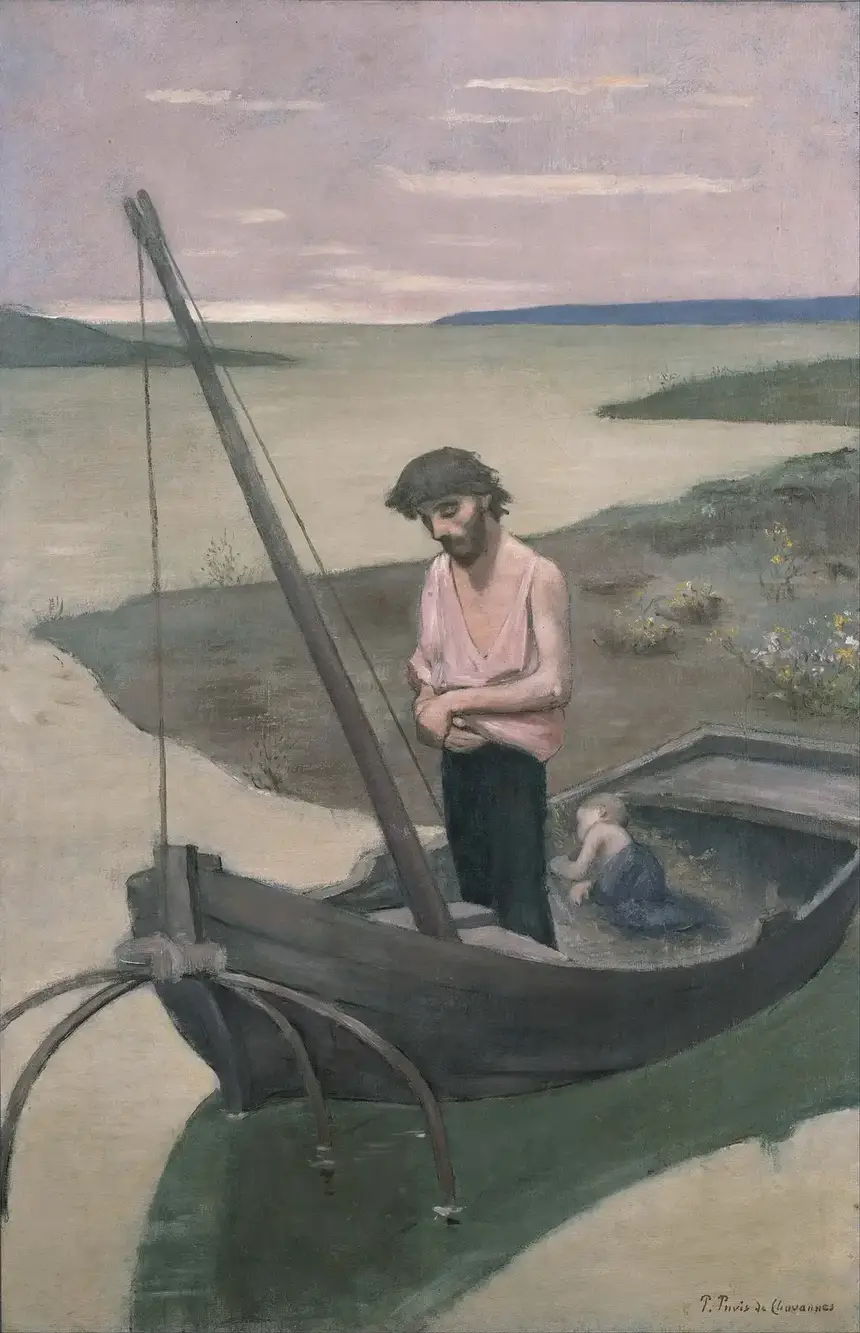
Painted by hand, the drapery in Poor Fisherman stays fabric rather than becoming a coloured shape.
Value does the modelling: the figure separates from the ground because it is lighter or darker, not because it is outlined.
Our painter keeps the half-tones wide, which is what makes the body look round.
The darks are mixed, not blackened — black straight from the tube would kill the passage.
Where the source has a loaded passage, ours is loaded too — you will feel it from the side.
This one repaints badly, so our painter gets the values right early and leaves them.
This reads well above a sofa or a sideboard, where it will be seen from two to three metres.
| Artist | Pierre Puvis de Chavannes |
|---|---|
| Title | Poor Fisherman |
| Medium | Oil on canvas, hand-painted to order |
| Our version | Oil on canvas, painted by hand to order |
| Original status | Public domain (artist deceased) |
The case for painting it by hand
Prints are good at information and bad at paint. This subject is mostly paint.
Edges are left soft where the form turns away and sharp where it does not. That single habit is what separates a painting from a copy.
| Aspect | Hand-painted oil | Printed canvas |
|---|---|---|
| Changing something | Tell us and the passage gets repainted | Usually means starting the file again |
| Lifespan | Slow to change; varnish can be refreshed decades later | Fades and cracks sooner |
| Texture | Ridges and drag you can see from across a room | None, or a printed imitation of it |
| Surface | Hand-painted oil on canvas | Ink on canvas, flat |
| Later on | Can be restored, re-framed, handed on | Replaceable, and usually replaced |
The difficulty is restraint: leaving out most of what a photograph would show.
Every canvas is painted to order, so the quote follows your size, frame and destination rather than a fixed list. Tell us what you need on WhatsApp and we reply with an exact figure, usually within the hour. You deal directly with the studio that paints it — no reseller layer.
The sequence on our floor
No two canvases are painted the same way, but the sequence is always this:
- Stretching and priming the support — cotton duck or linen goes onto the bars and gets its ground.
- The drawing goes down — charcoal or thin paint, done by eye rather than traced from a printout.
- Blocking the masses — thin paint, working the whole surface rather than one corner at a time.
- Getting the values right — the stage that decides whether the finished painting holds together.
- Building the colour — a warm and a cool version of each passage, put down in order.
- Finishing passes — the loaded highlights go on at the end and stay there.
- It dries, then gets varnished — and only then is it photographed for you.
The passage that will take longest is the one that looks simplest.
Canvas, paint and varnish
Each painter works on one canvas at a time — the painting you ordered is not shared with another order. Stretcher bars are kiln-dried and wedged, so the canvas can be re-tensioned years later.
We buy pigment in tubes from the same suppliers the village has used for years, not in bulk drums. Large canvases get a cross-brace; anything over about a metre and a half needs one.
Frames
We can supply a simple floater frame, a traditional gilt, or nothing at all. It is your call.
A frame is a separate line on the quote, not a bundle. You choose it once the painting exists.
Living with it
Oil paint needs very little: no water, no cleaners, no sprays. A dry brush and a stable room.
What size works
Any size is possible. These are simply the ones that come up most often in quotes:
| Size (inches) | Size (cm) | Best for |
|---|---|---|
| 32 × 24 in | 81 × 61 cm | Living room, above a sideboard |
| 30 × 24 in | 76 × 61 cm | Dining room, bedroom feature wall |
| 24 × 20 in | 60 × 50 cm | Study, home office, above a desk |
| 20 × 16 in | 50 × 40 cm | Bedroom, hallway, above a console |
Anything outside this table is fine — we paint to the number you give us. We sell DAP: the price covers the painting and the freight, and any import duties or taxes are the buyer's to settle with customs. We do not collect them and we do not estimate them.
Given the subject, this sits naturally in a living room or a study rather than a hallway.
Send the wall, the size and whether you want a frame, and we will quote.
💬 Get a Quote for Poor FishermanGetting it to you
The painting takes 9–15 days, and delivery is priced separately on the quote so there is no surprise later.
Expect 7–10 business days in transit, with tracking from our door to yours. Rolled in a tube it travels cheaper and safer than framed; most overseas clients take it that way.
Before anything is packed, you get photographs of the actual canvas and a chance to ask for changes. Adjustments are part of the process. Say what you want different and it gets done.
DAP terms: we pay the freight, you settle any duty or tax your country applies. We do not collect taxes on anyone's behalf.
A deposit starts the canvas and books the painter's time; the balance is due before the crate leaves. Report any transit damage within 48 hours with photographs and we will deal with the carrier. We will not promise a payout, but we will not leave you to argue alone either.
Questions worth asking
How do I know what size will look right?
Measure the wall and send a photograph. We will say honestly if the canvas you have in mind is too small for the space, which is the most common mistake.
Is there a rush option?
It depends on the canvas and what else is in the studio. Ask on WhatsApp with your size and we will tell you straight what is possible.
What about duties and import taxes?
Those are the buyer's responsibility (DAP). The amounts are set by your customs authority, not by us.
How long does it take?
Allow 9–15 days for the painting itself, then roughly 7–10 business days in transit.
Do you ship to my country?
We export to more than 20 countries. Tell us where you are and we will quote the freight as a separate line.
Can you paint it from a different photograph of the same work?
Yes. If you have a better reference, send it on WhatsApp and we will work from yours.
What does it cost?
There is no price list, because the number depends on your size and frame. Message us and we will quote exactly.
Who pays the import duty?
You do. We sell DAP, so any duty or tax your customs authority charges is settled by you at import. We do not collect it and we do not estimate it.
Is it really painted by hand?
Yes. One painter, oil paint, brushes. We do not own a printer that touches canvas.
Can you paint a different work by Pierre Puvis de Chavannes?
Yes — send us the image, or look through the other Pierre Puvis de Chavannes works on the site.
Do you take a deposit?
A deposit starts the canvas and the balance falls due before it ships. Both figures appear on the quote.
Does it come framed?
Frames are priced on their own line. Most clients choose after seeing the photographs.