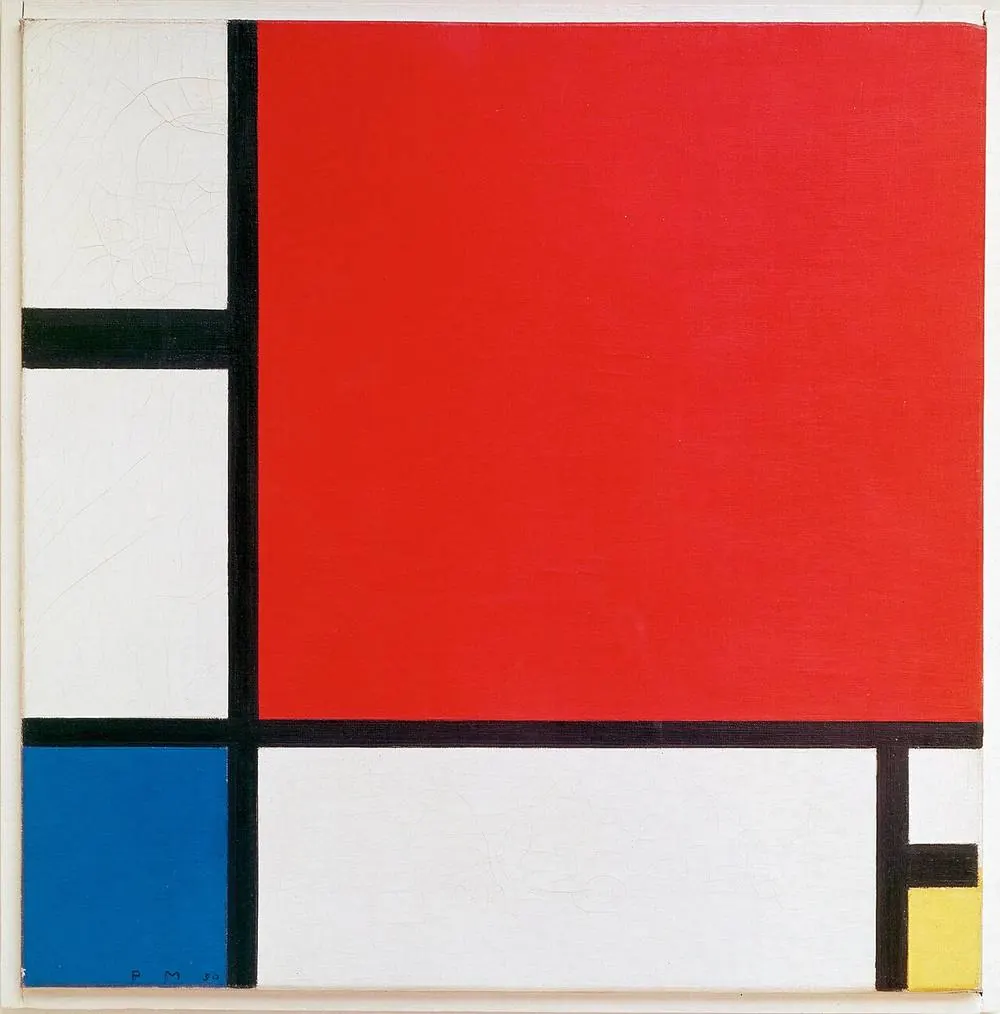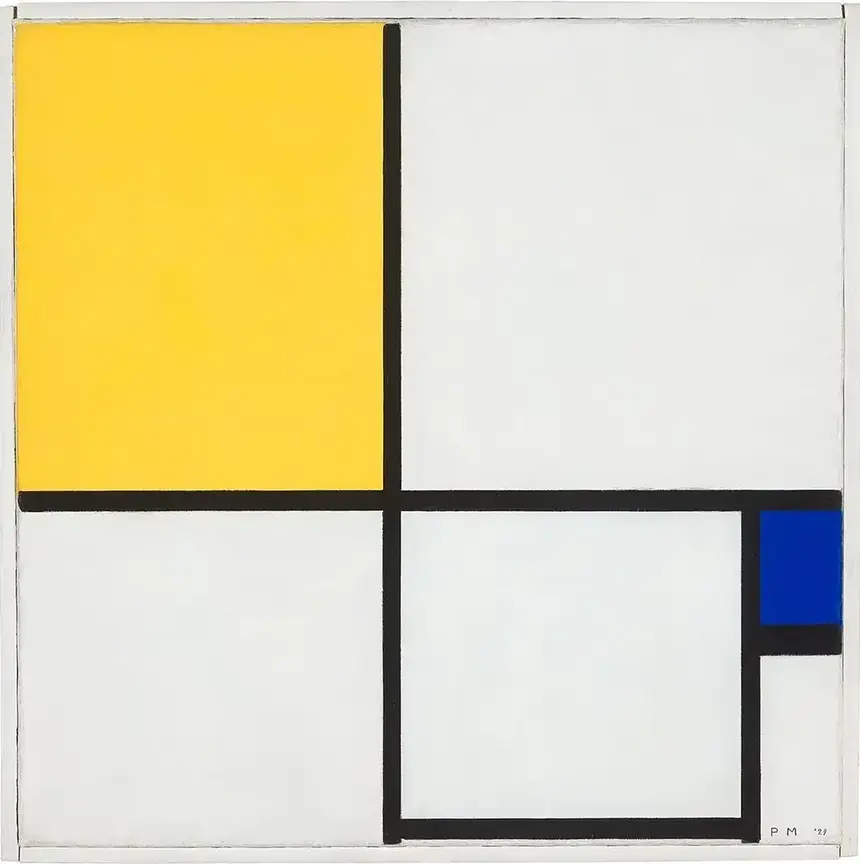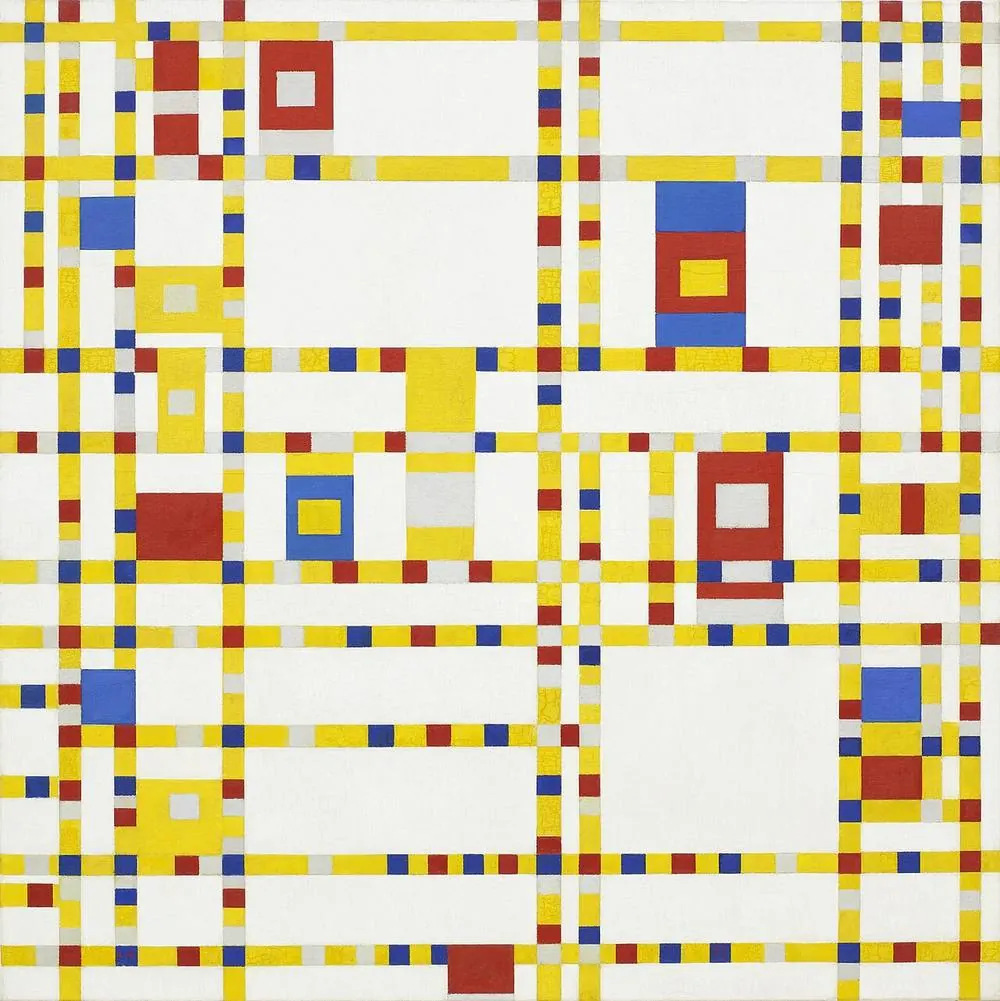
Where this painting comes from
Piet Mondrian died in 1944, so the work has been in the public domain for decades. Reproducing it by hand is legal, and so is owning one.
Ours is a painting made with brushes. There is no giclée, no canvas transfer and no digital underlayer anywhere in the process.
The painting was made in the years before 1944, and what we reproduce is the record of it, not the object.
If you want something printed, we are the wrong workshop. We do not own a printer that touches canvas.
What to look at
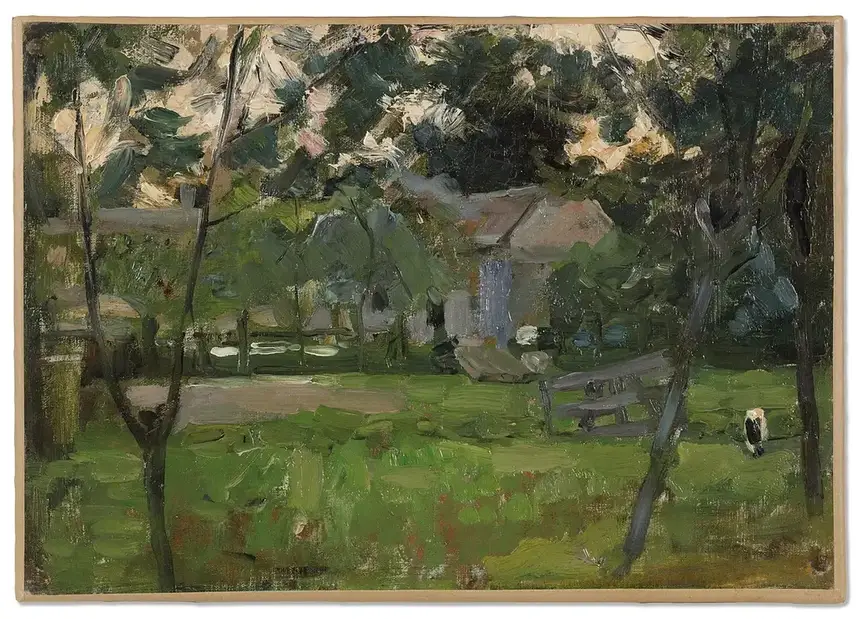
There is a reason a landscape is the hardest thing to print and the easiest thing to paint: the paint itself carries the depth.
Nothing in Boerenerf in het Gooi is centred for the sake of being centred; the weight sits where the painter wanted it.
The sky sets the light for everything below it, so it is painted first.
Whites here are never white. They are warm or cool depending on the light, and that is what makes them read.
The last marks are the ones that are left alone. Overworking is the enemy.
Anyone can copy the shapes. The skill is in the transitions, and that is what takes the days.
It wants a wall where the light rakes across it, because the surface is part of the picture.
| Artist | Piet Mondrian |
|---|---|
| Title | Boerenerf in het Gooi |
| Medium | Oil on canvas, hand-painted to order |
| How it is made | Painted by hand in oil on canvas, to your size |
| Public domain | Yes — the artist died over 70 years ago |
Hand-painted, not printed
The difference is not subtle when the two hang side by side. Ink sits on the surface; oil stands off it.
Our painter follows the same logic rather than copying a photograph of it: the far distances go down cool and weak, the near ground stays loaded, and nothing is blended flat.
| Aspect | Hand-painted oil | Printed canvas |
|---|---|---|
| Sense of depth | Real, created by layers of paint | Simulated by darker ink |
| Changing something | Tell us and the passage gets repainted | Usually means starting the file again |
| Lifespan | Slow to change; varnish can be refreshed decades later | Fades and cracks sooner |
| Edge quality | Soft where the form turns, sharp where it does not | Uniformly sharp or uniformly blurred |
| The surface | Built up with brushes and knives | Printed flat in one pass |
The passage that will take longest is the one that looks simplest.
Every canvas is painted to order, so the quote follows your size, frame and destination rather than a fixed list. Tell us what you need on WhatsApp and we reply with an exact figure, usually within the hour. No resellers, no drop-shipper. The painter's studio handles your commission from first message to final crate.
How it gets painted
Here is what actually happens between your message and the crate:
- Stretching and priming the support — cotton duck or linen goes onto the bars and gets its ground.
- A loose underdrawing — proportions checked by eye against the source image.
- Blocking the masses — thin paint, working the whole surface rather than one corner at a time.
- Getting the values right — the stage that decides whether the finished painting holds together.
- The colour passes — each area gets its own mixture rather than one colour used throughout.
- Finishing passes — the loaded highlights go on at the end and stay there.
- Drying and varnishing — the final varnish goes on once the paint has set, before we photograph it.
The risk with a landscape is overworking, and the way to avoid it is knowing when to stop.
Living with it
Oil paint needs very little: no water, no cleaners, no sprays. A dry brush and a stable room.
Framing
Framing is quoted separately, so you can decide after you have seen the finished canvas in photographs.
We can supply a simple floater frame, a traditional gilt, or nothing at all. It is your call.
What it is made of
We buy pigment in tubes from the same suppliers the village has used for years, not in bulk drums. Nothing is sprayed, sealed or laminated. The surface you see is paint and varnish, and that is all.
We use cotton duck for most sizes and linen where the canvas is large or the client asks for it. The paint is built in layers, fat over lean, which is what stops it cracking later.
Canvas sizes
Any size is possible. These are simply the ones that come up most often in quotes:
| Size (inches) | Size (cm) | Best for |
|---|---|---|
| 20 × 16 in | 50 × 40 cm | Bedroom, hallway, above a console |
| 16 × 12 in | 40 × 30 cm | A shelf, a small wall, a gallery group |
| 64 × 48 in | 163 × 122 cm | Villa scale, lobby, hospitality wall |
| 48 × 36 in | 122 × 91 cm | Large living room, stairwell, loft |
| 40 × 30 in | 102 × 76 cm | Living room focal wall, above a sofa |
Anything outside this table is fine — we paint to the number you give us. DAP terms: we pay the freight, you settle any duty or tax your country applies. We do not collect taxes on anyone's behalf.
For a stairwell or a double-height space, go larger than you think — the composition was built for distance.
Give us your size and framing preference and you will have a quote shortly.
💬 Get a Quote for Boerenerf in het Gooi geflankeerd door jonge boompjesGetting it to you
From order to finished canvas is 9–15 days. Freight appears as a separate line on the quote and is fixed before you pay.
Transit is usually 7–10 business days, tracked all the way. Unframed canvases are rolled face-out on a tube; framed ones are corner-protected and crated.
Nothing ships before you have seen it. Photographs of the finished painting go to you first. Adjustments are part of the process. Say what you want different and it gets done.
Import charges, where they exist, are the buyer's responsibility (DAP). We never add them to the quote and never guess what they will be.
A deposit starts the canvas and books the painter's time; the balance is due before the crate leaves. Report any transit damage within 48 hours with photographs and we will deal with the carrier. We will not promise a payout, but we will not leave you to argue alone either.
Before you order
Does changing the size change the composition?
No — we keep the original's proportions and scale from there, rather than cropping the image to fit a standard frame.
Can I resell the reproduction?
Yes. Because the underlying work is in the public domain, the hand-painted canvas is yours to sell, gift or install commercially.
Will it look exactly like the image?
Not exactly, and that is the point — it is a painting, not a scan. Composition, colour and drawing follow the original closely; the surface is where a painter's own decisions show.
What does it cost?
Every canvas is quoted on size, frame and destination rather than a fixed list. Tell us what you need and we reply with an exact figure.
Is it really painted by hand?
Yes — oil on canvas, brush and knife. There is no printing, no giclée and no canvas transfer at any stage.
Do you ship to my country?
We ship to over 20 countries. Give us your city and the freight appears as its own line on the quote.
Do you take a deposit?
A deposit starts the canvas and the balance falls due before it ships. Both figures appear on the quote.
Who pays the import duty?
The buyer does. Terms are DAP: duties and taxes, where they apply, are paid on arrival. We never add a tax line of our own.
What is the canvas made of?
Cotton duck as standard, linen on request, artist-grade oil paint, and a final varnish once the paint is fully dry.
How do I hang it?
Centre it at about 145 cm from the floor, or two-thirds the width of the furniture below it. We will tell you the exact number for your wall.
Can you change the colours to suit my room?
We can shift the palette, but we will tell you honestly when a change would spoil the painting.
Can you paint a different work by Piet Mondrian?
Yes. Send the image and we will quote it, or browse the other paintings we have listed.