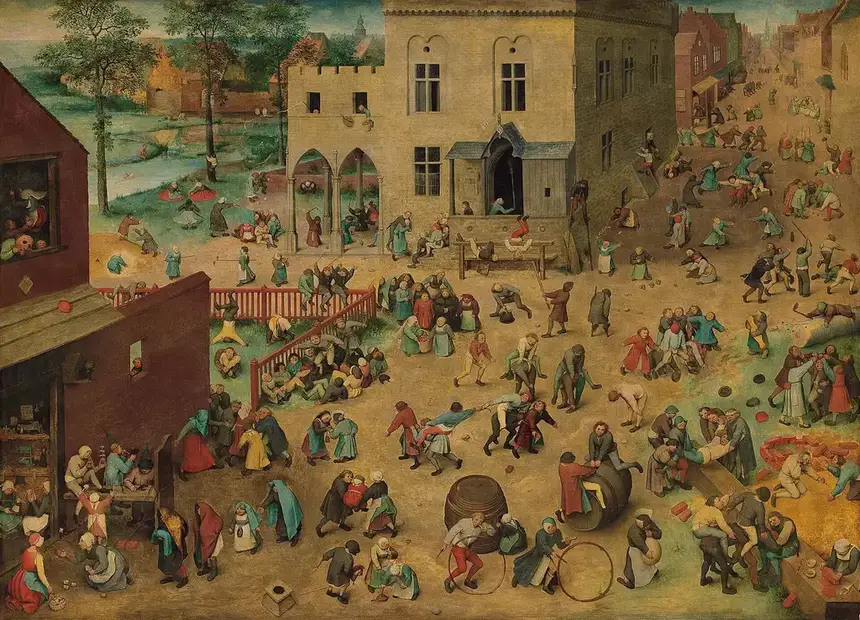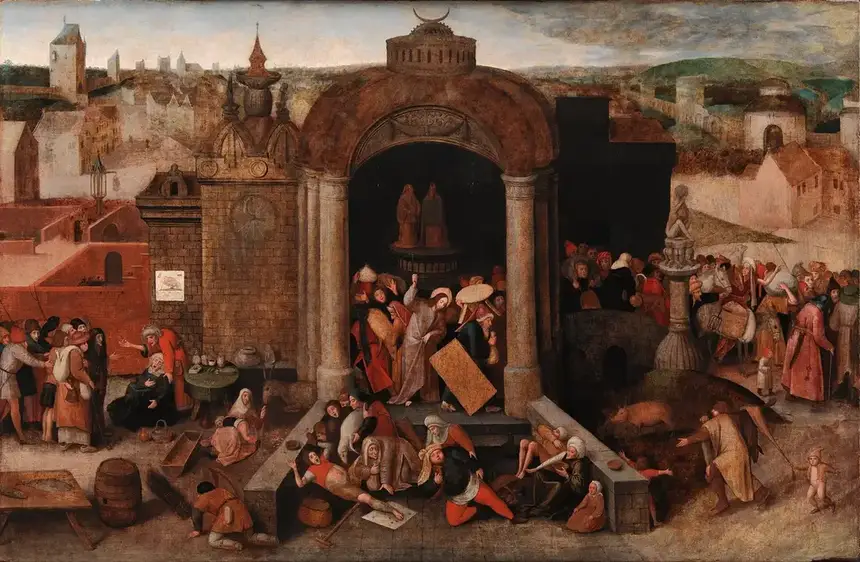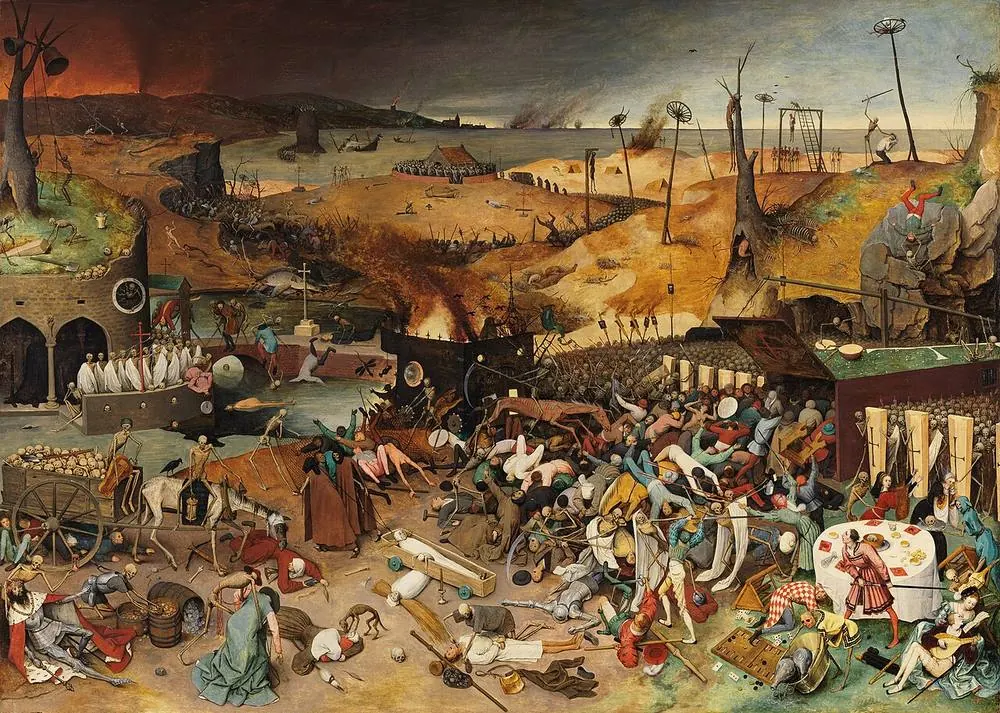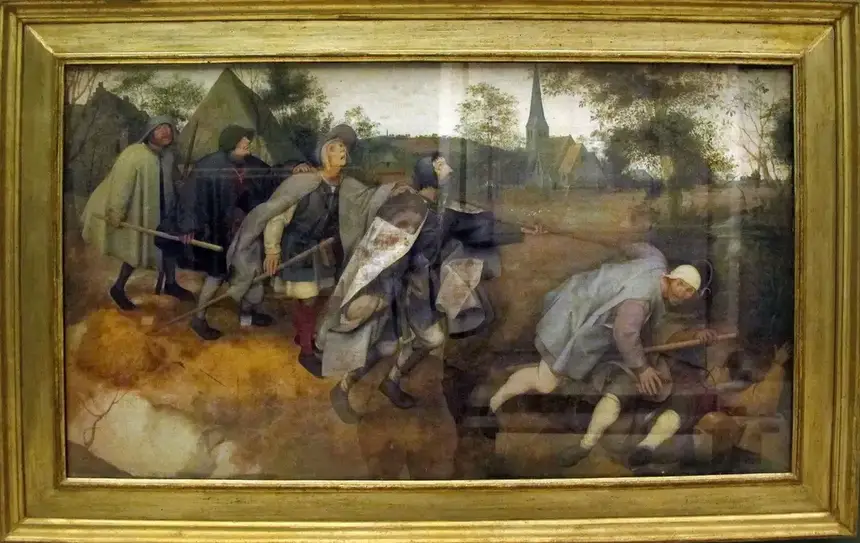
Where this painting comes from
Because Pieter Bruegel the Elder died in 1569, this work is in the public domain. We are painting a copy of a painting — we never pass it off as the original, and neither should anyone selling you one.
Ours is a painting made with brushes. There is no giclée, no canvas transfer and no digital underlayer anywhere in the process.
The painting was made in the years before 1569, and what we reproduce is the record of it, not the object.
If you want something printed, we are the wrong workshop. We do not own a printer that touches canvas.
What to look at
Bruegel il vecchio, parabola is not a postcard. There is a decision in every zone of the canvas, and the decision is visible.
Nothing in Bruegel il vecchio, parabola is centred for the sake of being centred; the weight sits where the painter wanted it.
We do not brighten the picture for reproduction. The original's key is kept as it is.
Our painter mixes on the palette but finishes on the canvas, which is where the small variations come from.
Our painter uses a larger brush than you would expect, which is why the passages stay simple.
What takes time here is the number of separate decisions, not the size of the canvas.
Given the subject, this sits naturally in a living room or a study rather than a hallway.
| Artist | Pieter Bruegel the Elder |
|---|---|
| Title | Bruegel il vecchio, parabola |
| Created (original) | 2013 |
| Medium | Oil on canvas, hand-painted to order |
| Year | 1568 |
| Reproduction | Hand-painted oil on canvas, made to order |
| Copyright | Public domain; the original is out of copyright |
The case for painting it by hand
The difference is not subtle when the two hang side by side. Ink sits on the surface; oil stands off it.
Our painter follows the same logic rather than copying a photograph of it: the far distances go down cool and weak, the near ground stays loaded, and nothing is blended flat.
| Aspect | Hand-painted oil | Printed canvas |
|---|---|---|
| Later on | Can be restored, re-framed, handed on | Replaceable, and usually replaced |
| Sense of depth | Real, created by layers of paint | Simulated by darker ink |
| Impasto | Real paint standing off the canvas | Flat ink, sometimes embossed to imitate |
| What it takes | One painter, several days, start to finish | A machine, a few minutes |
| How it ages | Warms and settles; cleanable by a conservator | Fades, then cracks at the stretcher |
The difficult part is not the detail. It is keeping the whole canvas at the same stage of finish.
Every canvas is painted to order, so the quote follows your size, frame and destination rather than a fixed list. Tell us what you need on WhatsApp and we reply with an exact figure, usually within the hour. No resellers, no drop-shipper. The painter's studio handles your commission from first message to final crate.
The sequence on our floor
Every canvas is painted to order, so nothing is pulled off a shelf. This is the sequence:
- We start with the canvas itself — stretched, sized and left to settle before any colour is mixed.
- Laying in the drawing — done by eye from the reference, not traced or projected.
- The big shapes are blocked in — thin paint, one colour at a time, the whole canvas at once.
- Getting the values right — the stage that decides whether the finished painting holds together.
- Building the colour — a warm and a cool version of each passage, put down in order.
- Detail and highlights last — put on thickly and then not touched again.
- Left to dry before varnish — nothing is photographed or packed until the surface is ready.
The difficulty is restraint: leaving out most of what a photograph would show.
Materials
Stretcher bars are kiln-dried and wedged, so the canvas can be re-tensioned years later. Each painter works on one canvas at a time — the painting you ordered is not shared with another order.
The ground is a proper acrylic sizing, so the oil does not rot the fabric over time. Pigment is artist-grade oil colour, not acrylic and not house paint. It behaves differently and it lasts.
Looking after it
Dust it with a dry, soft brush. Keep it out of direct sun and away from radiators, and it will outlive you.
On framing
If you are shipping, an unframed canvas rolled in a tube is considerably cheaper to move than a framed one.
A frame is a separate line on the quote, not a bundle. You choose it once the painting exists.
What size works
Because each piece is painted from scratch, you are not limited to stock dimensions. These are the sizes clients ask for most:
| Size (inches) | Size (cm) | Best for |
|---|---|---|
| 64 × 48 in | 163 × 122 cm | Villa scale, lobby, hospitality wall |
| 48 × 36 in | 122 × 91 cm | Large living room, stairwell, loft |
| 40 × 30 in | 102 × 76 cm | Living room focal wall, above a sofa |
| 32 × 24 in | 81 × 61 cm | Living room, above a sideboard |
| 30 × 24 in | 76 × 61 cm | Dining room, bedroom feature wall |
| 24 × 20 in | 60 × 50 cm | Study, home office, above a desk |
If your wall is an odd shape, send the measurement and we will work to it. Proportions from the original are kept unless you ask us to change them. We sell DAP: the price covers the painting and the freight, and any import duties or taxes are the buyer's to settle with customs. We do not collect them and we do not estimate them.
It is a picture for a room you use, not a corridor you walk through.
Give us your size and framing preference and you will have a quote shortly.
💬 Get a Quote for Bruegel il vecchio, parabola dei ciechi, 1568, Q1, 01From order to your wall
Allow 9–15 days for the painting itself. Shipping is a separate line on your quote — you see it before payment, not after.
Expect 7–10 business days in transit, with tracking from our door to yours. We send photographs of the finished painting before it is packed, and again once it is boxed.
You see photographs of the finished painting before it ships, and you tell us what to adjust. Changes are handled by telling us what to change; we change it and send new photographs.
Shipments go out DAP. If your customs office charges duty or tax on arrival, that is between you and them — we do not collect it and we do not put a number on it.
A deposit starts the canvas and books the painter's time; the balance is due before the crate leaves. If a crate arrives damaged, send us photographs within 48 hours and contact us directly — we will sort it out with you.
Questions worth asking
Why not just print it?
A print flattens the surface into a poster: the distance collapses and the highlights turn to grey. Paint keeps the depth and the texture the original was built from.
When will it actually arrive?
Studio time is 9–15 days, then a few more days for the oil to set before we can photograph and pack it. We tell you where your canvas is at each stage.
What happens after I message you?
You tell us the painting, size and whether you want a frame. We quote, a painter starts on your canvas, and you get photographs before it ships.
Do you sell prints?
No prints at all — no giclée, no canvas transfer, nothing machine-made.
How do I hang it?
Roughly 145 cm from floor to centre works for most rooms. Tell us your wall and we will give you the measurement.
Is it really painted by hand?
Yes. One painter, oil paint, brushes. We do not own a printer that touches canvas.
How long does it take?
From order to finished canvas is 9–15 days; delivery adds about 7–10 business days by air.
Do you ship to my country?
We ship to over 20 countries. Give us your city and the freight appears as its own line on the quote.
What if it arrives damaged?
send us photographs within 48 hours and contact us directly — we will sort it out with you.
Does it come framed?
Frames are priced on their own line. Most clients choose after seeing the photographs.
Do you take a deposit?
A deposit starts the canvas and the balance falls due before it ships. Both figures appear on the quote.
Can I change the size?
Any size you like. We paint to the number you give us rather than to a standard range.