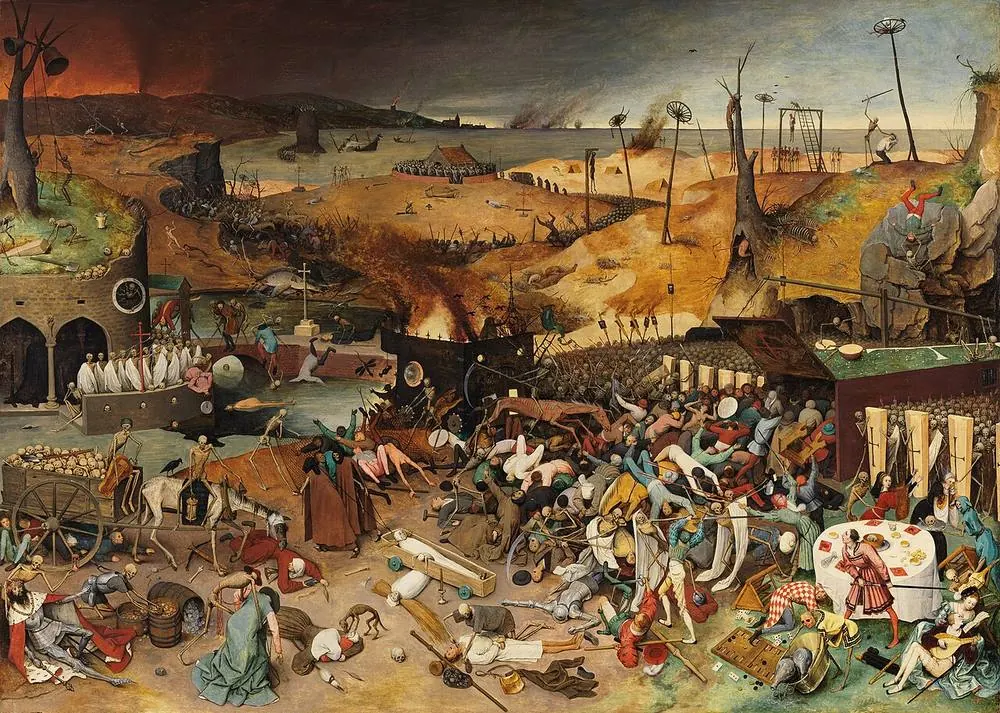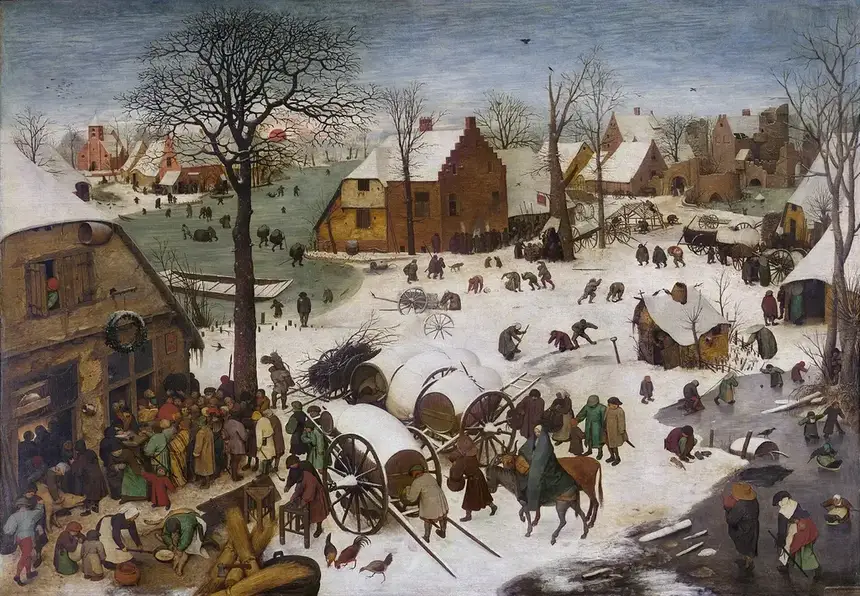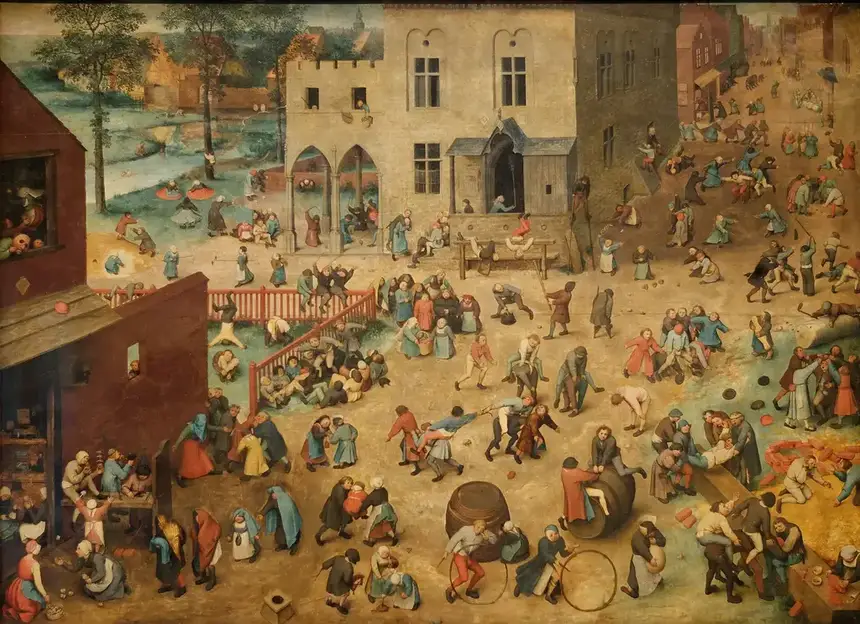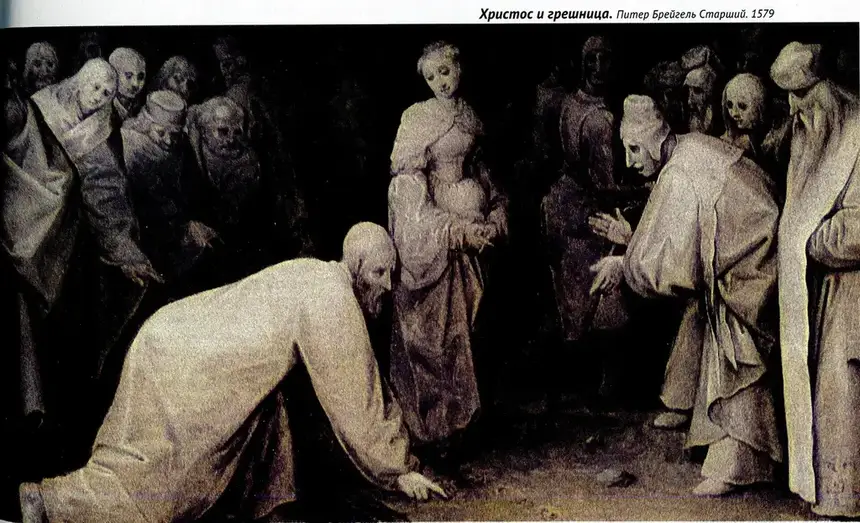
The original, and why we can paint it
Because Pieter Bruegel the Elder died in 1569, this work is in the public domain. We are painting a copy of a painting — we never pass it off as the original, and neither should anyone selling you one.
We paint it in oil on canvas, one at a time, in Dafen Village. Nothing is printed, scanned or transferred.
The painting was made in the years before 1569, and what we reproduce is the record of it, not the object.
What arrives is a canvas with paint on it, made by a person. That is the only thing we sell.
What to look at
What survives from the original into a hand-painted copy is the order it was built in, and you can read that order in ours.
Our painter keeps the original's proportions rather than cropping to a standard frame.
Where the source relies on reflected light, we put it in. Removing it makes the form look like cardboard.
The saturation is deliberately uneven: strongest at the focal point, weaker everywhere else.
The marks have a direction, and the direction follows the form.
The risk with a religious subject is overworking, and the way to avoid it is knowing when to stop.
Hang it at eye level — roughly 145 cm from the floor to the centre — and it will hold the wall.
| Artist | Pieter Bruegel the Elder |
|---|---|
| Title | Christ and the Woman Taken in Adultery |
| Created (original) | 1565 |
| Medium | Oil on canvas, hand-painted to order |
| How it is made | Painted by hand in oil on canvas, to your size |
| Original status | Public domain (artist deceased) |
Hand-painted, not printed
Prints are good at information and bad at paint. This subject is mostly paint.
Paint goes on in the original's order — thin first, thick last — so the surface behaves the way the painter intended.
| Aspect | Hand-painted oil | Printed canvas |
|---|---|---|
| How it ages | Warms and settles; cleanable by a conservator | Fades, then cracks at the stretcher |
| Sense of depth | Real, created by layers of paint | Simulated by darker ink |
| Value over time | Can be re-stretched, cleaned and re-framed | Little value beyond the print |
| Edge quality | Soft where the form turns, sharp where it does not | Uniformly sharp or uniformly blurred |
| Impasto | Real paint standing off the canvas | Flat ink, sometimes embossed to imitate |
The difficulty is restraint: leaving out most of what a photograph would show.
Every canvas is painted to order, so the quote follows your size, frame and destination rather than a fixed list. Tell us what you need on WhatsApp and we reply with an exact figure, usually within the hour. You deal directly with the studio that paints it — no reseller layer.
The sequence on our floor
No two canvases are painted the same way, but the sequence is always this:
- Stretching and priming the support — cotton duck or linen goes onto the bars and gets its ground.
- The drawing goes down — charcoal or thin paint, done by eye rather than traced from a printout.
- The first colour pass — thin and simple, establishing the main shapes only.
- Setting the key — how dark the darks go determines everything that follows.
- Building the colour — a warm and a cool version of each passage, put down in order.
- The detail and highlights go on — last, loaded, and left alone once they are down.
- Left to dry before varnish — nothing is photographed or packed until the surface is ready.
Matching the original's degree of finish is harder than matching its colours.
Keeping it
Once the varnish has cured the surface can be cleaned by a conservator, but in a normal house it will not need it for decades.
Canvas, paint and varnish
The ground is a proper acrylic sizing, so the oil does not rot the fabric over time. Stretcher bars are kiln-dried and wedged, so the canvas can be re-tensioned years later.
We use a neutral-sized ground so the whites stay warm rather than going blue over time. We use cotton duck for most sizes and linen where the canvas is large or the client asks for it.
Framing
Most clients wait for the photographs before choosing a frame, which is the sensible order.
Framing is quoted separately, so you can decide after you have seen the finished canvas in photographs.
Choosing a size
Because each piece is painted from scratch, you are not limited to stock dimensions. These are the sizes clients ask for most:
| Size (inches) | Size (cm) | Best for |
|---|---|---|
| 20 × 16 in | 50 × 40 cm | Bedroom, hallway, above a console |
| 16 × 12 in | 40 × 30 cm | A shelf, a small wall, a gallery group |
| 64 × 48 in | 163 × 122 cm | Villa scale, lobby, hospitality wall |
| 48 × 36 in | 122 × 91 cm | Large living room, stairwell, loft |
Anything outside this table is fine — we paint to the number you give us. Duties and import taxes are the buyer's account (DAP). Your customs authority sets them; we do not.
In a bedroom it works above a headboard, sized to about two-thirds of the furniture width.
Send the wall, the size and whether you want a frame, and we will quote.
💬 Get a Quote for Christ and the Woman Taken in AdulteryHow it reaches you
From order to finished canvas is 9–15 days. Freight appears as a separate line on the quote and is fixed before you pay.
In transit it is typically 7–10 business days by air, tracked door to door. Every shipment goes out with tracking. We do not send anything untracked.
Before anything is packed, you get photographs of the actual canvas and a chance to ask for changes. If something is not right, tell us what to adjust and we adjust it.
We quote DAP, so any duty or tax your country charges is settled by you at import. We do not add a tax line of our own.
Work begins on a deposit and ships on the balance. Both figures are on the quote. Report any transit damage within 48 hours with photographs and we will deal with the carrier. We will not promise a payout, but we will not leave you to argue alone either.
Before you order
Is there a rush option?
It depends on the canvas and what else is in the studio. Ask on WhatsApp with your size and we will tell you straight what is possible.
Can I change something in the composition?
Often yes — background, cropping, or adapting the proportions to your wall. Tell us what you have in mind and we will say honestly whether it will work.
Can I resell the reproduction?
Yes. Because the underlying work is in the public domain, the hand-painted canvas is yours to sell, gift or install commercially.
How do I hang it?
Centre it at about 145 cm from the floor, or two-thirds the width of the furniture below it. We will tell you the exact number for your wall.
Is it really painted by hand?
Yes. One painter, oil paint, brushes. We do not own a printer that touches canvas.
How long does it take?
From order to finished canvas is 9–15 days; delivery adds about 7–10 business days by air.
Can you paint a different work by Pieter Bruegel the Elder?
Yes — send us the image, or look through the other Pieter Bruegel the Elder works on the site.
What does it cost?
There is no price list, because the number depends on your size and frame. Message us and we will quote exactly.
Do you ship to my country?
We export to more than 20 countries. Tell us where you are and we will quote the freight as a separate line.
Can I change the size?
Yes. The canvas is painted to your measurement, not taken from a stock list.
Is owning a reproduction legal?
Yes. Pieter Bruegel the Elder died more than 70 years ago, so the work is in the public domain and owning a hand-painted version is legal anywhere. We never pass ours off as the original.
What if it arrives damaged?
Report damage within 48 hours with photographs. We deal with the carrier rather than leaving you to argue alone.