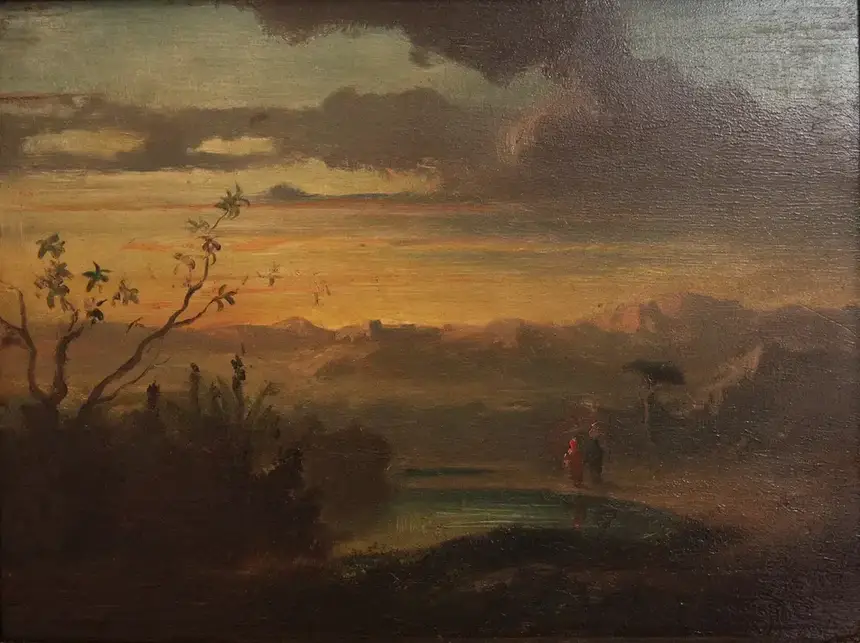
Where this painting comes from
Because Prosper Marilhat died in 1847, this work is in the public domain. We are painting a copy of a painting — we never pass it off as the original, and neither should anyone selling you one.
Ours is a painting made with brushes. There is no giclée, no canvas transfer and no digital underlayer anywhere in the process.
It is an original composition painted before 1847, and our version is painted from the surviving image of it.
What arrives is a canvas with paint on it, made by a person. That is the only thing we sell.
Where the painting lives
Painted by hand, Environs du Caire keeps the hesitation in the brushwork that gives the place its scale.
Space in a landscape is made with value, not perspective: things that are further away are painted cooler and weaker.
We do not brighten the picture for reproduction. The original's key is kept as it is.
Our painter mixes on the palette but finishes on the canvas, which is where the small variations come from.
The marks have a direction, and the direction follows the form.
Anyone can copy the shapes. The skill is in the transitions, and that is what takes the days.
Given the subject, this sits naturally in a living room or a study rather than a hallway.
| Artist | Prosper Marilhat |
|---|---|
| Title | Environs du Caire |
| Medium | Oil on canvas, hand-painted to order |
| How it is made | Painted by hand in oil on canvas, to your size |
| Original status | Public domain (artist deceased) |
Hand-painted, not printed
Prints are good at information and bad at paint. This subject is mostly paint.
Where the original is loaded, ours is loaded. Where it is thin, ours is thin. Matching the weight of the paint matters more than matching the colour.
| Aspect | Hand-painted oil | Printed canvas |
|---|---|---|
| How it ages | Warms and settles; cleanable by a conservator | Fades, then cracks at the stretcher |
| Changing something | Tell us and the passage gets repainted | Usually means starting the file again |
| Surface | Hand-painted oil on canvas | Ink on canvas, flat |
| Edges | Chosen by the painter, passage by passage | Whatever the file happens to contain |
| Texture | Ridges and drag you can see from across a room | None, or a printed imitation of it |
This one repaints badly, so our painter gets the values right early and leaves them.
Every canvas is painted to order, so the quote follows your size, frame and destination rather than a fixed list. Tell us what you need on WhatsApp and we reply with an exact figure, usually within the hour. You are buying from the workshop, not a catalogue.
From blank canvas to finished painting
The order of work matters as much as the work itself. Ours runs like this:
- Stretching and priming the support — cotton duck or linen goes onto the bars and gets its ground.
- Laying in the drawing — done by eye from the reference, not traced or projected.
- Blocking the masses — thin paint, working the whole surface rather than one corner at a time.
- Setting the key — how dark the darks go determines everything that follows.
- Colour is built up — warmer and cooler versions of each passage, laid over the underpainting.
- The detail and highlights go on — last, loaded, and left alone once they are down.
- Left to dry before varnish — nothing is photographed or packed until the surface is ready.
The hardest passage is the quiet one, where a small mistake has nowhere to hide.
Canvas, paint and varnish
We do not use a printer at any stage. There is no giclée, no canvas transfer, no digital underlayer. We use cotton duck for most sizes and linen where the canvas is large or the client asks for it.
Varnish goes on only once the paint is properly dry, months after the last stroke, not before. We use a neutral-sized ground so the whites stay warm rather than going blue over time.
On framing
Framing is quoted separately, so you can decide after you have seen the finished canvas in photographs.
A frame is a separate line on the quote, not a bundle. You choose it once the painting exists.
Keeping it
Do not wipe it with anything wet. Dust lightly, hang it somewhere stable, and forget about it.
What size works
Any size is possible. These are simply the ones that come up most often in quotes:
| Size (inches) | Size (cm) | Best for |
|---|---|---|
| 40 × 30 in | 102 × 76 cm | Living room focal wall, above a sofa |
| 32 × 24 in | 81 × 61 cm | Living room, above a sideboard |
| 30 × 24 in | 76 × 61 cm | Dining room, bedroom feature wall |
| 24 × 20 in | 60 × 50 cm | Study, home office, above a desk |
Anything outside this table is fine — we paint to the number you give us. Shipments go out DAP. If your customs office charges duty or tax on arrival, that is between you and them — we do not collect it and we do not put a number on it.
It is a picture for a room you use, not a corridor you walk through.
Tell us the size and frame — exact quote back, usually within the hour.
💬 Get a Quote for Environs du CaireHow it reaches you
Painting takes 9–15 days. Freight is quoted as its own line on the quote, agreed before you pay anything, and never added afterwards.
Expect 7–10 business days in transit, with tracking from our door to yours. Unframed canvases are rolled face-out on a tube; framed ones are corner-protected and crated.
You approve the painting from photographs before it is packed — that is the checkpoint. Changes are handled by telling us what to change; we change it and send new photographs.
Duties and import taxes are the buyer's account (DAP). Your customs authority sets them; we do not.
You pay a deposit to start and the remainder before shipping. Nothing is hidden in between. Damage in transit should be reported to us within 48 hours, with photographs. We pursue it with the carrier rather than promising a refund.
What people ask us
Will it look exactly like the image?
Not exactly, and that is the point — it is a painting, not a scan. Composition, colour and drawing follow the original closely; the surface is where a painter's own decisions show.
Is it really painted by hand?
Yes. We hand-paint from public-domain source images, do not sell prints, and never claim the original.
Can I change the size?
Yes. The canvas is painted to your measurement, not taken from a stock list.
Do you sell prints?
No prints at all — no giclée, no canvas transfer, nothing machine-made.
Do you take a deposit?
A deposit starts the canvas and the balance falls due before it ships. Both figures appear on the quote.
Can you paint it from a different photograph of the same work?
Yes. If you have a better reference, send it on WhatsApp and we will work from yours.
Can you change the colours to suit my room?
Sometimes. We will adjust the palette if it can be done without ruining the picture, and say so if it cannot.
Who pays the import duty?
The buyer does. Terms are DAP: duties and taxes, where they apply, are paid on arrival. We never add a tax line of our own.
What if it arrives damaged?
send us photographs within 48 hours and contact us directly — we will sort it out with you.
What is the canvas made of?
Cotton duck as standard, linen on request, artist-grade oil paint, and a final varnish once the paint is fully dry.
Can you paint a different work by Prosper Marilhat?
Yes. Send the image and we will quote it, or browse the other paintings we have listed.