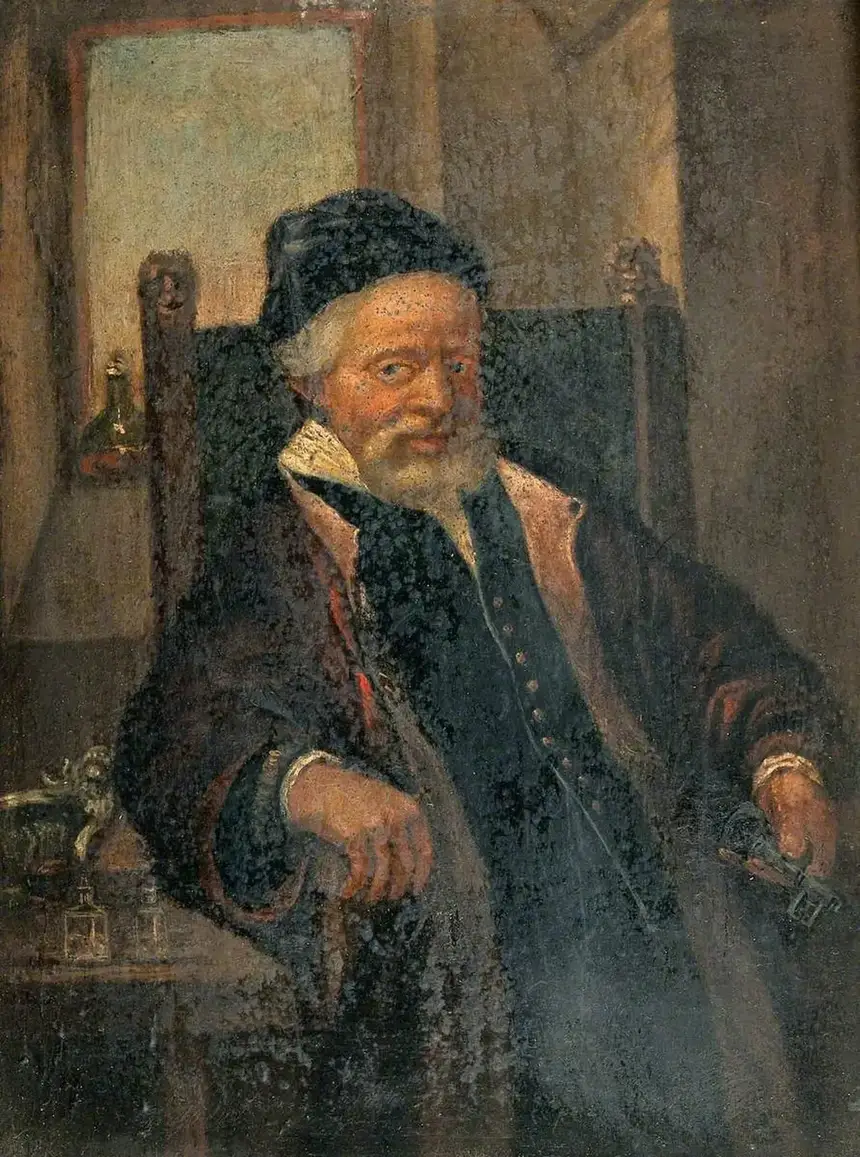
What you are buying into
Because Rembrandt died in 1669, this work is in the public domain. We are painting a copy of a painting — we never pass it off as the original, and neither should anyone selling you one.
Every version we make is oil on canvas, painted by one painter from start to finish. No printing is involved at any stage.
The painting was made in the years before 1669, and what we reproduce is the record of it, not the object.
You are buying a painting, not a file. That distinction is the whole business we are in.
What to look at
The reason Jan Lutma still works as a painting is that it was built as paint, not as a picture of a place.
The near ground is painted loaded and the far ground thin. That single decision creates the whole space.
Where the source has light coming through the paint, we glaze rather than paint opaque white.
Our painter mixes on the palette but finishes on the canvas, which is where the small variations come from.
The last marks are the ones that are left alone. Overworking is the enemy.
Getting Jan Lutma right means painting it in the right order, and the order is not obvious.
A plain wall is better than a busy one; the painting supplies the interest.
| Artist | Rembrandt |
|---|---|
| Title | Jan Lutma |
| Medium | Oil on canvas, hand-painted to order |
| Reproduction | Hand-painted oil on canvas, made to order |
| Original status | Public domain (artist deceased) |
Why this one cannot be printed
What you lose in a print is the air. A press lays ink flat; a painter builds depth in layers, and the depth is what you actually see.
Paint goes on in the original's order — thin first, thick last — so the surface behaves the way the painter intended.
| Aspect | Hand-painted oil | Printed canvas |
|---|---|---|
| Corrections | We adjust it and repaint the passage | The file is reprinted or it is not |
| Depth | Built in layers, catches light from the side | Flat; highlights are printed as pale ink |
| How it ages | Warms and settles; cleanable by a conservator | Fades, then cracks at the stretcher |
| Available sizes | Whatever you need, painted to order | What the printer can output |
| Later on | Can be restored, re-framed, handed on | Replaceable, and usually replaced |
Anyone can copy the shapes. The skill is in the transitions, and that is what takes the days.
Every canvas is painted to order, so the quote follows your size, frame and destination rather than a fixed list. Tell us what you need on WhatsApp and we reply with an exact figure, usually within the hour. No resellers, no drop-shipper. The painter's studio handles your commission from first message to final crate.
The sequence on our floor
No two canvases are painted the same way, but the sequence is always this:
- Stretching and priming the support — cotton duck or linen goes onto the bars and gets its ground.
- Laying in the drawing — done by eye from the reference, not traced or projected.
- The big shapes are blocked in — thin paint, one colour at a time, the whole canvas at once.
- Setting the key — how dark the darks go determines everything that follows.
- Building the colour — a warm and a cool version of each passage, put down in order.
- Finishing passes — the loaded highlights go on at the end and stay there.
- It dries, then gets varnished — and only then is it photographed for you.
The passage that will take longest is the one that looks simplest.
What goes into it
Pigment is artist-grade oil colour, not acrylic and not house paint. It behaves differently and it lasts. The varnish is removable, so a conservator can clean the painting in fifty years without touching the paint.
We buy pigment in tubes from the same suppliers the village has used for years, not in bulk drums. Each painter works on one canvas at a time — the painting you ordered is not shared with another order.
Whether to frame it
Most clients wait for the photographs before choosing a frame, which is the sensible order.
Frames are priced once you have chosen them, not estimated in advance.
Living with it
Dust it with a dry, soft brush. Keep it out of direct sun and away from radiators, and it will outlive you.
What size works
Any size is possible. These are simply the ones that come up most often in quotes:
| Size (inches) | Size (cm) | Best for |
|---|---|---|
| 64 × 48 in | 163 × 122 cm | Villa scale, lobby, hospitality wall |
| 48 × 36 in | 122 × 91 cm | Large living room, stairwell, loft |
| 40 × 30 in | 102 × 76 cm | Living room focal wall, above a sofa |
| 32 × 24 in | 81 × 61 cm | Living room, above a sideboard |
Anything outside this table is fine — we paint to the number you give us. Our terms are DAP, meaning the freight is paid by us and any import charges are yours to settle. We will not estimate them, because the figure is your customs authority's to set.
In a bedroom it works above a headboard, sized to about two-thirds of the furniture width.
Give us your size and framing preference and you will have a quote shortly.
💬 Get a Quote for Jan LutmaTimeline and shipping
Painting takes 9–15 days. Freight is quoted as its own line on the quote, agreed before you pay anything, and never added afterwards.
In transit it is typically 7–10 business days by air, tracked door to door. Every shipment goes out with tracking. We do not send anything untracked.
You approve the painting from photographs before it is packed — that is the checkpoint. If something is not right, tell us what to adjust and we adjust it.
Shipments go out DAP. If your customs office charges duty or tax on arrival, that is between you and them — we do not collect it and we do not put a number on it.
A deposit starts the canvas and books the painter's time; the balance is due before the crate leaves. Report any transit damage within 48 hours with photographs and we will deal with the carrier. We will not promise a payout, but we will not leave you to argue alone either.
The practical questions
Why not just print it?
A print flattens the surface into a poster: the distance collapses and the highlights turn to grey. Paint keeps the depth and the texture the original was built from.
What happens after I message you?
You tell us the painting, size and whether you want a frame. We quote, a painter starts on your canvas, and you get photographs before it ships.
Can I see progress photos while it is being painted?
We send photographs of the finished painting for approval before it ships. Mid-process images are not part of the standard workflow.
What is the canvas made of?
Cotton duck as standard, linen on request, artist-grade oil paint, and a final varnish once the paint is fully dry.
Is it really painted by hand?
Yes — oil on canvas, brush and knife. There is no printing, no giclée and no canvas transfer at any stage.
What if it arrives damaged?
Report damage within 48 hours with photographs. We deal with the carrier rather than leaving you to argue alone.
Can I change the size?
Yes. The canvas is painted to your measurement, not taken from a stock list.
Does it come framed?
Frames are priced on their own line. Most clients choose after seeing the photographs.
Do you take a deposit?
Work begins on a deposit and ships once the balance is paid. Nothing is charged that is not on the quote.
What does it cost?
There is no price list, because the number depends on your size and frame. Message us and we will quote exactly.
Do you sell prints?
No. Hand-painted oil on canvas only. No printing, no giclée, no canvas transfer.
How do I hang it?
Centre it at about 145 cm from the floor, or two-thirds the width of the furniture below it. We will tell you the exact number for your wall.