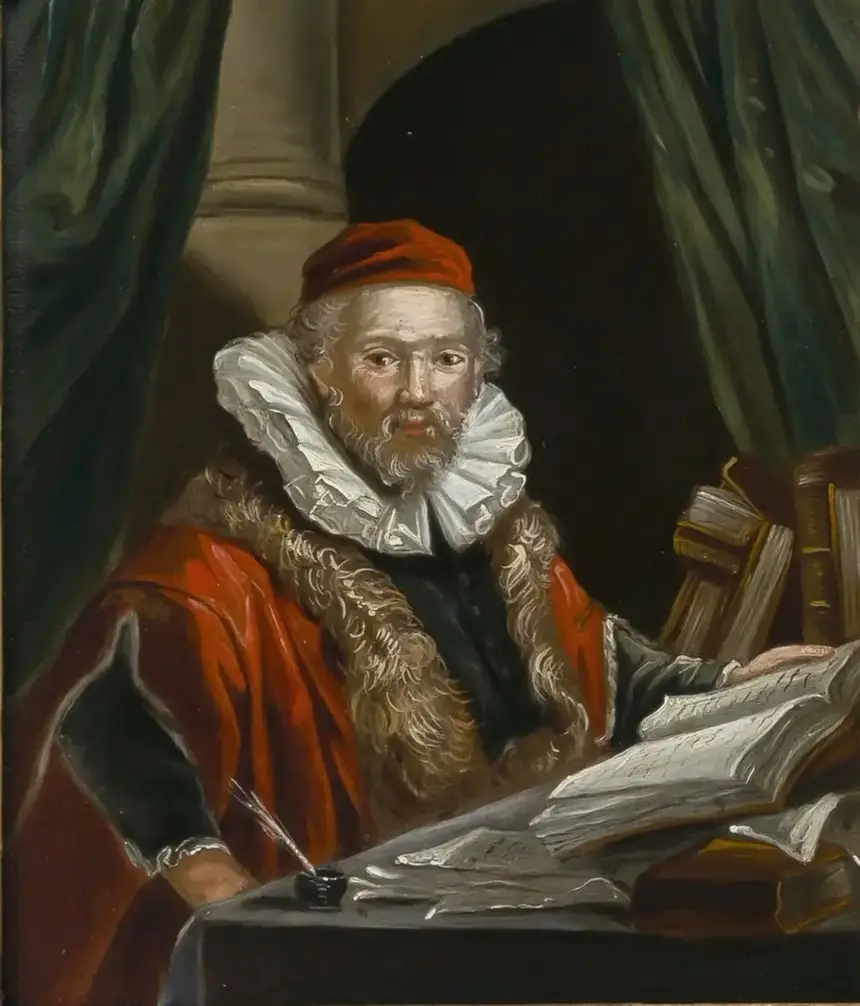
About Jan Uytenbogaert
Because Rembrandt died in 1669, this work is in the public domain. We are painting a copy of a painting — we never pass it off as the original, and neither should anyone selling you one.
Ours is a painting made with brushes. There is no giclée, no canvas transfer and no digital underlayer anywhere in the process.
The painting was made in the years before 1669, and what we reproduce is the record of it, not the object.
You are buying a painting, not a file. That distinction is the whole business we are in.
Looking at it properly
There is a reason a landscape is the hardest thing to print and the easiest thing to paint: the paint itself carries the depth.
Our painter works freehand on a blank canvas, so the scale of the original survives the enlargement.
The sky sets the light for everything below it, so it is painted first.
Whites here are never white. They are warm or cool depending on the light, and that is what makes them read.
The last marks are the ones that are left alone. Overworking is the enemy.
The risk with a landscape is overworking, and the way to avoid it is knowing when to stop.
This reads well above a sofa or a sideboard, where it will be seen from two to three metres.
| Artist | Rembrandt |
|---|---|
| Title | Jan Uytenbogaert |
| Medium | Oil on canvas, hand-painted to order |
| Our version | Oil on canvas, painted by hand to order |
| Original status | Public domain (artist deceased) |
The case for painting it by hand
Prints are good at information and bad at paint. This subject is mostly paint.
Our painter follows the same logic rather than copying a photograph of it: the far distances go down cool and weak, the near ground stays loaded, and nothing is blended flat.
| Aspect | Hand-painted oil | Printed canvas |
|---|---|---|
| Surface | Hand-painted oil on canvas | Ink on canvas, flat |
| Depth | Built in layers, catches light from the side | Flat; highlights are printed as pale ink |
| What it takes | One painter, several days, start to finish | A machine, a few minutes |
| Edge quality | Soft where the form turns, sharp where it does not | Uniformly sharp or uniformly blurred |
| Colour | Mixed for each passage, warm and cool versions | One flat value per area |
The difficult part is not the detail. It is keeping the whole canvas at the same stage of finish.
Every canvas is painted to order, so the quote follows your size, frame and destination rather than a fixed list. Tell us what you need on WhatsApp and we reply with an exact figure, usually within the hour. You are buying from the workshop, not a catalogue.
How the canvas is built
Every canvas is painted to order, so nothing is pulled off a shelf. This is the sequence:
- Stretching and priming the support — cotton duck or linen goes onto the bars and gets its ground.
- The drawing goes down — charcoal or thin paint, done by eye rather than traced from a printout.
- The big shapes are blocked in — thin paint, one colour at a time, the whole canvas at once.
- The values are established — this is the stage that decides whether the painting works.
- Building the colour — a warm and a cool version of each passage, put down in order.
- Detail and highlights last — put on thickly and then not touched again.
- It dries, then gets varnished — and only then is it photographed for you.
The passage that will take longest is the one that looks simplest.
Materials
Nothing is sprayed, sealed or laminated. The surface you see is paint and varnish, and that is all. Linen is worth the extra cost above about a metre across, because it holds tension better in humid rooms.
We do not use a printer at any stage. There is no giclée, no canvas transfer, no digital underlayer. Large canvases get a cross-brace; anything over about a metre and a half needs one.
Frames
A frame is a separate line on the quote, not a bundle. You choose it once the painting exists.
Framing is quoted separately, so you can decide after you have seen the finished canvas in photographs.
Looking after it
Do not wipe it with anything wet. Dust lightly, hang it somewhere stable, and forget about it.
Canvas sizes
Because each piece is painted from scratch, you are not limited to stock dimensions. These are the sizes clients ask for most:
| Size (inches) | Size (cm) | Best for |
|---|---|---|
| 32 × 24 in | 81 × 61 cm | Living room, above a sideboard |
| 30 × 24 in | 76 × 61 cm | Dining room, bedroom feature wall |
| 24 × 20 in | 60 × 50 cm | Study, home office, above a desk |
| 20 × 16 in | 50 × 40 cm | Bedroom, hallway, above a console |
Tell us the wall width and we will tell you what looks right rather than what is standard. We sell DAP: the price covers the painting and the freight, and any import duties or taxes are the buyer's to settle with customs. We do not collect them and we do not estimate them.
It wants a wall where the light rakes across it, because the surface is part of the picture.
Tell us the size and frame — exact quote back, usually within the hour.
💬 Get a Quote for Jan UytenbogaertHow it reaches you
Allow 9–15 days for the painting itself. Shipping is a separate line on your quote — you see it before payment, not after.
Transit is usually 7–10 business days, tracked all the way. Rolled in a tube it travels cheaper and safer than framed; most overseas clients take it that way.
You see photographs of the finished painting before it ships, and you tell us what to adjust. If something is not right, tell us what to adjust and we adjust it.
Import charges, where they exist, are the buyer's responsibility (DAP). We never add them to the quote and never guess what they will be.
Work begins on a deposit and ships on the balance. Both figures are on the quote. Damage in transit should be reported to us within 48 hours, with photographs. We pursue it with the carrier rather than promising a refund.
The practical questions
How do I know what size will look right?
Measure the wall and send a photograph. We will say honestly if the canvas you have in mind is too small for the space, which is the most common mistake.
Is there a rush option?
It depends on the canvas and what else is in the studio. Ask on WhatsApp with your size and we will tell you straight what is possible.
How close will it be to the original?
The composition, colour and drawing follow the original closely; the brushwork carries the painter's own hand. The painter works freehand on a blank canvas, following the same logic as the original rather than copying a photograph.
What if it arrives damaged?
send us photographs within 48 hours and contact us directly — we will sort it out with you.
Can you paint a different work by Rembrandt?
Yes — send us the image, or look through the other Rembrandt works on the site.
Does it come framed?
Frames are priced on their own line. Most clients choose after seeing the photographs.
Can you paint it from a different photograph of the same work?
Yes. If you have a better reference, send it on WhatsApp and we will work from yours.
What is the canvas made of?
Cotton or linen, oil colour, and varnish. Stretcher bars are wedged so the canvas can be re-tensioned later.
Can you change the colours to suit my room?
Sometimes. We will adjust the palette if it can be done without ruining the picture, and say so if it cannot.
Do you sell prints?
No prints at all — no giclée, no canvas transfer, nothing machine-made.
Will I see it before it ships?
Yes — photographs of the actual painting go to you first, and nothing is packed until you have seen them.
Do you ship to my country?
We export to more than 20 countries. Tell us where you are and we will quote the freight as a separate line.