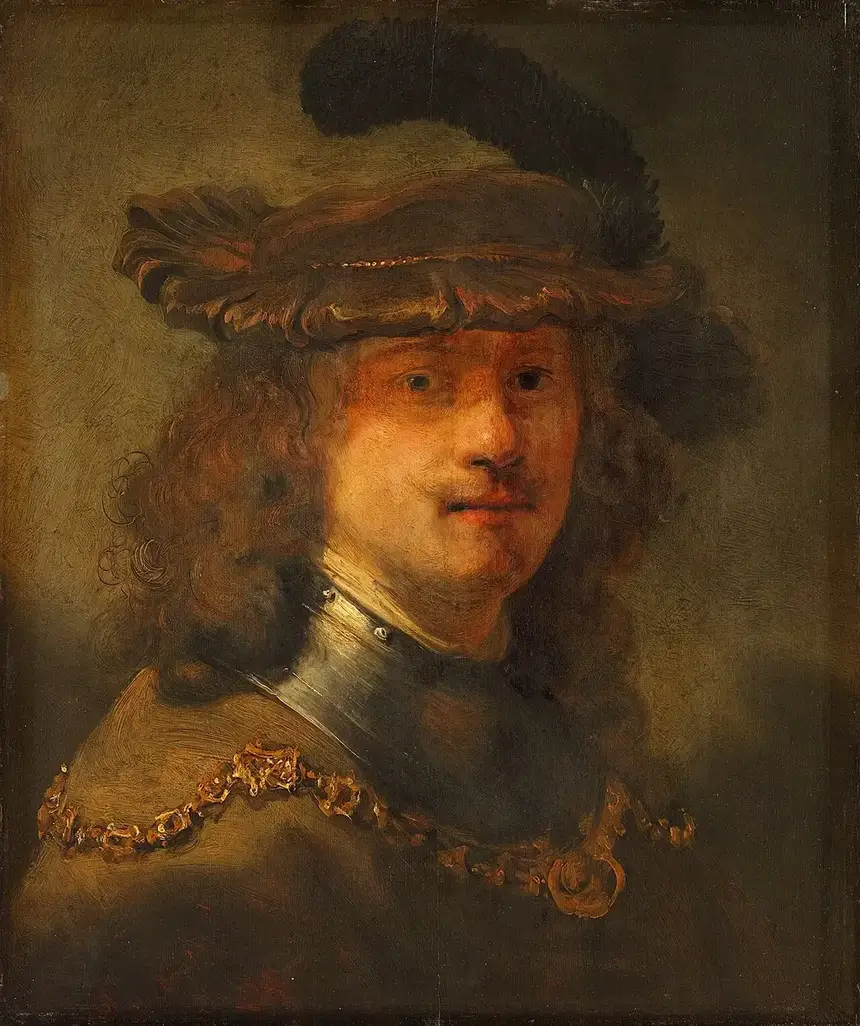
What you are buying into
Because Rembrandt died in 1669, this work is in the public domain. We are painting a copy of a painting — we never pass it off as the original, and neither should anyone selling you one.
We paint it in oil on canvas, one at a time, in Dafen Village. Nothing is printed, scanned or transferred.
It is an original composition painted before 1669, and our version is painted from the surviving image of it.
You are buying a painting, not a file. That distinction is the whole business we are in.
How to read it
The sitter in mit Samtbarett und eiserner is built out of half-tones. Those half-tones are the whole painting.
Our painter starts with the structure of the head and paints the features into it, not onto it.
The highlight on the forehead and nose is put on last and left alone.
The saturation is deliberately uneven: strongest at the focal point, weaker everywhere else.
Where the source has a loaded passage, ours is loaded too — you will feel it from the side.
The difficulty is restraint: leaving out most of what a photograph would show.
It is a picture for a room you use, not a corridor you walk through.
| Artist | Rembrandt |
|---|---|
| Title | mit Samtbarett und eiserner |
| Created (original) | 1634 |
| Medium | Oil on canvas, hand-painted to order |
| How it is made | Painted by hand in oil on canvas, to your size |
| Public domain | Yes — the artist died over 70 years ago |
Why this one cannot be printed
Prints are good at information and bad at paint. This subject is mostly paint.
Where the original is loaded, ours is loaded. Where it is thin, ours is thin. Matching the weight of the paint matters more than matching the colour.
| Aspect | Hand-painted oil | Printed canvas |
|---|---|---|
| What it takes | One painter, several days, start to finish | A machine, a few minutes |
| Value over time | Can be re-stretched, cleaned and re-framed | Little value beyond the print |
| Texture | Ridges and drag you can see from across a room | None, or a printed imitation of it |
| Depth | Built in layers, catches light from the side | Flat; highlights are printed as pale ink |
| Size | Any size, painted to your wall | Limited by the printer |
The difficult part is not the detail. It is keeping the whole canvas at the same stage of finish.
Every canvas is painted to order, so the quote follows your size, frame and destination rather than a fixed list. Tell us what you need on WhatsApp and we reply with an exact figure, usually within the hour. You deal directly with the studio that paints it — no reseller layer.
From blank canvas to finished painting
The order of work matters as much as the work itself. Ours runs like this:
- We start with the canvas itself — stretched, sized and left to settle before any colour is mixed.
- The drawing goes down — charcoal or thin paint, done by eye rather than traced from a printout.
- The big shapes are blocked in — thin paint, one colour at a time, the whole canvas at once.
- Setting the key — how dark the darks go determines everything that follows.
- The colour passes — each area gets its own mixture rather than one colour used throughout.
- The detail and highlights go on — last, loaded, and left alone once they are down.
- Drying and varnishing — the final varnish goes on once the paint has set, before we photograph it.
The risk with a self-portrait is overworking, and the way to avoid it is knowing when to stop.
Canvas, paint and varnish
We do not use a printer at any stage. There is no giclée, no canvas transfer, no digital underlayer. Stretcher bars are kiln-dried and wedged, so the canvas can be re-tensioned years later.
Linen is worth the extra cost above about a metre across, because it holds tension better in humid rooms. We use cotton duck for most sizes and linen where the canvas is large or the client asks for it.
Keeping it
Dust it with a dry, soft brush. Keep it out of direct sun and away from radiators, and it will outlive you.
Frames
We can supply a simple floater frame, a traditional gilt, or nothing at all. It is your call.
Framing is quoted separately, so you can decide after you have seen the finished canvas in photographs.
Canvas sizes
The canvas is cut to your wall, not the other way round. For reference, these are the dimensions most often requested:
| Size (inches) | Size (cm) | Best for |
|---|---|---|
| 20 × 16 in | 50 × 40 cm | Bedroom, hallway, above a console |
| 16 × 12 in | 40 × 30 cm | A shelf, a small wall, a gallery group |
| 64 × 48 in | 163 × 122 cm | Villa scale, lobby, hospitality wall |
| 48 × 36 in | 122 × 91 cm | Large living room, stairwell, loft |
| 40 × 30 in | 102 × 76 cm | Living room focal wall, above a sofa |
Tell us the wall width and we will tell you what looks right rather than what is standard. Terms are DAP. Import duties and taxes, where they apply, are paid by the buyer on arrival — we never collect them in advance and never guess at the amount.
It wants a wall where the light rakes across it, because the surface is part of the picture.
Send the wall, the size and whether you want a frame, and we will quote.
💬 Get a Quote for mit Samtbarett und eiserner Halsberge Self portrait with a velvet bereTimeline and shipping
Painting takes 9–15 days. Freight is quoted as its own line on the quote, agreed before you pay anything, and never added afterwards.
Expect 7–10 business days in transit, with tracking from our door to yours. Rolled in a tube it travels cheaper and safer than framed; most overseas clients take it that way.
You approve the painting from photographs before it is packed — that is the checkpoint. If something is not right, tell us what to adjust and we adjust it.
Import charges, where they exist, are the buyer's responsibility (DAP). We never add them to the quote and never guess what they will be.
Work begins on a deposit and ships on the balance. Both figures are on the quote. Report any transit damage within 48 hours with photographs and we will deal with the carrier. We will not promise a payout, but we will not leave you to argue alone either.
Before you order
How long does a hand-painted version take?
9–15 days of studio time, depending mostly on size and how much impasto the surface carries, then several more days for the oil to set before we photograph, pack and send.
Can I change something in the composition?
Often yes — background, cropping, or adapting the proportions to your wall. Tell us what you have in mind and we will say honestly whether it will work.
What is the canvas made of?
Cotton or linen, oil colour, and varnish. Stretcher bars are wedged so the canvas can be re-tensioned later.
Who pays the import duty?
You do. We sell DAP, so any duty or tax your customs authority charges is settled by you at import. We do not collect it and we do not estimate it.
Do you take a deposit?
A deposit starts the canvas and the balance falls due before it ships. Both figures appear on the quote.
Do you sell prints?
No prints at all — no giclée, no canvas transfer, nothing machine-made.
Can you paint it from a different photograph of the same work?
Yes. If you have a better reference, send it on WhatsApp and we will work from yours.
Can I change the size?
Yes. The canvas is painted to your measurement, not taken from a stock list.
Does it come framed?
Frames are priced on their own line. Most clients choose after seeing the photographs.
Will I see it before it ships?
Yes. We send photographs of the finished canvas and wait for your reply before packing.
How do I hang it?
Roughly 145 cm from floor to centre works for most rooms. Tell us your wall and we will give you the measurement.