The original, and why we can paint it
Rembrandt died in 1669, so the work has been in the public domain for decades. Reproducing it by hand is legal, and so is owning one.
Every version we make is oil on canvas, painted by one painter from start to finish. No printing is involved at any stage.
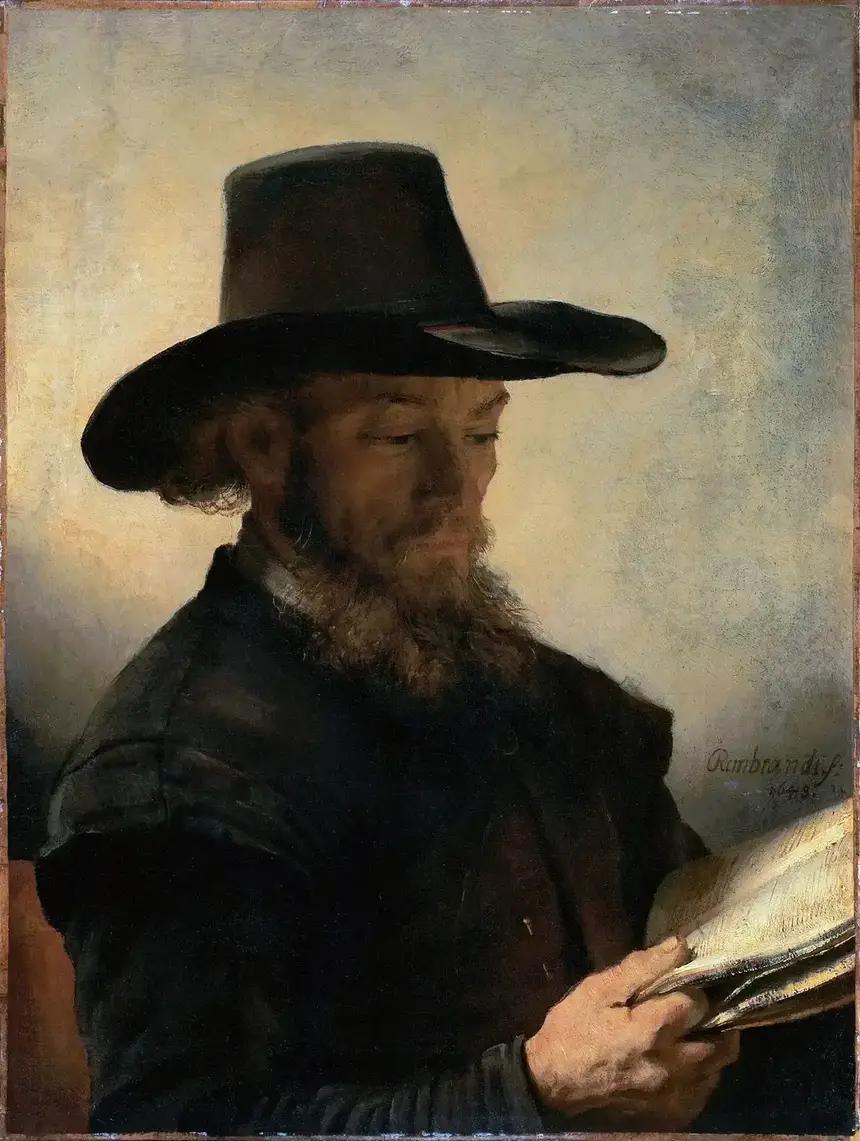
It is an original composition painted before 1669, and our version is painted from the surviving image of it.
If you want something printed, we are the wrong workshop. We do not own a printer that touches canvas.
Looking at it properly
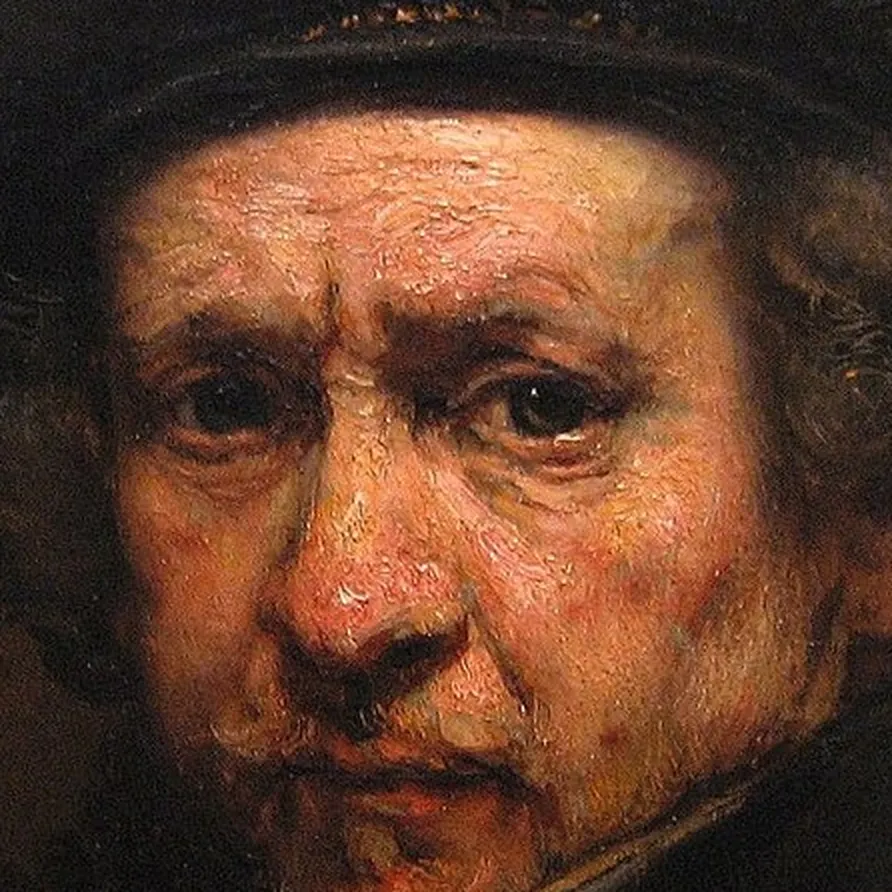
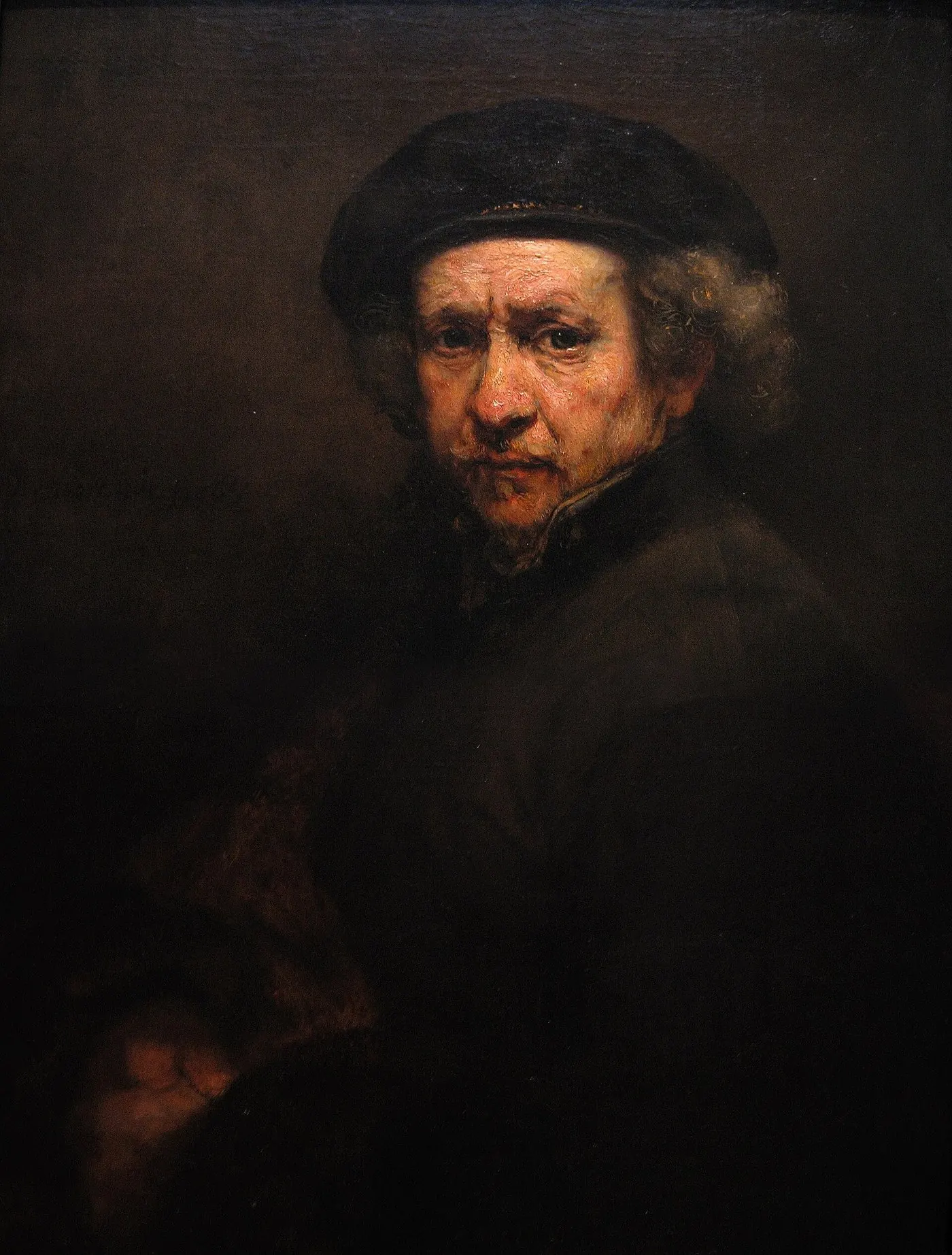
Self-Portrait with Beret and is the kind of portrait that only reads correctly in oil, because the shadows are transparent rather than grey.
Our painter keeps the original crop, including the empty space, because the emptiness is doing a job.
Skin here is translucent: light goes in, bounces, and comes back warm. That is done with thin paint over a lighter ground.
The saturation is deliberately uneven: strongest at the focal point, weaker everywhere else.
Paint is laid on, not pushed around. That is what keeps it fresh.
The risk with a self-portrait is overworking, and the way to avoid it is knowing when to stop.
It suits a room with warm, low light. Strong downlighting flattens the surface.
| Artist | Rembrandt |
|---|---|
| Title | Self-Portrait with Beret and |
| What you receive | A hand-painted oil painting on canvas |
| Public domain | Yes — the artist died over 70 years ago |
Why hand-painting matters here
Prints are good at information and bad at paint. This subject is mostly paint.
Paint goes on in the original's order — thin first, thick last — so the surface behaves the way the painter intended.
| Aspect | Hand-painted oil | Printed canvas |
|---|---|---|
| Available sizes | Whatever you need, painted to order | What the printer can output |
| The surface | Built up with brushes and knives | Printed flat in one pass |
| Corrections | We adjust it and repaint the passage | The file is reprinted or it is not |
| Value over time | Can be re-stretched, cleaned and re-framed | Little value beyond the print |
| Edges | Chosen by the painter, passage by passage | Whatever the file happens to contain |
Getting Self-Portrait with Beret and right means painting it in the right order, and the order is not obvious.
Every canvas is painted to order, so the quote follows your size, frame and destination rather than a fixed list. Tell us what you need on WhatsApp and we reply with an exact figure, usually within the hour. You deal directly with the studio that paints it — no reseller layer.
How it gets painted
The order of work matters as much as the work itself. Ours runs like this:
- The canvas is stretched and primed — cotton or linen, sized and ready before any paint goes near it.
- The drawing goes down — charcoal or thin paint, done by eye rather than traced from a printout.
- Blocking the masses — thin paint, working the whole surface rather than one corner at a time.
- Setting the key — how dark the darks go determines everything that follows.
- The colour passes — each area gets its own mixture rather than one colour used throughout.
- Detail and highlights last — put on thickly and then not touched again.
- It dries, then gets varnished — and only then is it photographed for you.
The difficult part is not the detail. It is keeping the whole canvas at the same stage of finish.
Materials
We use cotton duck for most sizes and linen where the canvas is large or the client asks for it. Pigment is artist-grade oil colour, not acrylic and not house paint. It behaves differently and it lasts.
Stretcher bars are kiln-dried and wedged, so the canvas can be re-tensioned years later. Linen is worth the extra cost above about a metre across, because it holds tension better in humid rooms.
Whether to frame it
Frames are priced once you have chosen them, not estimated in advance.
Frames are priced once you have chosen them, not estimated in advance.
Looking after it
Do not wipe it with anything wet. Dust lightly, hang it somewhere stable, and forget about it.
Getting the size right
Any size is possible. These are simply the ones that come up most often in quotes:
| Size (inches) | Size (cm) | Best for |
|---|---|---|
| 30 × 45 in | 76 × 114 cm | Double-height space, narrow feature wall |
| 36 × 54 in | 91 × 137 cm | Lobby, chapel-like corner, tall foyer |
| 12 × 16 in | 30 × 40 cm | A narrow wall between two openings |
| 16 × 24 in | 41 × 61 cm | Hallway end, beside a door |
| 20 × 30 in | 51 × 76 cm | A tight wall that needs height, not width |
Tell us the wall width and we will tell you what looks right rather than what is standard. We quote DAP, so any duty or tax your country charges is settled by you at import. We do not add a tax line of our own.
For a stairwell or a double-height space, go larger than you think — the composition was built for distance.
Tell us your size and frame — we reply with an exact quote, usually within the hour.
💬 Get a Self-Portrait with Beret and Turned-Up Collar Quote on WhatsAppPlanning a wall or comparing options? Save this painting to Pinterest
How it reaches you
From order to finished canvas is 9–15 days. Freight appears as a separate line on the quote and is fixed before you pay.
Transit is usually 7–10 business days, tracked all the way. Unframed canvases are rolled face-out on a tube; framed ones are corner-protected and crated.
Before anything is packed, you get photographs of the actual canvas and a chance to ask for changes. If something is not right, tell us what to adjust and we adjust it.
DAP terms: we pay the freight, you settle any duty or tax your country applies. We do not collect taxes on anyone's behalf.
Work begins on a deposit and ships on the balance. Both figures are on the quote. Damage in transit should be reported to us within 48 hours, with photographs. We pursue it with the carrier rather than promising a refund.
The practical questions
What if my wall is an unusual shape?
That is normal for us. Send the measurements and we will work out a canvas proportion that suits the space.
Do you work from my own photograph?
Yes, though that is a separate service. This page is for a hand-painted version of {title}; for a photo-to-painting commission, send the image on WhatsApp.
What about duties and import taxes?
Those are the buyer's responsibility (DAP). The amounts are set by your customs authority, not by us.
Will I see it before it ships?
Yes. We send photographs of the finished canvas and wait for your reply before packing.
Is owning a reproduction legal?
Yes. Rembrandt died more than 70 years ago, so the work is in the public domain and owning a hand-painted version is legal anywhere. We never pass ours off as the original.
Can you paint it from a different photograph of the same work?
Send your own reference image and we will paint from that instead.
Is it really painted by hand?
Yes — oil on canvas, brush and knife. There is no printing, no giclée and no canvas transfer at any stage.
How long does it take?
Allow 9–15 days for the painting itself, then roughly 7–10 business days in transit.
Do you sell prints?
No prints at all — no giclée, no canvas transfer, nothing machine-made.
Who pays the import duty?
The buyer does. Terms are DAP: duties and taxes, where they apply, are paid on arrival. We never add a tax line of our own.
How do I hang it?
Roughly 145 cm from floor to centre works for most rooms. Tell us your wall and we will give you the measurement.
What does it cost?
There is no price list, because the number depends on your size and frame. Message us and we will quote exactly.
Brushwork details
Close-up crops of this 100% hand-painted oil reproduction — real oil texture, never a print.