The original, and why we can paint it
Rik Wouters died in 1916, so the work has been in the public domain for decades. Reproducing it by hand is legal, and so is owning one.
Every version we make is oil on canvas, painted by one painter from start to finish. No printing is involved at any stage.
The painting was made in the years before 1916, and what we reproduce is the record of it, not the object.
What arrives is a canvas with paint on it, made by a person. That is the only thing we sell.
What to look at
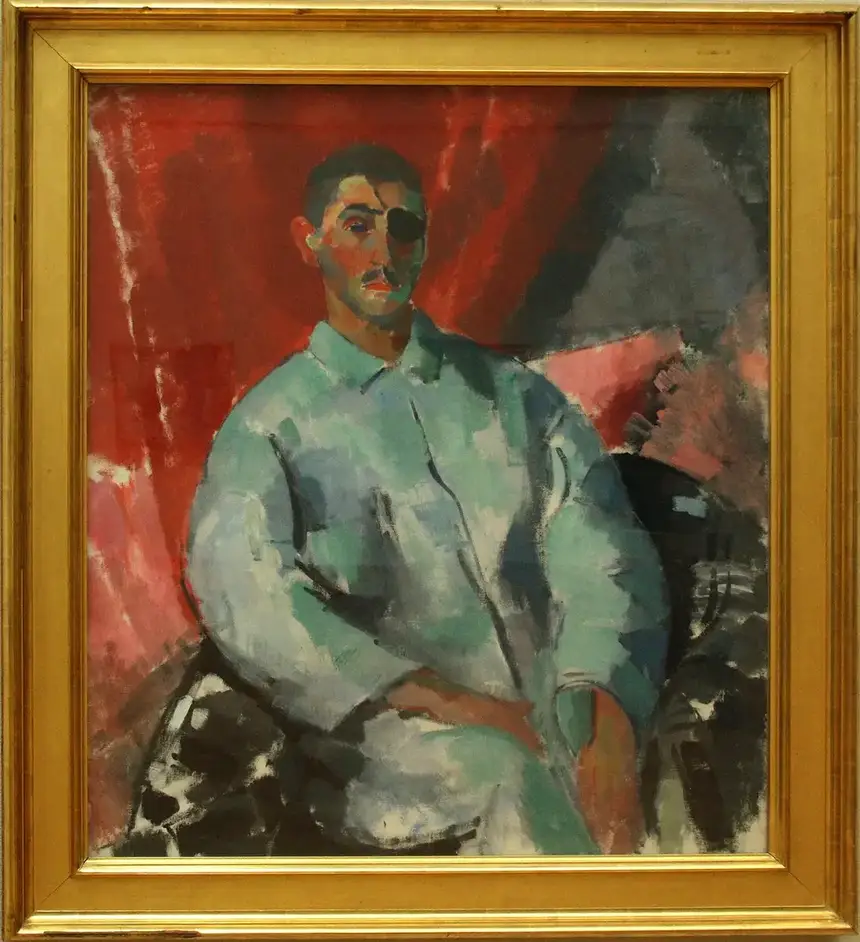
Painted by hand, Self-portrait with Black Bandage keeps the soft edge where the face turns away — the edge a print turns into a line.
Our painter starts with the structure of the head and paints the features into it, not onto it.
Our painter keeps the halftone — the narrow band between light and shadow — which is where a face lives.
Temperature does the work of contrast in the quiet areas, where value differences are small.
Edges are made by the brush, not by an outline, and they are the hardest thing to copy.
Anyone can copy the shapes. The skill is in the transitions, and that is what takes the days.
It suits a room with warm, low light. Strong downlighting flattens the surface.
| Artist | Rik Wouters |
|---|---|
| Title | Self-portrait with Black Bandage |
| Created (original) | 1915 |
| Medium | Oil on canvas, hand-painted to order |
| What you receive | A hand-painted oil painting on canvas |
| Original status | Public domain (artist deceased) |
Hand-painted, not printed
What you lose in a print is the air. A press lays ink flat; a painter builds depth in layers, and the depth is what you actually see.
Where the original is loaded, ours is loaded. Where it is thin, ours is thin. Matching the weight of the paint matters more than matching the colour.
| Aspect | Hand-painted oil | Printed canvas |
|---|---|---|
| Available sizes | Whatever you need, painted to order | What the printer can output |
| How it ages | Warms and settles; cleanable by a conservator | Fades, then cracks at the stretcher |
| Impasto | Real paint standing off the canvas | Flat ink, sometimes embossed to imitate |
| Edges | Chosen by the painter, passage by passage | Whatever the file happens to contain |
| Surface | Hand-painted oil on canvas | Ink on canvas, flat |
The passage that will take longest is the one that looks simplest.
Every canvas is painted to order, so the quote follows your size, frame and destination rather than a fixed list. Tell us what you need on WhatsApp and we reply with an exact figure, usually within the hour. You deal directly with the studio that paints it — no reseller layer.
How your painting is made
Here is what actually happens between your message and the crate:
- Stretching and priming the support — cotton duck or linen goes onto the bars and gets its ground.
- The drawing goes down — charcoal or thin paint, done by eye rather than traced from a printout.
- The big shapes are blocked in — thin paint, one colour at a time, the whole canvas at once.
- The values are established — this is the stage that decides whether the painting works.
- Colour is built up — warmer and cooler versions of each passage, laid over the underpainting.
- Finishing passes — the loaded highlights go on at the end and stay there.
- Left to dry before varnish — nothing is photographed or packed until the surface is ready.
Matching the original's degree of finish is harder than matching its colours.
Living with it
Oil paint needs very little: no water, no cleaners, no sprays. A dry brush and a stable room.
Materials
The ground is a proper acrylic sizing, so the oil does not rot the fabric over time. Oil paint dries by oxidation, not evaporation, which is why a finished canvas needs weeks before it travels.
Linen is worth the extra cost above about a metre across, because it holds tension better in humid rooms. Large canvases get a cross-brace; anything over about a metre and a half needs one.
Framing
If you are shipping, an unframed canvas rolled in a tube is considerably cheaper to move than a framed one.
Most clients wait for the photographs before choosing a frame, which is the sensible order.
Sizing it
You are not choosing from a list; you are telling us a measurement. These are the common ones:
| Size (inches) | Size (cm) | Best for |
|---|---|---|
| 24 × 20 in | 60 × 50 cm | Study, home office, above a desk |
| 20 × 16 in | 50 × 40 cm | Bedroom, hallway, above a console |
| 16 × 12 in | 40 × 30 cm | A shelf, a small wall, a gallery group |
| 64 × 48 in | 163 × 122 cm | Villa scale, lobby, hospitality wall |
If your wall is an odd shape, send the measurement and we will work to it. Proportions from the original are kept unless you ask us to change them. Our terms are DAP, meaning the freight is paid by us and any import charges are yours to settle. We will not estimate them, because the figure is your customs authority's to set.
It is a picture for a room you use, not a corridor you walk through.
Send the wall, the size and whether you want a frame, and we will quote.
💬 Get a Quote for Self-portrait with Black BandageHow it reaches you
Painting takes 9–15 days. Freight is quoted as its own line on the quote, agreed before you pay anything, and never added afterwards.
Transit is usually 7–10 business days, tracked all the way. Every shipment goes out with tracking. We do not send anything untracked.
You approve the painting from photographs before it is packed — that is the checkpoint. Changes are handled by telling us what to change; we change it and send new photographs.
We quote DAP, so any duty or tax your country charges is settled by you at import. We do not add a tax line of our own.
Work begins on a deposit and ships on the balance. Both figures are on the quote. If a crate arrives damaged, send us photographs within 48 hours and contact us directly — we will sort it out with you.
Questions worth asking
What size should I order?
You choose the size. Each canvas is cut to your measurements rather than pulled from stock, so tell us the wall dimensions and we will tell you what proportion works.
How do I clean and care for it?
Dust lightly with a dry, soft brush and keep it out of direct sun. Nothing else is needed for decades; oil paint is slow to change and easy to live with.
Is there a rush option?
It depends on the canvas and what else is in the studio. Ask on WhatsApp with your size and we will tell you straight what is possible.
What does it cost?
There is no price list, because the number depends on your size and frame. Message us and we will quote exactly.
What if it arrives damaged?
send us photographs within 48 hours and contact us directly — we will sort it out with you.
What is the canvas made of?
Cotton or linen, oil colour, and varnish. Stretcher bars are wedged so the canvas can be re-tensioned later.
Is it really painted by hand?
Yes. One painter, oil paint, brushes. We do not own a printer that touches canvas.
Can I change the size?
Yes. The canvas is painted to your measurement, not taken from a stock list.
How do I hang it?
Roughly 145 cm from floor to centre works for most rooms. Tell us your wall and we will give you the measurement.
Do you sell prints?
No. Hand-painted oil on canvas only. No printing, no giclée, no canvas transfer.
Who pays the import duty?
You do. We sell DAP, so any duty or tax your customs authority charges is settled by you at import. We do not collect it and we do not estimate it.
Does it come framed?
Frames are priced on their own line. Most clients choose after seeing the photographs.