Where this painting comes from
Because Robert Henri died in 1929, this work is in the public domain. We are painting a copy of a painting — we never pass it off as the original, and neither should anyone selling you one.
Every version we make is oil on canvas, painted by one painter from start to finish. No printing is involved at any stage.
It is an original composition painted before 1929, and our version is painted from the surviving image of it.
What arrives is a canvas with paint on it, made by a person. That is the only thing we sell.
What to look at
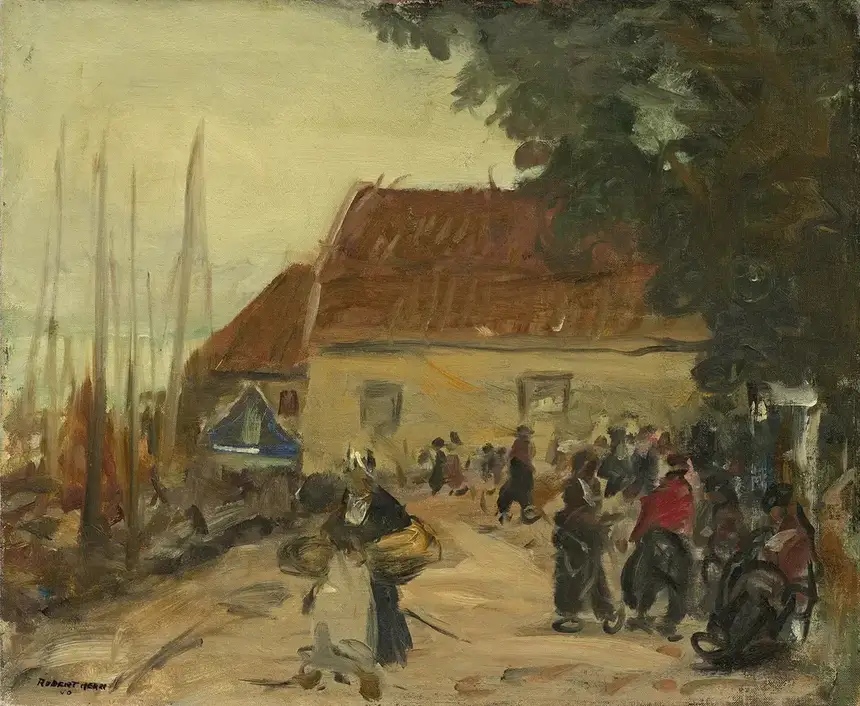
City subjects fail in print because the geometry goes mechanical. Painted by hand, Volendam Street Scene A1 keeps its hand in the lines.
The geometry is underdrawn first and painted over freely, which keeps the lines true without going mechanical.
Sunlit facades and shaded ones are two temperatures, not one colour at two strengths.
Our painter mixes on the palette but finishes on the canvas, which is where the small variations come from.
Edges are made by the brush, not by an outline, and they are the hardest thing to copy.
The difficult part is not the detail. It is keeping the whole canvas at the same stage of finish.
Given the subject, this sits naturally in a living room or a study rather than a hallway.
| Artist | Robert Henri |
|---|---|
| Title | Volendam Street Scene A1 |
| Created (original) | 1910 |
| Medium | Oil on canvas, hand-painted to order |
| Our version | Oil on canvas, painted by hand to order |
| Original status | Public domain (artist deceased) |
Why this one cannot be printed
A print reproduces the shapes and drops the substance. It is the substance you are buying.
Paint goes on in the original's order — thin first, thick last — so the surface behaves the way the painter intended.
| Aspect | Hand-painted oil | Printed canvas |
|---|---|---|
| How it ages | Warms and settles; cleanable by a conservator | Fades, then cracks at the stretcher |
| The surface | Built up with brushes and knives | Printed flat in one pass |
| Edges | Chosen by the painter, passage by passage | Whatever the file happens to contain |
| Time to make | Days of one painter's working time | Minutes |
| Colour | Mixed for each passage, warm and cool versions | One flat value per area |
The difficulty is restraint: leaving out most of what a photograph would show.
Every canvas is painted to order, so the quote follows your size, frame and destination rather than a fixed list. Tell us what you need on WhatsApp and we reply with an exact figure, usually within the hour. No resellers, no drop-shipper. The painter's studio handles your commission from first message to final crate.
How it gets painted
Every canvas is painted to order, so nothing is pulled off a shelf. This is the sequence:
- Stretching and priming the support — cotton duck or linen goes onto the bars and gets its ground.
- A loose underdrawing — proportions checked by eye against the source image.
- The first colour pass — thin and simple, establishing the main shapes only.
- Setting the key — how dark the darks go determines everything that follows.
- Colour is built up — warmer and cooler versions of each passage, laid over the underpainting.
- The detail and highlights go on — last, loaded, and left alone once they are down.
- Drying and varnishing — the final varnish goes on once the paint has set, before we photograph it.
The risk with a city view is overworking, and the way to avoid it is knowing when to stop.
What goes into it
Large canvases get a cross-brace; anything over about a metre and a half needs one. The paint is built in layers, fat over lean, which is what stops it cracking later.
Each painter works on one canvas at a time — the painting you ordered is not shared with another order. Brushes, knives and rags. That is the equipment list; there is no machine in the process.
Frames
A frame is a separate line on the quote, not a bundle. You choose it once the painting exists.
Frames are priced once you have chosen them, not estimated in advance.
Keeping it
Oil paint needs very little: no water, no cleaners, no sprays. A dry brush and a stable room.
Canvas sizes
You are not choosing from a list; you are telling us a measurement. These are the common ones:
| Size (inches) | Size (cm) | Best for |
|---|---|---|
| 16 × 12 in | 40 × 30 cm | A shelf, a small wall, a gallery group |
| 64 × 48 in | 163 × 122 cm | Villa scale, lobby, hospitality wall |
| 48 × 36 in | 122 × 91 cm | Large living room, stairwell, loft |
| 40 × 30 in | 102 × 76 cm | Living room focal wall, above a sofa |
Anything outside this table is fine — we paint to the number you give us. Our terms are DAP, meaning the freight is paid by us and any import charges are yours to settle. We will not estimate them, because the figure is your customs authority's to set.
It suits a room with warm, low light. Strong downlighting flattens the surface.
Give us your size and framing preference and you will have a quote shortly.
💬 Get a Quote for Volendam Street Scene A1How it reaches you
Allow 9–15 days for the painting itself. Shipping is a separate line on your quote — you see it before payment, not after.
Transit is usually 7–10 business days, tracked all the way. Unframed canvases are rolled face-out on a tube; framed ones are corner-protected and crated.
Before anything is packed, you get photographs of the actual canvas and a chance to ask for changes. If something is not right, tell us what to adjust and we adjust it.
Terms are DAP. Import duties and taxes, where they apply, are paid by the buyer on arrival — we never collect them in advance and never guess at the amount.
You pay a deposit to start and the remainder before shipping. Nothing is hidden in between. Damage in transit should be reported to us within 48 hours, with photographs. We pursue it with the carrier rather than promising a refund.
The practical questions
How do I know what size will look right?
Measure the wall and send a photograph. We will say honestly if the canvas you have in mind is too small for the space, which is the most common mistake.
Is there a rush option?
It depends on the canvas and what else is in the studio. Ask on WhatsApp with your size and we will tell you straight what is possible.
Do you work from my own photograph?
Yes, though that is a separate service. This page is for a hand-painted version of {title}; for a photo-to-painting commission, send the image on WhatsApp.
Will I see it before it ships?
Yes. We send photographs of the finished canvas and wait for your reply before packing.
Do you sell prints?
No prints at all — no giclée, no canvas transfer, nothing machine-made.
Is it really painted by hand?
Yes. One painter, oil paint, brushes. We do not own a printer that touches canvas.
Can you change the colours to suit my room?
Sometimes. We will adjust the palette if it can be done without ruining the picture, and say so if it cannot.
What if it arrives damaged?
send us photographs within 48 hours and contact us directly — we will sort it out with you.
How do I hang it?
Roughly 145 cm from floor to centre works for most rooms. Tell us your wall and we will give you the measurement.
Is owning a reproduction legal?
Yes. Robert Henri died more than 70 years ago, so the work is in the public domain and owning a hand-painted version is legal anywhere. We never pass ours off as the original.
What does it cost?
Every canvas is quoted on size, frame and destination rather than a fixed list. Tell us what you need and we reply with an exact figure.
Who pays the import duty?
You do. We sell DAP, so any duty or tax your customs authority charges is settled by you at import. We do not collect it and we do not estimate it.