What you are buying into
Rogier van der Weyden died in 1464, so the work has been in the public domain for decades. Reproducing it by hand is legal, and so is owning one.
We paint it in oil on canvas, one at a time, in Dafen Village. Nothing is printed, scanned or transferred.
The painting was made in the years before 1464, and what we reproduce is the record of it, not the object.
If you want something printed, we are the wrong workshop. We do not own a printer that touches canvas.
How to read it
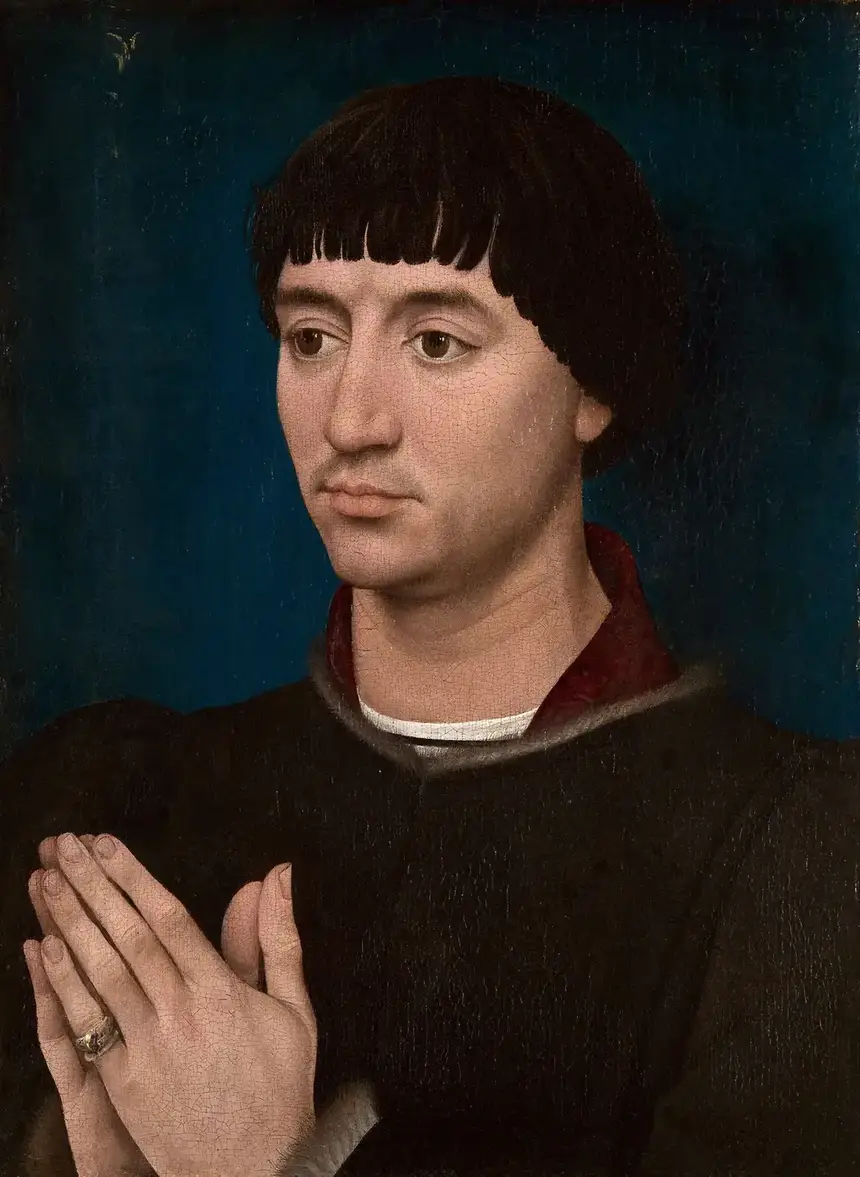
A hand-painted portrait ages differently. Portrait of a Man, about 1450, 2018.27 will look warmer in twenty years, not flatter.
The whole portrait is organised around the light source, and everything else follows from it.
Skin here is translucent: light goes in, bounces, and comes back warm. That is done with thin paint over a lighter ground.
Every colour in Portrait of a Man, about 1450, 2018.27 has a warm version and a cool version, and the painter chooses between them passage by passage.
The last marks are the ones that are left alone. Overworking is the enemy.
The difficult part is not the detail. It is keeping the whole canvas at the same stage of finish.
It wants a wall where the light rakes across it, because the surface is part of the picture.
| Artist | Rogier van der Weyden |
|---|---|
| Title | Portrait of a Man, about 1450, 2018.27 |
| Medium | Oil on canvas, hand-painted to order |
| Year | 1450 |
| Our version | Oil on canvas, painted by hand to order |
| Public domain | Yes — the artist died over 70 years ago |
Hand-painted, not printed
The difference is not subtle when the two hang side by side. Ink sits on the surface; oil stands off it.
Paint goes on in the original's order — thin first, thick last — so the surface behaves the way the painter intended.
| Aspect | Hand-painted oil | Printed canvas |
|---|---|---|
| Handling of colour | Mixed on the palette and finished on the canvas | Fixed by the colour profile |
| Corrections | We adjust it and repaint the passage | The file is reprinted or it is not |
| Lifespan | Slow to change; varnish can be refreshed decades later | Fades and cracks sooner |
| Depth | Built in layers, catches light from the side | Flat; highlights are printed as pale ink |
| Edges | Chosen by the painter, passage by passage | Whatever the file happens to contain |
Getting Portrait of a Man, about 1450, 2018.27 right means painting it in the right order, and the order is not obvious.
Every canvas is painted to order, so the quote follows your size, frame and destination rather than a fixed list. Tell us what you need on WhatsApp and we reply with an exact figure, usually within the hour. There is no agency in between; the studio that paints your canvas is the one answering your messages.
How your painting is made
This is how the painting is built, in the order our painters build it:
- We start with the canvas itself — stretched, sized and left to settle before any colour is mixed.
- The drawing goes down — charcoal or thin paint, done by eye rather than traced from a printout.
- The big shapes are blocked in — thin paint, one colour at a time, the whole canvas at once.
- Getting the values right — the stage that decides whether the finished painting holds together.
- The colour passes — each area gets its own mixture rather than one colour used throughout.
- The detail and highlights go on — last, loaded, and left alone once they are down.
- Drying and varnishing — the final varnish goes on once the paint has set, before we photograph it.
This one repaints badly, so our painter gets the values right early and leaves them.
Canvas, paint and varnish
The ground is a proper acrylic sizing, so the oil does not rot the fabric over time. Large canvases get a cross-brace; anything over about a metre and a half needs one.
Pigment is artist-grade oil colour, not acrylic and not house paint. It behaves differently and it lasts. We do not use a printer at any stage. There is no giclée, no canvas transfer, no digital underlayer.
Framing
We can supply a simple floater frame, a traditional gilt, or nothing at all. It is your call.
We can supply a simple floater frame, a traditional gilt, or nothing at all. It is your call.
Keeping it
Once the varnish has cured the surface can be cleaned by a conservator, but in a normal house it will not need it for decades.
What size works
Because each piece is painted from scratch, you are not limited to stock dimensions. These are the sizes clients ask for most:
| Size (inches) | Size (cm) | Best for |
|---|---|---|
| 16 × 12 in | 40 × 30 cm | A shelf, a small wall, a gallery group |
| 64 × 48 in | 163 × 122 cm | Villa scale, lobby, hospitality wall |
| 48 × 36 in | 122 × 91 cm | Large living room, stairwell, loft |
| 40 × 30 in | 102 × 76 cm | Living room focal wall, above a sofa |
| 32 × 24 in | 81 × 61 cm | Living room, above a sideboard |
Anything outside this table is fine — we paint to the number you give us. DAP terms: we pay the freight, you settle any duty or tax your country applies. We do not collect taxes on anyone's behalf.
It works best on a wall you pass rather than one you sit and stare at — the paint rewards a moving eye.
Tell us where it will hang and how big it needs to be — we will price it properly.
💬 Get a Quote for Portrait of a Man, about 1450, 2018.27Getting it to you
The painting takes 9–15 days, and delivery is priced separately on the quote so there is no surprise later.
Air freight runs about 7–10 business days, tracked, to your door. Unframed canvases are rolled face-out on a tube; framed ones are corner-protected and crated.
You see photographs of the finished painting before it ships, and you tell us what to adjust. Adjustments are part of the process. Say what you want different and it gets done.
Terms are DAP. Import duties and taxes, where they apply, are paid by the buyer on arrival — we never collect them in advance and never guess at the amount.
You pay a deposit to start and the remainder before shipping. Nothing is hidden in between. Report any transit damage within 48 hours with photographs and we will deal with the carrier. We will not promise a payout, but we will not leave you to argue alone either.
Before you order
What about duties and import taxes?
Those are the buyer's responsibility (DAP). The amounts are set by your customs authority, not by us.
How do I know what size will look right?
Measure the wall and send a photograph. We will say honestly if the canvas you have in mind is too small for the space, which is the most common mistake.
What if my wall is an unusual shape?
That is normal for us. Send the measurements and we will work out a canvas proportion that suits the space.
What is the canvas made of?
Cotton duck as standard, linen on request, artist-grade oil paint, and a final varnish once the paint is fully dry.
How long does it take?
Painting takes 9–15 days. Air freight is usually 7–10 business days on top of that, tracked.
Do you sell prints?
No. Hand-painted oil on canvas only. No printing, no giclée, no canvas transfer.
Can you paint a different work by Rogier van der Weyden?
Yes — send us the image, or look through the other Rogier van der Weyden works on the site.
Is owning a reproduction legal?
Yes. The painting is out of copyright because Rogier van der Weyden died more than 70 years ago. We paint copies honestly and never claim they are originals.
Will I see it before it ships?
Yes — photographs of the actual painting go to you first, and nothing is packed until you have seen them.
What if it arrives damaged?
Report damage within 48 hours with photographs. We deal with the carrier rather than leaving you to argue alone.
Can you paint it from a different photograph of the same work?
Yes. If you have a better reference, send it on WhatsApp and we will work from yours.
Do you ship to my country?
We export to more than 20 countries. Tell us where you are and we will quote the freight as a separate line.