About the original
Santiago Rusiñol died in 1931. That puts the painting well outside copyright, which is why we can paint it and you can own it anywhere in the world.
Every version we make is oil on canvas, painted by one painter from start to finish. No printing is involved at any stage.
The painting was made in the years before 1931, and what we reproduce is the record of it, not the object.
You are buying a painting, not a file. That distinction is the whole business we are in.
Looking at it properly
A painted a landscape is an argument about air. Copy the shapes and you still have not copied the argument.
Where the original has an awkward crop, we keep it. Correcting it would be painting a different picture.
The brightest passage is kept small. That is what makes it read as bright.
The saturation is deliberately uneven: strongest at the focal point, weaker everywhere else.
Where the source has a loaded passage, ours is loaded too — you will feel it from the side.
The passage that will take longest is the one that looks simplest.
A plain wall is better than a busy one; the painting supplies the interest.
| Artist | Santiago Rusiñol |
|---|---|
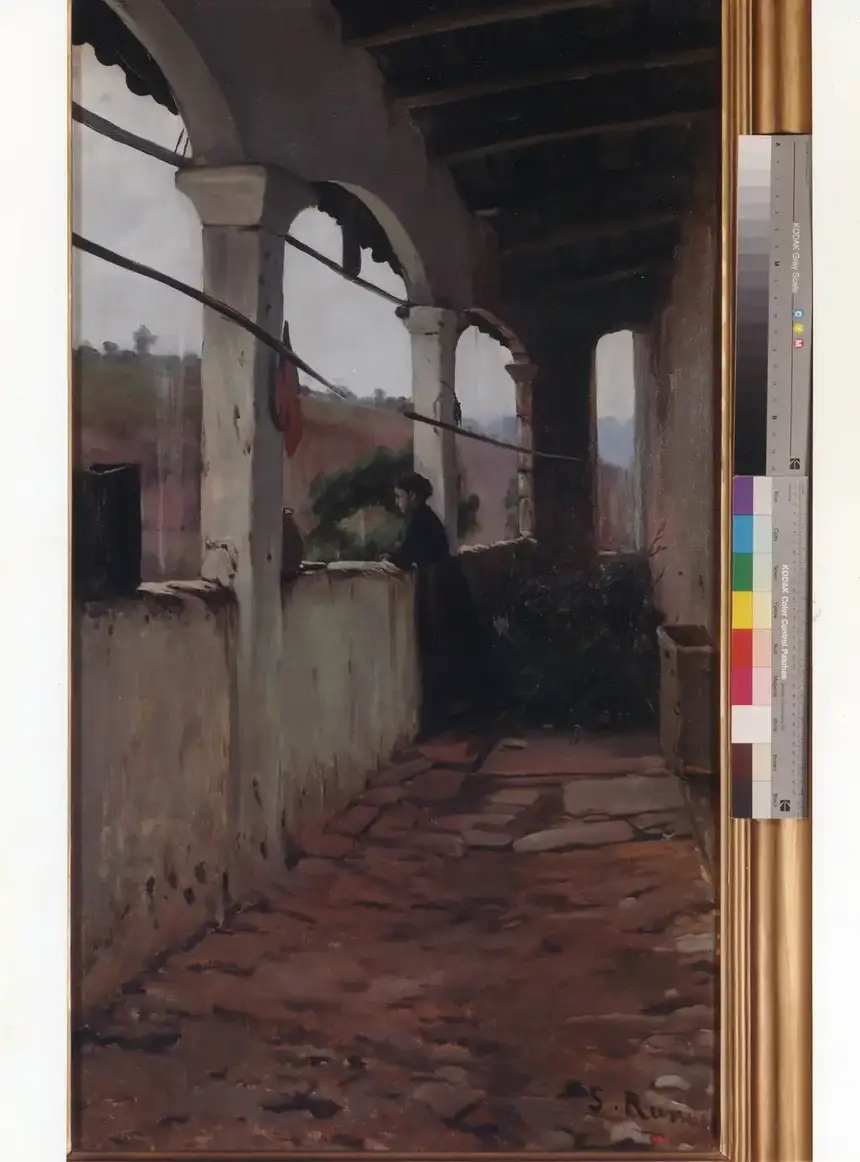
| Title | El porxo del jardí o Tarda de Pluja |
| Created (original) | 1889 |
| Medium | Oil on canvas, hand-painted to order |
| How it is made | Painted by hand in oil on canvas, to your size |
| Copyright | Public domain; the original is out of copyright |
Why hand-painting matters here
What you lose in a print is the air. A press lays ink flat; a painter builds depth in layers, and the depth is what you actually see.
Our painter follows the same logic rather than copying a photograph of it: the far distances go down cool and weak, the near ground stays loaded, and nothing is blended flat.
| Aspect | Hand-painted oil | Printed canvas |
|---|---|---|
| Changing something | Tell us and the passage gets repainted | Usually means starting the file again |
| Edges | Chosen by the painter, passage by passage | Whatever the file happens to contain |
| Value over time | Can be re-stretched, cleaned and re-framed | Little value beyond the print |
| Available sizes | Whatever you need, painted to order | What the printer can output |
| Depth | Built in layers, catches light from the side | Flat; highlights are printed as pale ink |
The risk with a landscape is overworking, and the way to avoid it is knowing when to stop.
Every canvas is painted to order, so the quote follows your size, frame and destination rather than a fixed list. Tell us what you need on WhatsApp and we reply with an exact figure, usually within the hour. You deal directly with the studio that paints it — no reseller layer.
How it gets painted
Here is what actually happens between your message and the crate:
- Stretching and priming the support — cotton duck or linen goes onto the bars and gets its ground.
- The drawing goes down — charcoal or thin paint, done by eye rather than traced from a printout.
- The big shapes are blocked in — thin paint, one colour at a time, the whole canvas at once.
- Getting the values right — the stage that decides whether the finished painting holds together.
- Colour is built up — warmer and cooler versions of each passage, laid over the underpainting.
- The detail and highlights go on — last, loaded, and left alone once they are down.
- Drying and varnishing — the final varnish goes on once the paint has set, before we photograph it.
The hardest passage is the quiet one, where a small mistake has nowhere to hide.
Whether to frame it
Frames are priced once you have chosen them, not estimated in advance.
We can supply a simple floater frame, a traditional gilt, or nothing at all. It is your call.
Care and cleaning
Dust it with a dry, soft brush. Keep it out of direct sun and away from radiators, and it will outlive you.
Canvas, paint and varnish
Linen is worth the extra cost above about a metre across, because it holds tension better in humid rooms. We use a neutral-sized ground so the whites stay warm rather than going blue over time.
Each painter works on one canvas at a time — the painting you ordered is not shared with another order. Large canvases get a cross-brace; anything over about a metre and a half needs one.
Choosing a size
Because each piece is painted from scratch, you are not limited to stock dimensions. These are the sizes clients ask for most:
| Size (inches) | Size (cm) | Best for |
|---|---|---|
| 40 × 30 in | 102 × 76 cm | Living room focal wall, above a sofa |
| 32 × 24 in | 81 × 61 cm | Living room, above a sideboard |
| 30 × 24 in | 76 × 61 cm | Dining room, bedroom feature wall |
| 24 × 20 in | 60 × 50 cm | Study, home office, above a desk |
| 20 × 16 in | 50 × 40 cm | Bedroom, hallway, above a console |
| 16 × 12 in | 40 × 30 cm | A shelf, a small wall, a gallery group |
We will size the canvas to the room, not to a stock list. Send us the measurement. We quote DAP, so any duty or tax your country charges is settled by you at import. We do not add a tax line of our own.
Hang it at eye level — roughly 145 cm from the floor to the centre — and it will hold the wall.
Send the wall, the size and whether you want a frame, and we will quote.
💬 Get a Quote for El porxo del jardí o Tarda de PlujaOrder, painting, shipping
From order to finished canvas is 9–15 days. Freight appears as a separate line on the quote and is fixed before you pay.
Air freight runs about 7–10 business days, tracked, to your door. We send photographs of the finished painting before it is packed, and again once it is boxed.
You see photographs of the finished painting before it ships, and you tell us what to adjust. Adjustments are part of the process. Say what you want different and it gets done.
We sell DAP: the price covers the painting and the freight, and any import duties or taxes are the buyer's to settle with customs. We do not collect them and we do not estimate them.
A deposit starts the canvas and books the painter's time; the balance is due before the crate leaves. If a crate arrives damaged, send us photographs within 48 hours and contact us directly — we will sort it out with you.
The practical questions
When will it actually arrive?
Studio time is 9–15 days, then a few more days for the oil to set before we can photograph and pack it. We tell you where your canvas is at each stage.
Can I change something in the composition?
Often yes — background, cropping, or adapting the proportions to your wall. Tell us what you have in mind and we will say honestly whether it will work.
Can I resell the reproduction?
Yes. Because the underlying work is in the public domain, the hand-painted canvas is yours to sell, gift or install commercially.
Will I see it before it ships?
Yes. We send photographs of the finished canvas and wait for your reply before packing.
Is owning a reproduction legal?
Yes. The painting is out of copyright because Santiago Rusiñol died more than 70 years ago. We paint copies honestly and never claim they are originals.
Can you change the colours to suit my room?
We can shift the palette, but we will tell you honestly when a change would spoil the painting.
Is it really painted by hand?
Yes — oil on canvas, brush and knife. There is no printing, no giclée and no canvas transfer at any stage.
How long does it take?
Painting takes 9–15 days. Air freight is usually 7–10 business days on top of that, tracked.
Who pays the import duty?
You do. We sell DAP, so any duty or tax your customs authority charges is settled by you at import. We do not collect it and we do not estimate it.
Do you ship to my country?
We export to more than 20 countries. Tell us where you are and we will quote the freight as a separate line.
How do I hang it?
Roughly 145 cm from floor to centre works for most rooms. Tell us your wall and we will give you the measurement.
Do you take a deposit?
A deposit starts the canvas and the balance falls due before it ships. Both figures appear on the quote.