The original, and why we can paint it
Because Telemaco Signorini died in 1901, this work is in the public domain. We are painting a copy of a painting — we never pass it off as the original, and neither should anyone selling you one.
Every version we make is oil on canvas, painted by one painter from start to finish. No printing is involved at any stage.
The painting was made in the years before 1901, and what we reproduce is the record of it, not the object.
If you want something printed, we are the wrong workshop. We do not own a printer that touches canvas.
Looking at it properly
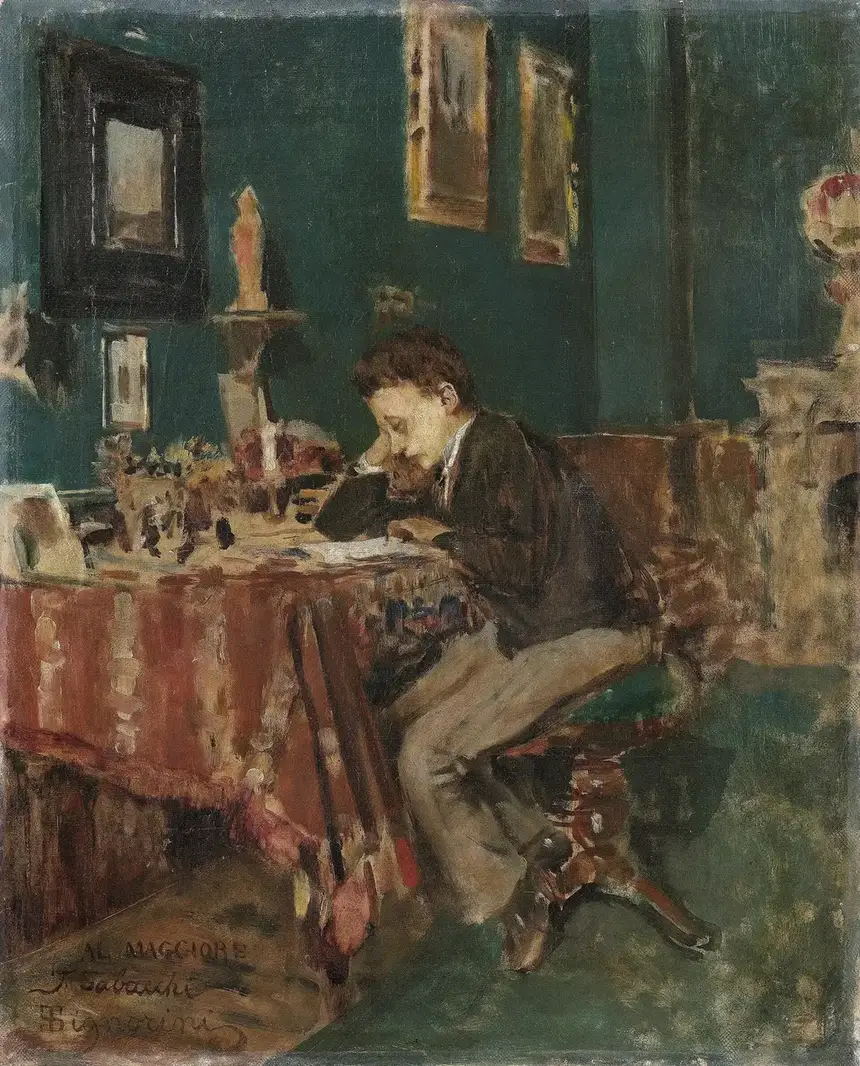
Unable to wait. The letter is carried by the body, and a body is carried by the way the paint turns.
The gesture is put down early and left alone. Overworking it would kill it.
Our painter keeps the half-tones wide, which is what makes the body look round.
Every colour in Unable to wait. The letter has a warm version and a cool version, and the painter chooses between them passage by passage.
Paint is laid on, not pushed around. That is what keeps it fresh.
The hardest passage is the quiet one, where a small mistake has nowhere to hide.
A plain wall is better than a busy one; the painting supplies the interest.
| Artist | Telemaco Signorini |
|---|---|
| Title | Unable to wait. The letter |
| Created (original) | 1867 |
| Medium | Oil on canvas, hand-painted to order |
| Reproduction | Hand-painted oil on canvas, made to order |
| Original status | Public domain (artist deceased) |
Why hand-painting matters here
What you lose in a print is the air. A press lays ink flat; a painter builds depth in layers, and the depth is what you actually see.
Edges are left soft where the form turns away and sharp where it does not. That single habit is what separates a painting from a copy.
| Aspect | Hand-painted oil | Printed canvas |
|---|---|---|
| Depth | Built in layers, catches light from the side | Flat; highlights are printed as pale ink |
| What it takes | One painter, several days, start to finish | A machine, a few minutes |
| Surface | Hand-painted oil on canvas | Ink on canvas, flat |
| Colour | Mixed for each passage, warm and cool versions | One flat value per area |
| How it ages | Warms and settles; cleanable by a conservator | Fades, then cracks at the stretcher |
The difficulty is restraint: leaving out most of what a photograph would show.
Every canvas is painted to order, so the quote follows your size, frame and destination rather than a fixed list. Tell us what you need on WhatsApp and we reply with an exact figure, usually within the hour. You deal directly with the studio that paints it — no reseller layer.
The sequence on our floor
Here is what actually happens between your message and the crate:
- Stretching and priming the support — cotton duck or linen goes onto the bars and gets its ground.
- Laying in the drawing — done by eye from the reference, not traced or projected.
- Blocking the masses — thin paint, working the whole surface rather than one corner at a time.
- Setting the key — how dark the darks go determines everything that follows.
- Colour is built up — warmer and cooler versions of each passage, laid over the underpainting.
- Detail and highlights last — put on thickly and then not touched again.
- It dries, then gets varnished — and only then is it photographed for you.
The risk with a figure subject is overworking, and the way to avoid it is knowing when to stop.
Whether to frame it
If you are shipping, an unframed canvas rolled in a tube is considerably cheaper to move than a framed one.
Frames are priced once you have chosen them, not estimated in advance.
Materials
We do not use a printer at any stage. There is no giclée, no canvas transfer, no digital underlayer. Large canvases get a cross-brace; anything over about a metre and a half needs one.
The ground is a proper acrylic sizing, so the oil does not rot the fabric over time. Stretcher bars are kiln-dried and wedged, so the canvas can be re-tensioned years later.
Looking after it
Dust it with a dry, soft brush. Keep it out of direct sun and away from radiators, and it will outlive you.
Getting the size right
Because each piece is painted from scratch, you are not limited to stock dimensions. These are the sizes clients ask for most:
| Size (inches) | Size (cm) | Best for |
|---|---|---|
| 64 × 48 in | 163 × 122 cm | Villa scale, lobby, hospitality wall |
| 48 × 36 in | 122 × 91 cm | Large living room, stairwell, loft |
| 40 × 30 in | 102 × 76 cm | Living room focal wall, above a sofa |
| 32 × 24 in | 81 × 61 cm | Living room, above a sideboard |
We will size the canvas to the room, not to a stock list. Send us the measurement. We sell DAP: the price covers the painting and the freight, and any import duties or taxes are the buyer's to settle with customs. We do not collect them and we do not estimate them.
Given the subject, this sits naturally in a living room or a study rather than a hallway.
Send the wall, the size and whether you want a frame, and we will quote.
💬 Get a Quote for Unable to wait. The letterOrder, painting, shipping
Painting takes 9–15 days. Freight is quoted as its own line on the quote, agreed before you pay anything, and never added afterwards.
In transit it is typically 7–10 business days by air, tracked door to door. Unframed canvases are rolled face-out on a tube; framed ones are corner-protected and crated.
You see photographs of the finished painting before it ships, and you tell us what to adjust. If something is not right, tell us what to adjust and we adjust it.
DAP terms: we pay the freight, you settle any duty or tax your country applies. We do not collect taxes on anyone's behalf.
Work begins on a deposit and ships on the balance. Both figures are on the quote. Report any transit damage within 48 hours with photographs and we will deal with the carrier. We will not promise a payout, but we will not leave you to argue alone either.
The practical questions
Can I see progress photos while it is being painted?
We send photographs of the finished painting for approval before it ships. Mid-process images are not part of the standard workflow.
Is there a rush option?
It depends on the canvas and what else is in the studio. Ask on WhatsApp with your size and we will tell you straight what is possible.
Does it come with a certificate of authenticity?
No, and we would be wary of anyone who issues one for a public-domain reproduction. What you receive is a hand-painted canvas and photographs of it before it ships.
What is the canvas made of?
Cotton or linen, oil colour, and varnish. Stretcher bars are wedged so the canvas can be re-tensioned later.
Can I change the size?
Yes. The canvas is painted to your measurement, not taken from a stock list.
What if it arrives damaged?
Report damage within 48 hours with photographs. We deal with the carrier rather than leaving you to argue alone.
Do you take a deposit?
Work begins on a deposit and ships once the balance is paid. Nothing is charged that is not on the quote.
Is owning a reproduction legal?
Yes. The painting is out of copyright because Telemaco Signorini died more than 70 years ago. We paint copies honestly and never claim they are originals.
Do you ship to my country?
We export to more than 20 countries. Tell us where you are and we will quote the freight as a separate line.
Does it come framed?
Frames are priced on their own line. Most clients choose after seeing the photographs.
Is it really painted by hand?
Yes. One painter, oil paint, brushes. We do not own a printer that touches canvas.
Can you paint it from a different photograph of the same work?
Yes. If you have a better reference, send it on WhatsApp and we will work from yours.