The original, and why we can paint it
Because Thomas Dewing died in 1938, this work is in the public domain. We are painting a copy of a painting — we never pass it off as the original, and neither should anyone selling you one.
Every version we make is oil on canvas, painted by one painter from start to finish. No printing is involved at any stage.
The painting was made in the years before 1938, and what we reproduce is the record of it, not the object.
What arrives is a canvas with paint on it, made by a person. That is the only thing we sell.
What the painting is doing
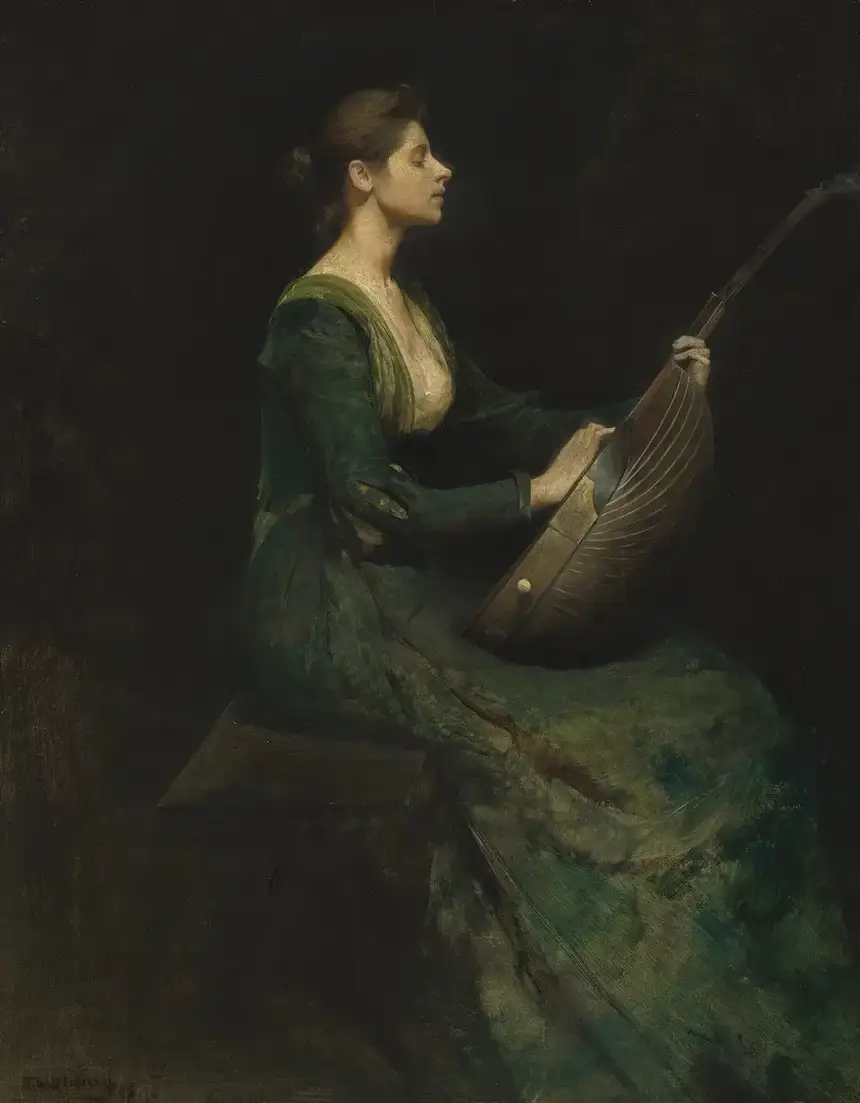
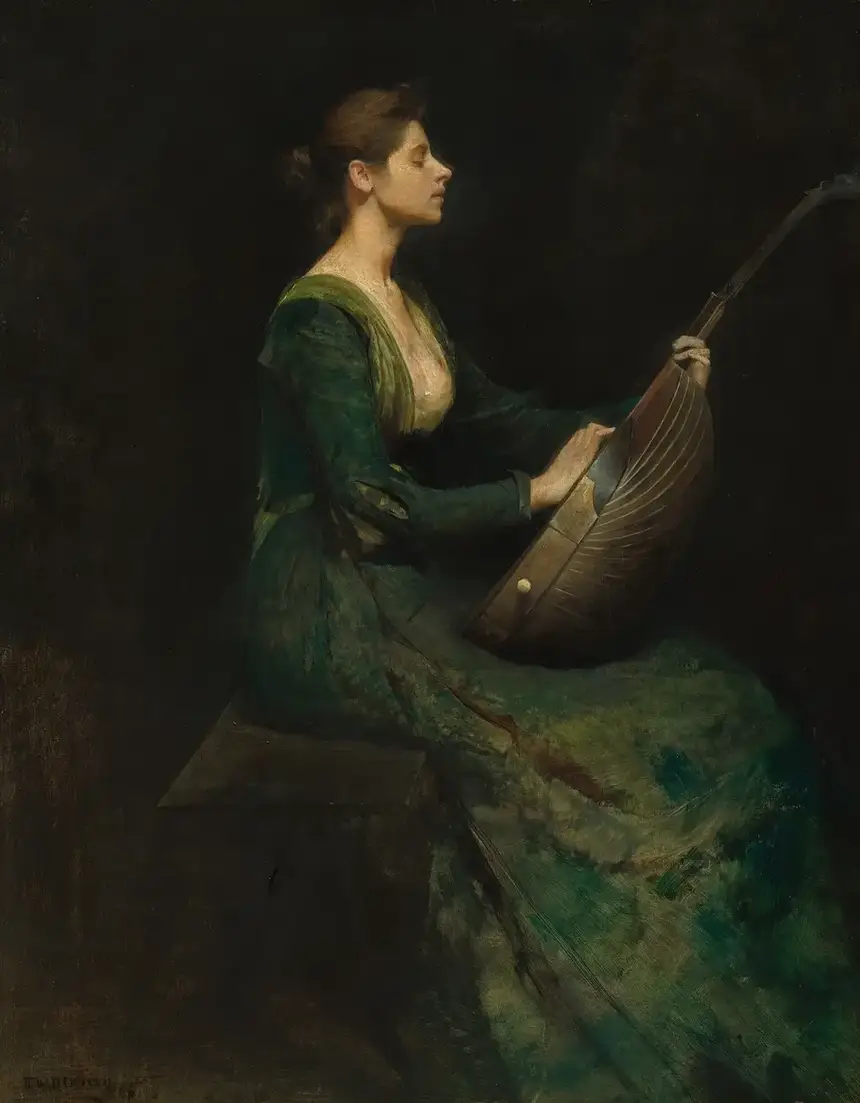
Painted by hand, Lady with a Lute, 1886 by keeps the soft edge where the face turns away — the edge a print turns into a line.
Our painter keeps the original crop, including the empty space, because the emptiness is doing a job.
The highlight on the forehead and nose is put on last and left alone.
The darks are mixed, not blackened — black straight from the tube would kill the passage.
Edges are made by the brush, not by an outline, and they are the hardest thing to copy.
The risk with a portrait is overworking, and the way to avoid it is knowing when to stop.
It is a picture for a room you use, not a corridor you walk through.
| Artist | Thomas Dewing |
|---|---|
| Title | Lady with a Lute, 1886 by |
| Created (original) | 1886 |
| Medium | Oil on canvas, hand-painted to order |
| Year | 1886 |
| Reproduction | Hand-painted oil on canvas, made to order |
| Public domain | Yes — the artist died over 70 years ago |
Hand-painted, not printed
The difference is not subtle when the two hang side by side. Ink sits on the surface; oil stands off it.
Paint goes on in the original's order — thin first, thick last — so the surface behaves the way the painter intended.
| Aspect | Hand-painted oil | Printed canvas |
|---|---|---|
| Lifespan | Slow to change; varnish can be refreshed decades later | Fades and cracks sooner |
| Colour | Mixed for each passage, warm and cool versions | One flat value per area |
| Corrections | We adjust it and repaint the passage | The file is reprinted or it is not |
| Later on | Can be restored, re-framed, handed on | Replaceable, and usually replaced |
| What it takes | One painter, several days, start to finish | A machine, a few minutes |
The difficulty is restraint: leaving out most of what a photograph would show.
Every canvas is painted to order, so the quote follows your size, frame and destination rather than a fixed list. Tell us what you need on WhatsApp and we reply with an exact figure, usually within the hour. You deal directly with the studio that paints it — no reseller layer.
How the canvas is built
The order of work matters as much as the work itself. Ours runs like this:
- The canvas is stretched and primed — cotton or linen, sized and ready before any paint goes near it.
- The drawing goes down — charcoal or thin paint, done by eye rather than traced from a printout.
- The first colour pass — thin and simple, establishing the main shapes only.
- The values are established — this is the stage that decides whether the painting works.
- Building the colour — a warm and a cool version of each passage, put down in order.
- Detail and highlights last — put on thickly and then not touched again.
- Drying and varnishing — the final varnish goes on once the paint has set, before we photograph it.
Matching the original's degree of finish is harder than matching its colours.
Frames
Frames are priced once you have chosen them, not estimated in advance.
A frame is a separate line on the quote, not a bundle. You choose it once the painting exists.
Looking after it
Dust it with a dry, soft brush. Keep it out of direct sun and away from radiators, and it will outlive you.
What it is made of
The varnish is removable, so a conservator can clean the painting in fifty years without touching the paint. Oil paint dries by oxidation, not evaporation, which is why a finished canvas needs weeks before it travels.
We use a neutral-sized ground so the whites stay warm rather than going blue over time. We buy pigment in tubes from the same suppliers the village has used for years, not in bulk drums.
What size works
Because each piece is painted from scratch, you are not limited to stock dimensions. These are the sizes clients ask for most:
| Size (inches) | Size (cm) | Best for |
|---|---|---|
| 64 × 48 in | 163 × 122 cm | Villa scale, lobby, hospitality wall |
| 48 × 36 in | 122 × 91 cm | Large living room, stairwell, loft |
| 40 × 30 in | 102 × 76 cm | Living room focal wall, above a sofa |
| 32 × 24 in | 81 × 61 cm | Living room, above a sideboard |
| 30 × 24 in | 76 × 61 cm | Dining room, bedroom feature wall |
If your wall is an odd shape, send the measurement and we will work to it. Proportions from the original are kept unless you ask us to change them. Duties and import taxes are the buyer's account (DAP). Your customs authority sets them; we do not.
Hang it at eye level — roughly 145 cm from the floor to the centre — and it will hold the wall.
Send the wall, the size and whether you want a frame, and we will quote.
💬 Get a Quote for Lady with a Lute, 1886 by Thomas Wilmer DewingHow it reaches you
Allow 9–15 days for the painting itself. Shipping is a separate line on your quote — you see it before payment, not after.
Air freight runs about 7–10 business days, tracked, to your door. We send photographs of the finished painting before it is packed, and again once it is boxed.
You approve the painting from photographs before it is packed — that is the checkpoint. Adjustments are part of the process. Say what you want different and it gets done.
Our terms are DAP, meaning the freight is paid by us and any import charges are yours to settle. We will not estimate them, because the figure is your customs authority's to set.
Work begins on a deposit and ships on the balance. Both figures are on the quote. Damage in transit should be reported to us within 48 hours, with photographs. We pursue it with the carrier rather than promising a refund.
What people ask us
What happens after I message you?
You tell us the painting, size and whether you want a frame. We quote, a painter starts on your canvas, and you get photographs before it ships.
Does it come with a certificate of authenticity?
No, and we would be wary of anyone who issues one for a public-domain reproduction. What you receive is a hand-painted canvas and photographs of it before it ships.
What is the canvas made of?
Cotton or linen, oil colour, and varnish. Stretcher bars are wedged so the canvas can be re-tensioned later.
Who pays the import duty?
The buyer does. Terms are DAP: duties and taxes, where they apply, are paid on arrival. We never add a tax line of our own.
Is owning a reproduction legal?
Yes. Thomas Dewing died more than 70 years ago, so the work is in the public domain and owning a hand-painted version is legal anywhere. We never pass ours off as the original.
Does it come framed?
Framing is quoted separately, so you can decide once you have seen the finished painting in photographs.
Can you paint a different work by Thomas Dewing?
Yes — send us the image, or look through the other Thomas Dewing works on the site.
Can you change the colours to suit my room?
Sometimes. We will adjust the palette if it can be done without ruining the picture, and say so if it cannot.
How long does it take?
Painting takes 9–15 days. Air freight is usually 7–10 business days on top of that, tracked.
Can you paint it from a different photograph of the same work?
Yes. If you have a better reference, send it on WhatsApp and we will work from yours.
Can I change the size?
Yes. The canvas is painted to your measurement, not taken from a stock list.