Where this painting comes from
Tom Roberts died in 1931. That puts the painting well outside copyright, which is why we can paint it and you can own it anywhere in the world.
We paint it in oil on canvas, one at a time, in Dafen Village. Nothing is printed, scanned or transferred.
The painting was made in the years before 1931, and what we reproduce is the record of it, not the object.
If you want something printed, we are the wrong workshop. We do not own a printer that touches canvas.
What to look at
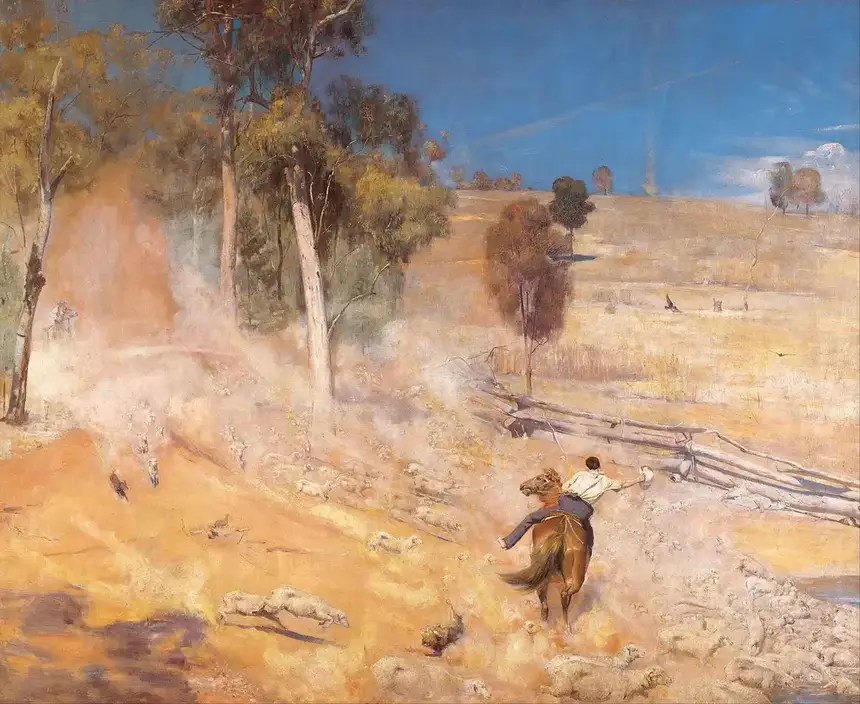
A break away! is not a postcard. There is a decision in every zone of the canvas, and the decision is visible.
Nothing in A break away! is centred for the sake of being centred; the weight sits where the painter wanted it.
Where the source has light coming through the paint, we glaze rather than paint opaque white.
The saturation is deliberately uneven: strongest at the focal point, weaker everywhere else.
Our painter loads the brush differently for the near and far passages, and you can read the difference.
This one repaints badly, so our painter gets the values right early and leaves them.
In a bedroom it works above a headboard, sized to about two-thirds of the furniture width.
| Artist | Tom Roberts |
|---|---|
| Title | A break away! |
| Created (original) | 1891 |
| Medium | Oil on canvas, hand-painted to order |
| Our version | Oil on canvas, painted by hand to order |
| Copyright | Public domain; the original is out of copyright |
What a print loses
The difference is not subtle when the two hang side by side. Ink sits on the surface; oil stands off it.
Edges are left soft where the form turns away and sharp where it does not. That single habit is what separates a painting from a copy.
| Aspect | Hand-painted oil | Printed canvas |
|---|---|---|
| Depth | Built in layers, catches light from the side | Flat; highlights are printed as pale ink |
| Colour | Mixed for each passage, warm and cool versions | One flat value per area |
| Value over time | Can be re-stretched, cleaned and re-framed | Little value beyond the print |
| Edge quality | Soft where the form turns, sharp where it does not | Uniformly sharp or uniformly blurred |
| How it ages | Warms and settles; cleanable by a conservator | Fades, then cracks at the stretcher |
Anyone can copy the shapes. The skill is in the transitions, and that is what takes the days.
Every canvas is painted to order, so the quote follows your size, frame and destination rather than a fixed list. Tell us what you need on WhatsApp and we reply with an exact figure, usually within the hour. You are talking to the people who will actually paint it, not a middleman.
From blank canvas to finished painting
The order of work matters as much as the work itself. Ours runs like this:
- The canvas is stretched and primed — cotton or linen, sized and ready before any paint goes near it.
- Laying in the drawing — done by eye from the reference, not traced or projected.
- Blocking the masses — thin paint, working the whole surface rather than one corner at a time.
- Getting the values right — the stage that decides whether the finished painting holds together.
- The colour passes — each area gets its own mixture rather than one colour used throughout.
- Finishing passes — the loaded highlights go on at the end and stay there.
- It dries, then gets varnished — and only then is it photographed for you.
The risk with a landscape is overworking, and the way to avoid it is knowing when to stop.
Frames
If you are shipping, an unframed canvas rolled in a tube is considerably cheaper to move than a framed one.
We can supply a simple floater frame, a traditional gilt, or nothing at all. It is your call.
Living with it
Once the varnish has cured the surface can be cleaned by a conservator, but in a normal house it will not need it for decades.
What goes into it
The varnish is removable, so a conservator can clean the painting in fifty years without touching the paint. Large canvases get a cross-brace; anything over about a metre and a half needs one.
Nothing is sprayed, sealed or laminated. The surface you see is paint and varnish, and that is all. Brushes, knives and rags. That is the equipment list; there is no machine in the process.
Canvas sizes
Because each piece is painted from scratch, you are not limited to stock dimensions. These are the sizes clients ask for most:
| Size (inches) | Size (cm) | Best for |
|---|---|---|
| 16 × 12 in | 40 × 30 cm | A shelf, a small wall, a gallery group |
| 64 × 48 in | 163 × 122 cm | Villa scale, lobby, hospitality wall |
| 48 × 36 in | 122 × 91 cm | Large living room, stairwell, loft |
| 40 × 30 in | 102 × 76 cm | Living room focal wall, above a sofa |
| 32 × 24 in | 81 × 61 cm | Living room, above a sideboard |
| 30 × 24 in | 76 × 61 cm | Dining room, bedroom feature wall |
If your wall is an odd shape, send the measurement and we will work to it. Proportions from the original are kept unless you ask us to change them. We quote DAP, so any duty or tax your country charges is settled by you at import. We do not add a tax line of our own.
A plain wall is better than a busy one; the painting supplies the interest.
Message us the dimensions you have in mind and we will come back with a figure.
💬 Get a Quote for A break away!How it reaches you
Painting takes 9–15 days. Freight is quoted as its own line on the quote, agreed before you pay anything, and never added afterwards.
In transit it is typically 7–10 business days by air, tracked door to door. Every shipment goes out with tracking. We do not send anything untracked.
Nothing ships before you have seen it. Photographs of the finished painting go to you first. If something is not right, tell us what to adjust and we adjust it.
Duties and import taxes are the buyer's account (DAP). Your customs authority sets them; we do not.
A deposit starts the canvas and books the painter's time; the balance is due before the crate leaves. If a crate arrives damaged, send us photographs within 48 hours and contact us directly — we will sort it out with you.
The practical questions
What about duties and import taxes?
Those are the buyer's responsibility (DAP). The amounts are set by your customs authority, not by us.
What if my wall is an unusual shape?
That is normal for us. Send the measurements and we will work out a canvas proportion that suits the space.
How do I know what size will look right?
Measure the wall and send a photograph. We will say honestly if the canvas you have in mind is too small for the space, which is the most common mistake.
Is owning a reproduction legal?
Yes. Tom Roberts died more than 70 years ago, so the work is in the public domain and owning a hand-painted version is legal anywhere. We never pass ours off as the original.
Can you paint a different work by Tom Roberts?
Yes — send us the image, or look through the other Tom Roberts works on the site.
Do you ship to my country?
We ship to over 20 countries. Give us your city and the freight appears as its own line on the quote.
How do I hang it?
Roughly 145 cm from floor to centre works for most rooms. Tell us your wall and we will give you the measurement.
Is it really painted by hand?
Yes — oil on canvas, brush and knife. There is no printing, no giclée and no canvas transfer at any stage.
Do you take a deposit?
A deposit starts the canvas and the balance falls due before it ships. Both figures appear on the quote.
What if it arrives damaged?
Report damage within 48 hours with photographs. We deal with the carrier rather than leaving you to argue alone.
Will I see it before it ships?
Yes — photographs of the actual painting go to you first, and nothing is packed until you have seen them.
Who pays the import duty?
You do. We sell DAP, so any duty or tax your customs authority charges is settled by you at import. We do not collect it and we do not estimate it.