About Sleep
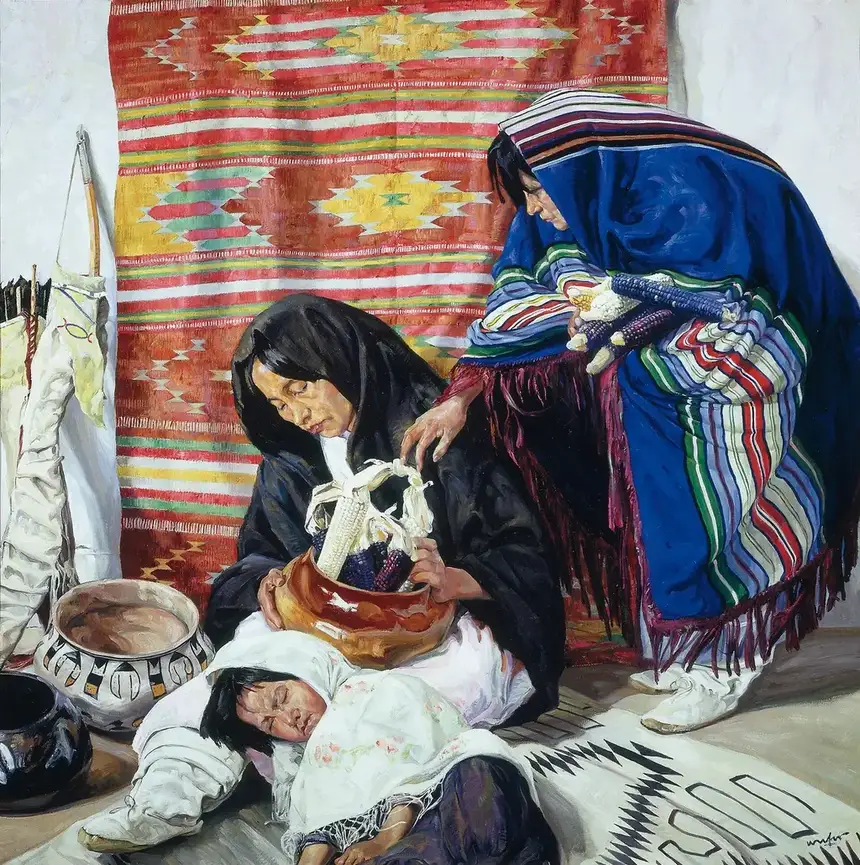
Because Walter Ufer died in 1936, this work is in the public domain. We are painting a copy of a painting — we never pass it off as the original, and neither should anyone selling you one.
Every version we make is oil on canvas, painted by one painter from start to finish. No printing is involved at any stage.
It is an original composition painted before 1936, and our version is painted from the surviving image of it.
If you want something printed, we are the wrong workshop. We do not own a printer that touches canvas.
What the painting is doing
The reason Sleep still works as a painting is that it was built as paint, not as a picture of a place.
The composition is built on a few large masses. Get those right and the rest follows.
We do not brighten the picture for reproduction. The original's key is kept as it is.
We keep the original's palette rather than brightening it, even where a modern eye would.
Our painter uses a larger brush than you would expect, which is why the passages stay simple.
The difficulty is restraint: leaving out most of what a photograph would show.
It suits a room with warm, low light. Strong downlighting flattens the surface.
| Artist | Walter Ufer |
|---|---|
| Title | Sleep |
| Created (original) | 1923 |
| Medium | Oil on canvas, hand-painted to order |
| Reproduction | Hand-painted oil on canvas, made to order |
| Original status | Public domain (artist deceased) |
What a print loses
The difference is not subtle when the two hang side by side. Ink sits on the surface; oil stands off it.
Paint goes on in the original's order — thin first, thick last — so the surface behaves the way the painter intended.
| Aspect | Hand-painted oil | Printed canvas |
|---|---|---|
| Changing something | Tell us and the passage gets repainted | Usually means starting the file again |
| Available sizes | Whatever you need, painted to order | What the printer can output |
| Depth | Built in layers, catches light from the side | Flat; highlights are printed as pale ink |
| What it takes | One painter, several days, start to finish | A machine, a few minutes |
| Later on | Can be restored, re-framed, handed on | Replaceable, and usually replaced |
The difficult part is not the detail. It is keeping the whole canvas at the same stage of finish.
Every canvas is painted to order, so the quote follows your size, frame and destination rather than a fixed list. Tell us what you need on WhatsApp and we reply with an exact figure, usually within the hour. You are talking to the people who will actually paint it, not a middleman.
How it gets painted
No two canvases are painted the same way, but the sequence is always this:
- The canvas is stretched and primed — cotton or linen, sized and ready before any paint goes near it.
- A loose underdrawing — proportions checked by eye against the source image.
- The big shapes are blocked in — thin paint, one colour at a time, the whole canvas at once.
- The values are established — this is the stage that decides whether the painting works.
- The colour passes — each area gets its own mixture rather than one colour used throughout.
- Finishing passes — the loaded highlights go on at the end and stay there.
- It dries, then gets varnished — and only then is it photographed for you.
This one repaints badly, so our painter gets the values right early and leaves them.
Materials
Brushes, knives and rags. That is the equipment list; there is no machine in the process. Pigment is artist-grade oil colour, not acrylic and not house paint. It behaves differently and it lasts.
Nothing is sprayed, sealed or laminated. The surface you see is paint and varnish, and that is all. The varnish is removable, so a conservator can clean the painting in fifty years without touching the paint.
Looking after it
Once the varnish has cured the surface can be cleaned by a conservator, but in a normal house it will not need it for decades.
Framing
Most clients wait for the photographs before choosing a frame, which is the sensible order.
A frame is a separate line on the quote, not a bundle. You choose it once the painting exists.
What size works
You are not choosing from a list; you are telling us a measurement. These are the common ones:
| Size (inches) | Size (cm) | Best for |
|---|---|---|
| 30 × 24 in | 76 × 61 cm | Dining room, bedroom feature wall |
| 24 × 20 in | 60 × 50 cm | Study, home office, above a desk |
| 20 × 16 in | 50 × 40 cm | Bedroom, hallway, above a console |
| 16 × 12 in | 40 × 30 cm | A shelf, a small wall, a gallery group |
If your wall is an odd shape, send the measurement and we will work to it. Proportions from the original are kept unless you ask us to change them. DAP terms: we pay the freight, you settle any duty or tax your country applies. We do not collect taxes on anyone's behalf.
This reads well above a sofa or a sideboard, where it will be seen from two to three metres.
Message us the dimensions you have in mind and we will come back with a figure.
💬 Get a Quote for SleepTimeline and shipping
Allow 9–15 days for the painting itself. Shipping is a separate line on your quote — you see it before payment, not after.
Transit is usually 7–10 business days, tracked all the way. Rolled in a tube it travels cheaper and safer than framed; most overseas clients take it that way.
You see photographs of the finished painting before it ships, and you tell us what to adjust. Adjustments are part of the process. Say what you want different and it gets done.
Import charges, where they exist, are the buyer's responsibility (DAP). We never add them to the quote and never guess what they will be.
You pay a deposit to start and the remainder before shipping. Nothing is hidden in between. Report any transit damage within 48 hours with photographs and we will deal with the carrier. We will not promise a payout, but we will not leave you to argue alone either.
Questions worth asking
Why not just print it?
A print flattens the surface into a poster: the distance collapses and the highlights turn to grey. Paint keeps the depth and the texture the original was built from.
Can I see progress photos while it is being painted?
We send photographs of the finished painting for approval before it ships. Mid-process images are not part of the standard workflow.
Does it come with a certificate of authenticity?
No, and we would be wary of anyone who issues one for a public-domain reproduction. What you receive is a hand-painted canvas and photographs of it before it ships.
Is it really painted by hand?
Yes — oil on canvas, brush and knife. There is no printing, no giclée and no canvas transfer at any stage.
Can you paint it from a different photograph of the same work?
Yes. If you have a better reference, send it on WhatsApp and we will work from yours.
What is the canvas made of?
Cotton or linen, oil colour, and varnish. Stretcher bars are wedged so the canvas can be re-tensioned later.
How do I hang it?
Centre it at about 145 cm from the floor, or two-thirds the width of the furniture below it. We will tell you the exact number for your wall.
Will I see it before it ships?
Yes. We send photographs of the finished canvas and wait for your reply before packing.
Does it come framed?
Frames are priced on their own line. Most clients choose after seeing the photographs.
Do you ship to my country?
We export to more than 20 countries. Tell us where you are and we will quote the freight as a separate line.
Can I change the size?
Any size you like. We paint to the number you give us rather than to a standard range.
What does it cost?
There is no price list, because the number depends on your size and frame. Message us and we will quote exactly.