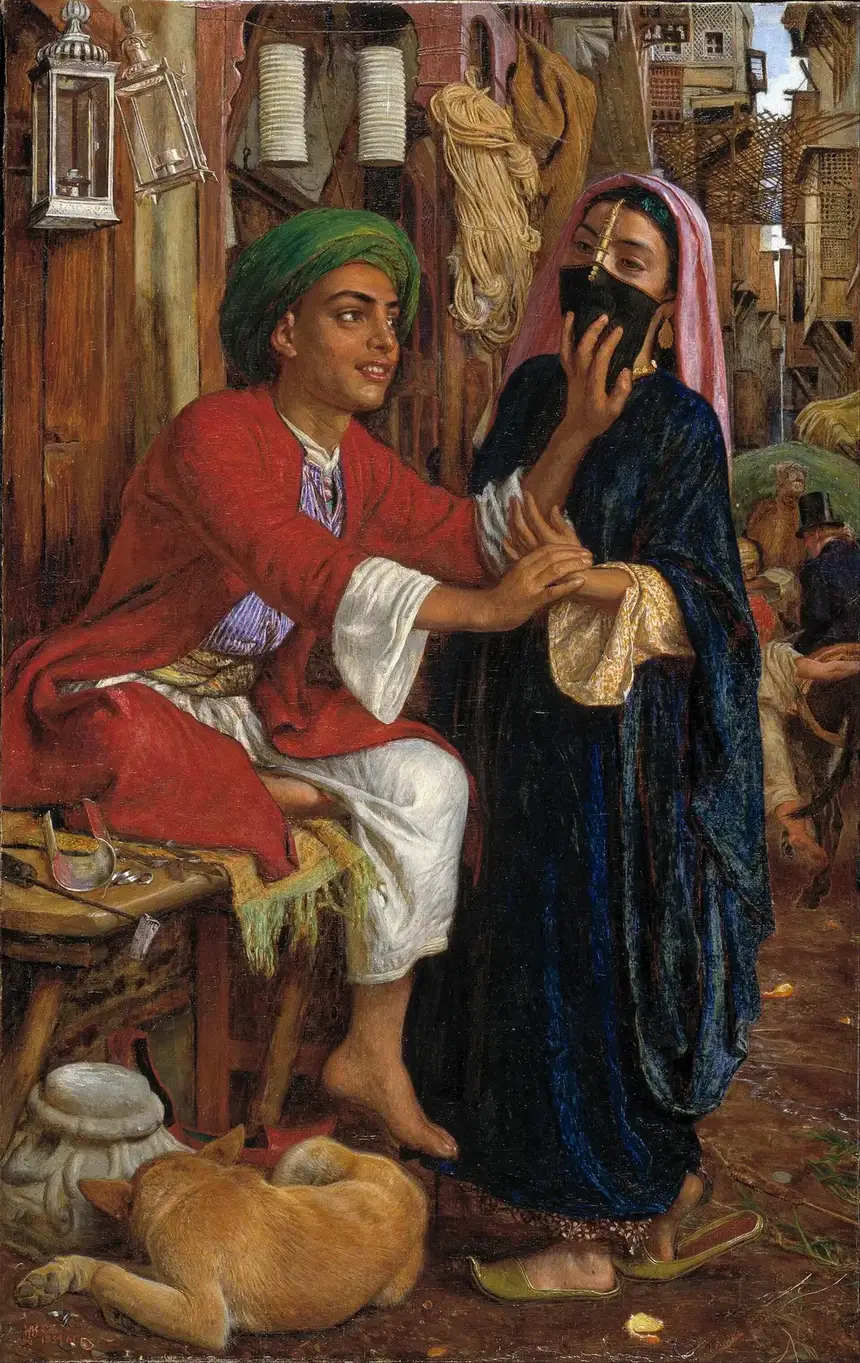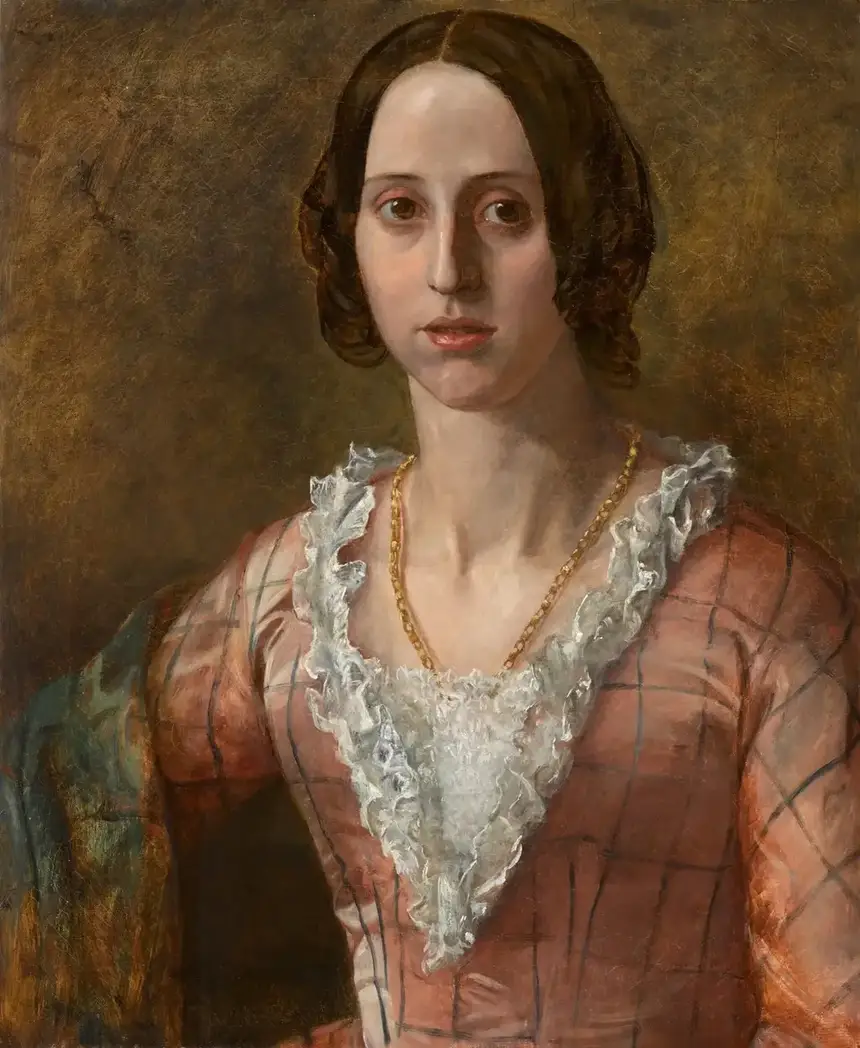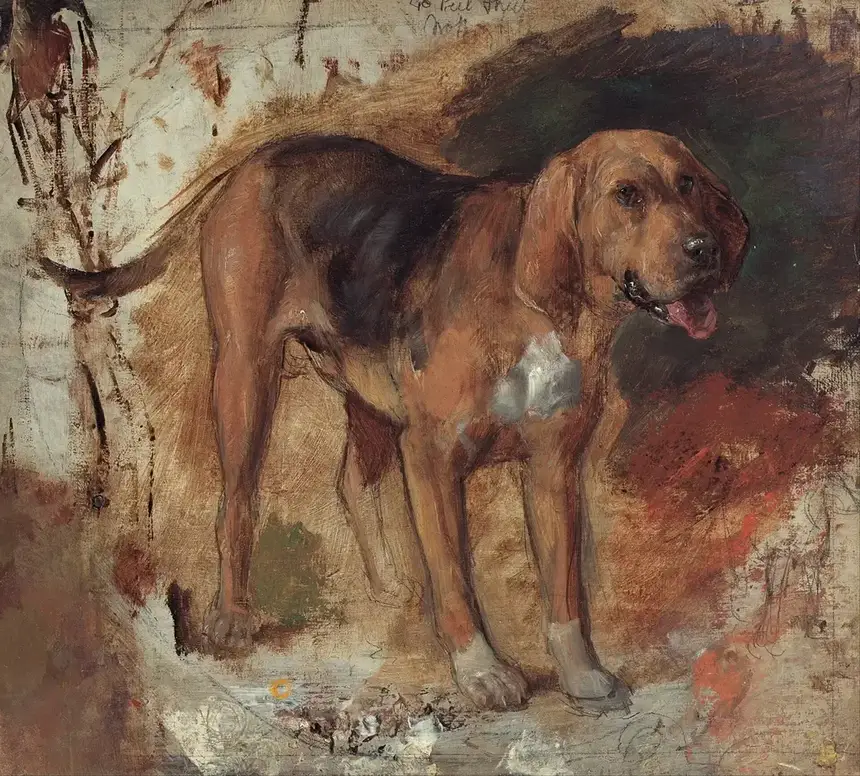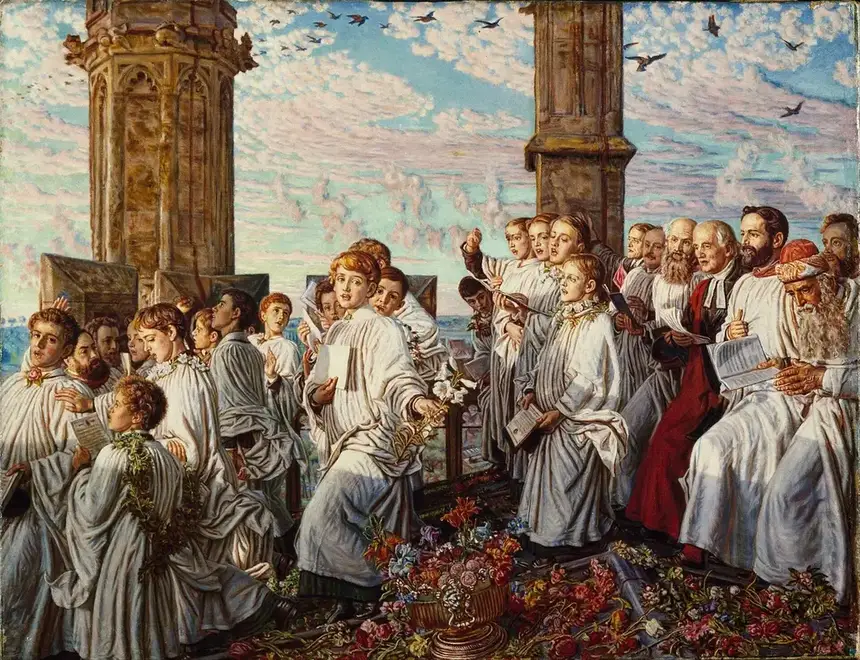
About the original
William Holman Hunt died in 1910, so the work has been in the public domain for decades. Reproducing it by hand is legal, and so is owning one.
Ours is a painting made with brushes. There is no giclée, no canvas transfer and no digital underlayer anywhere in the process.
It is an original composition painted before 1910, and our version is painted from the surviving image of it.
If you want something printed, we are the wrong workshop. We do not own a printer that touches canvas.
Looking at it properly
May Morning on Magdalen depends on the painter knowing anatomy, not just copying a photograph of it.
We keep the horizon low, as in the source, so the animal has room.
The ground is kept lower in key than the animal so the animal reads first.
Temperature does the work of contrast in the quiet areas, where value differences are small.
The thick paint is kept for the light and the thin paint for the dark, which is the traditional way round.
Anyone can copy the shapes. The skill is in the transitions, and that is what takes the days.
This reads well above a sofa or a sideboard, where it will be seen from two to three metres.
| Artist | William Holman Hunt |
|---|---|
| Title | May Morning on Magdalen |
| Created (original) | 1888 |
| Medium | Oil on canvas, hand-painted to order |
| Reproduction | Hand-painted oil on canvas, made to order |
| Copyright | Public domain; the original is out of copyright |
What a print loses
A print reproduces the shapes and drops the substance. It is the substance you are buying.
Edges are left soft where the form turns away and sharp where it does not. That single habit is what separates a painting from a copy.
| Aspect | Hand-painted oil | Printed canvas |
|---|---|---|
| How it ages | Warms and settles; cleanable by a conservator | Fades, then cracks at the stretcher |
| Corrections | We adjust it and repaint the passage | The file is reprinted or it is not |
| Edge quality | Soft where the form turns, sharp where it does not | Uniformly sharp or uniformly blurred |
| Handling of colour | Mixed on the palette and finished on the canvas | Fixed by the colour profile |
| Sense of depth | Real, created by layers of paint | Simulated by darker ink |
The risk with an animal subject is overworking, and the way to avoid it is knowing when to stop.
Every canvas is painted to order, so the quote follows your size, frame and destination rather than a fixed list. Tell us what you need on WhatsApp and we reply with an exact figure, usually within the hour. No resellers, no drop-shipper. The painter's studio handles your commission from first message to final crate.
How the canvas is built
The order of work matters as much as the work itself. Ours runs like this:
- We start with the canvas itself — stretched, sized and left to settle before any colour is mixed.
- The drawing goes down — charcoal or thin paint, done by eye rather than traced from a printout.
- The big shapes are blocked in — thin paint, one colour at a time, the whole canvas at once.
- Setting the key — how dark the darks go determines everything that follows.
- Colour is built up — warmer and cooler versions of each passage, laid over the underpainting.
- The detail and highlights go on — last, loaded, and left alone once they are down.
- Left to dry before varnish — nothing is photographed or packed until the surface is ready.
The difficulty is restraint: leaving out most of what a photograph would show.
Materials
Nothing is sprayed, sealed or laminated. The surface you see is paint and varnish, and that is all. Large canvases get a cross-brace; anything over about a metre and a half needs one.
We buy pigment in tubes from the same suppliers the village has used for years, not in bulk drums. Pigment is artist-grade oil colour, not acrylic and not house paint. It behaves differently and it lasts.
Keeping it
Once the varnish has cured the surface can be cleaned by a conservator, but in a normal house it will not need it for decades.
Frames
Frames are priced once you have chosen them, not estimated in advance.
Most clients wait for the photographs before choosing a frame, which is the sensible order.
Sizing it
Any size is possible. These are simply the ones that come up most often in quotes:
| Size (inches) | Size (cm) | Best for |
|---|---|---|
| 64 × 48 in | 163 × 122 cm | Villa scale, lobby, hospitality wall |
| 48 × 36 in | 122 × 91 cm | Large living room, stairwell, loft |
| 40 × 30 in | 102 × 76 cm | Living room focal wall, above a sofa |
| 32 × 24 in | 81 × 61 cm | Living room, above a sideboard |
| 30 × 24 in | 76 × 61 cm | Dining room, bedroom feature wall |
| 24 × 20 in | 60 × 50 cm | Study, home office, above a desk |
Anything outside this table is fine — we paint to the number you give us. Import charges, where they exist, are the buyer's responsibility (DAP). We never add them to the quote and never guess what they will be.
For a stairwell or a double-height space, go larger than you think — the composition was built for distance.
Give us your size and framing preference and you will have a quote shortly.
💬 Get a Quote for May Morning on Magdalen College, Oxford, Ancient Annual CeremonyGetting it to you
Allow 9–15 days for the painting itself. Shipping is a separate line on your quote — you see it before payment, not after.
In transit it is typically 7–10 business days by air, tracked door to door. Every shipment goes out with tracking. We do not send anything untracked.
You see photographs of the finished painting before it ships, and you tell us what to adjust. Changes are handled by telling us what to change; we change it and send new photographs.
Shipments go out DAP. If your customs office charges duty or tax on arrival, that is between you and them — we do not collect it and we do not put a number on it.
You pay a deposit to start and the remainder before shipping. Nothing is hidden in between. If a crate arrives damaged, send us photographs within 48 hours and contact us directly — we will sort it out with you.
The practical questions
Will the light effects survive reproduction?
Sunrise and sunset passages are the hardest thing to copy mechanically, and the easiest to get wrong by hand. The painter builds the glow in layers underneath, the way the original does.
Does it come with a certificate of authenticity?
No, and we would be wary of anyone who issues one for a public-domain reproduction. What you receive is a hand-painted canvas and photographs of it before it ships.
What happens after I message you?
You tell us the painting, size and whether you want a frame. We quote, a painter starts on your canvas, and you get photographs before it ships.
Can I change the size?
Any size you like. We paint to the number you give us rather than to a standard range.
Does it come framed?
Framing is quoted separately, so you can decide once you have seen the finished painting in photographs.
How do I hang it?
Roughly 145 cm from floor to centre works for most rooms. Tell us your wall and we will give you the measurement.
How long does it take?
Allow 9–15 days for the painting itself, then roughly 7–10 business days in transit.
What is the canvas made of?
Cotton or linen, oil colour, and varnish. Stretcher bars are wedged so the canvas can be re-tensioned later.
Who pays the import duty?
You do. We sell DAP, so any duty or tax your customs authority charges is settled by you at import. We do not collect it and we do not estimate it.
Can you paint a different work by William Holman Hunt?
Yes — send us the image, or look through the other William Holman Hunt works on the site.
Will I see it before it ships?
Yes — photographs of the actual painting go to you first, and nothing is packed until you have seen them.
Do you ship to my country?
We ship to over 20 countries. Give us your city and the freight appears as its own line on the quote.