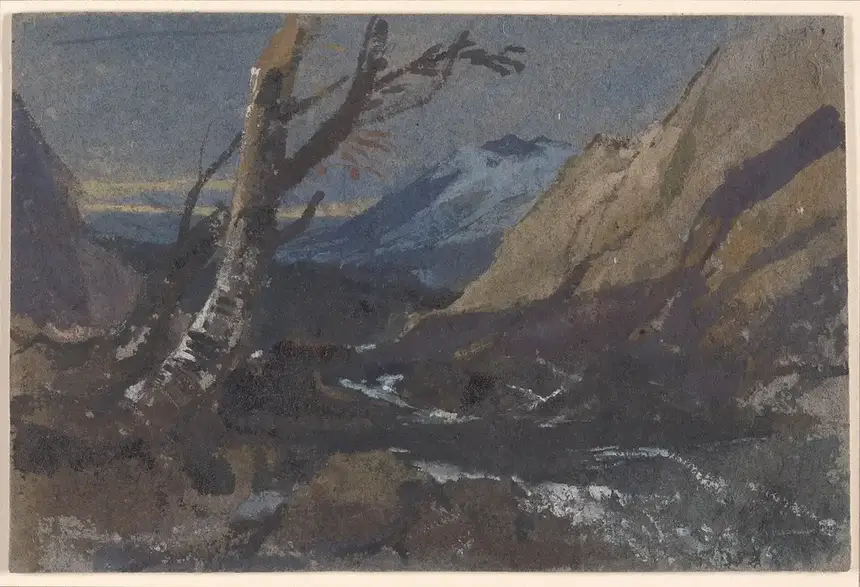
About Study of Trees by a Mountain
William James Müller died in 1845, so the work has been in the public domain for decades. Reproducing it by hand is legal, and so is owning one.
Ours is a painting made with brushes. There is no giclée, no canvas transfer and no digital underlayer anywhere in the process.
It is an original composition painted before 1845, and our version is painted from the surviving image of it.
You are buying a painting, not a file. That distinction is the whole business we are in.
Looking at it properly
This is a painting about paint. That sounds like a platitude until you stand next to one and look across the surface.
The structure is simple and the interest is in the surface, which is the hardest combination to reproduce.
Where the source relies on reflected light, we put it in. Removing it makes the form look like cardboard.
Colour here is mixed for the passage, not for the object, which is why nothing looks like it was filled in.
The marks have a direction, and the direction follows the form.
Anyone can copy the shapes. The skill is in the transitions, and that is what takes the days.
It works best on a wall you pass rather than one you sit and stare at — the paint rewards a moving eye.
| Artist | William James Müller |
|---|---|
| Title | Study of Trees by a Mountain Stream |
| Created (original) | 1833 |
| Medium | Oil on canvas, hand-painted to order |
| Our version | Oil on canvas, painted by hand to order |
| Original status | Public domain (artist deceased) |
What a print loses
Prints are good at information and bad at paint. This subject is mostly paint.
Paint goes on in the original's order — thin first, thick last — so the surface behaves the way the painter intended.
| Aspect | Hand-painted oil | Printed canvas |
|---|---|---|
| Available sizes | Whatever you need, painted to order | What the printer can output |
| Time to make | Days of one painter's working time | Minutes |
| Value over time | Can be re-stretched, cleaned and re-framed | Little value beyond the print |
| Impasto | Real paint standing off the canvas | Flat ink, sometimes embossed to imitate |
| How it ages | Warms and settles; cleanable by a conservator | Fades, then cracks at the stretcher |
The passage that will take longest is the one that looks simplest.
Every canvas is painted to order, so the quote follows your size, frame and destination rather than a fixed list. Tell us what you need on WhatsApp and we reply with an exact figure, usually within the hour. No resellers, no drop-shipper. The painter's studio handles your commission from first message to final crate.
From blank canvas to finished painting
Here is what actually happens between your message and the crate:
- Stretching and priming the support — cotton duck or linen goes onto the bars and gets its ground.
- Laying in the drawing — done by eye from the reference, not traced or projected.
- The big shapes are blocked in — thin paint, one colour at a time, the whole canvas at once.
- Getting the values right — the stage that decides whether the finished painting holds together.
- The colour passes — each area gets its own mixture rather than one colour used throughout.
- The detail and highlights go on — last, loaded, and left alone once they are down.
- Drying and varnishing — the final varnish goes on once the paint has set, before we photograph it.
The hardest passage is the quiet one, where a small mistake has nowhere to hide.
Whether to frame it
Frames are priced once you have chosen them, not estimated in advance.
Frames are priced once you have chosen them, not estimated in advance.
What goes into it
We use a neutral-sized ground so the whites stay warm rather than going blue over time. Large canvases get a cross-brace; anything over about a metre and a half needs one.
Nothing is sprayed, sealed or laminated. The surface you see is paint and varnish, and that is all. The varnish is removable, so a conservator can clean the painting in fifty years without touching the paint.
Keeping it
Oil paint needs very little: no water, no cleaners, no sprays. A dry brush and a stable room.
Choosing a size
Because each piece is painted from scratch, you are not limited to stock dimensions. These are the sizes clients ask for most:
| Size (inches) | Size (cm) | Best for |
|---|---|---|
| 32 × 24 in | 81 × 61 cm | Living room, above a sideboard |
| 30 × 24 in | 76 × 61 cm | Dining room, bedroom feature wall |
| 24 × 20 in | 60 × 50 cm | Study, home office, above a desk |
| 20 × 16 in | 50 × 40 cm | Bedroom, hallway, above a console |
We will size the canvas to the room, not to a stock list. Send us the measurement. Terms are DAP. Import duties and taxes, where they apply, are paid by the buyer on arrival — we never collect them in advance and never guess at the amount.
It wants a wall where the light rakes across it, because the surface is part of the picture.
Give us your size and framing preference and you will have a quote shortly.
💬 Get a Quote for Study of Trees by a Mountain Stream MET DP-20677From order to your wall
From order to finished canvas is 9–15 days. Freight appears as a separate line on the quote and is fixed before you pay.
Transit is usually 7–10 business days, tracked all the way. Unframed canvases are rolled face-out on a tube; framed ones are corner-protected and crated.
Nothing ships before you have seen it. Photographs of the finished painting go to you first. Changes are handled by telling us what to change; we change it and send new photographs.
Import charges, where they exist, are the buyer's responsibility (DAP). We never add them to the quote and never guess what they will be.
Work begins on a deposit and ships on the balance. Both figures are on the quote. Damage in transit should be reported to us within 48 hours, with photographs. We pursue it with the carrier rather than promising a refund.
What people ask us
How do I know what size will look right?
Measure the wall and send a photograph. We will say honestly if the canvas you have in mind is too small for the space, which is the most common mistake.
Do you work from my own photograph?
Yes, though that is a separate service. This page is for a hand-painted version of {title}; for a photo-to-painting commission, send the image on WhatsApp.
What about duties and import taxes?
Those are the buyer's responsibility (DAP). The amounts are set by your customs authority, not by us.
What is the canvas made of?
Cotton duck as standard, linen on request, artist-grade oil paint, and a final varnish once the paint is fully dry.
Is it really painted by hand?
Yes — oil on canvas, brush and knife. There is no printing, no giclée and no canvas transfer at any stage.
Who pays the import duty?
You do. We sell DAP, so any duty or tax your customs authority charges is settled by you at import. We do not collect it and we do not estimate it.
What if it arrives damaged?
Report damage within 48 hours with photographs. We deal with the carrier rather than leaving you to argue alone.
Can I change the size?
Any size you like. We paint to the number you give us rather than to a standard range.
Do you ship to my country?
We export to more than 20 countries. Tell us where you are and we will quote the freight as a separate line.
How do I hang it?
Roughly 145 cm from floor to centre works for most rooms. Tell us your wall and we will give you the measurement.
Can you paint it from a different photograph of the same work?
Send your own reference image and we will paint from that instead.
Does it come framed?
Frames are priced on their own line. Most clients choose after seeing the photographs.