What you are buying into
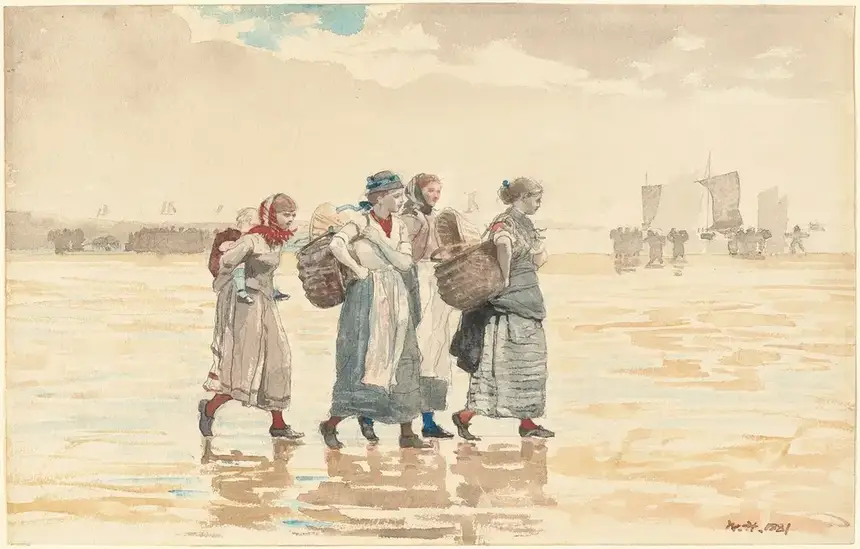
Because Winslow Homer died in 1910, this work is in the public domain. We are painting a copy of a painting — we never pass it off as the original, and neither should anyone selling you one.
Ours is a painting made with brushes. There is no giclée, no canvas transfer and no digital underlayer anywhere in the process.
It is an original composition painted before 1910, and our version is painted from the surviving image of it.
What arrives is a canvas with paint on it, made by a person. That is the only thing we sell.
Where the painting lives
There is a reason a seascape is the hardest thing to print and the easiest thing to paint: the paint itself carries the depth.
The near ground is painted loaded and the far ground thin. That single decision creates the whole space.
Light is handled as a value problem: how dark the darkest dark is determines the whole picture.
Whites here are never white. They are warm or cool depending on the light, and that is what makes them read.
The brushwork is left visible, which is the whole argument for painting it by hand.
The passage that will take longest is the one that looks simplest.
It wants a wall where the light rakes across it, because the surface is part of the picture.
| Artist | Winslow Homer |
|---|---|
| Title | Four Fishwives on the Beach |
| Created (original) | 1881 |
| Medium | Oil on canvas, hand-painted to order |
| Reproduction | Hand-painted oil on canvas, made to order |
| Copyright | Public domain; the original is out of copyright |
What a print loses
What you lose in a print is the air. A press lays ink flat; a painter builds depth in layers, and the depth is what you actually see.
Where the original is loaded, ours is loaded. Where it is thin, ours is thin. Matching the weight of the paint matters more than matching the colour.
| Aspect | Hand-painted oil | Printed canvas |
|---|---|---|
| Impasto | Real paint standing off the canvas | Flat ink, sometimes embossed to imitate |
| What it takes | One painter, several days, start to finish | A machine, a few minutes |
| Sense of depth | Real, created by layers of paint | Simulated by darker ink |
| Corrections | We adjust it and repaint the passage | The file is reprinted or it is not |
| Surface | Hand-painted oil on canvas | Ink on canvas, flat |
Anyone can copy the shapes. The skill is in the transitions, and that is what takes the days.
There is no price list because there is no standard job. Tell us the wall, the size and whether you want it framed, and we will come back with a figure. You deal directly with the studio that paints it — no reseller layer.
How it gets painted
Every canvas is painted to order, so nothing is pulled off a shelf. This is the sequence:
- The canvas is stretched and primed — cotton or linen, sized and ready before any paint goes near it.
- The drawing goes down — charcoal or thin paint, done by eye rather than traced from a printout.
- The big shapes are blocked in — thin paint, one colour at a time, the whole canvas at once.
- Setting the key — how dark the darks go determines everything that follows.
- The colour passes — each area gets its own mixture rather than one colour used throughout.
- The detail and highlights go on — last, loaded, and left alone once they are down.
- Left to dry before varnish — nothing is photographed or packed until the surface is ready.
Matching the original's degree of finish is harder than matching its colours.
Looking after it
Once the varnish has cured the surface can be cleaned by a conservator, but in a normal house it will not need it for decades.
Frames
A frame is a separate line on the quote, not a bundle. You choose it once the painting exists.
Most clients wait for the photographs before choosing a frame, which is the sensible order.
What goes into it
Linen is worth the extra cost above about a metre across, because it holds tension better in humid rooms. The ground is a proper acrylic sizing, so the oil does not rot the fabric over time.
Oil paint dries by oxidation, not evaporation, which is why a finished canvas needs weeks before it travels. The paint is built in layers, fat over lean, which is what stops it cracking later.
Canvas sizes
The canvas is cut to your wall, not the other way round. For reference, these are the dimensions most often requested:
| Size (inches) | Size (cm) | Best for |
|---|---|---|
| 72 × 24 in | 183 × 61 cm | Villa scale, double-height wall |
| 30 × 12 in | 76 × 30 cm | A long wall that would swallow a normal canvas |
| 36 × 14 in | 91 × 36 cm | Above a wide sideboard or a long console |
| 40 × 16 in | 102 × 41 cm | Stairwell, or a hallway with room to run |
| 48 × 18 in | 122 × 46 cm | Panoramic wall, open-plan living area |
| 60 × 20 in | 152 × 51 cm | Lobby, hospitality corridor, large loft |
Tell us the wall width and we will tell you what looks right rather than what is standard. DAP terms: we pay the freight, you settle any duty or tax your country applies. We do not collect taxes on anyone's behalf.
For a stairwell or a double-height space, go larger than you think — the composition was built for distance.
Send the wall, the size and whether you want a frame, and we will quote.
💬 Get a Quote for Four Fishwives on the BeachGetting it to you
From order to finished canvas is 9–15 days. Freight appears as a separate line on the quote and is fixed before you pay.
Expect 7–10 business days in transit, with tracking from our door to yours. Rolled in a tube it travels cheaper and safer than framed; most overseas clients take it that way.
Nothing ships before you have seen it. Photographs of the finished painting go to you first. Adjustments are part of the process. Say what you want different and it gets done.
Our terms are DAP, meaning the freight is paid by us and any import charges are yours to settle. We will not estimate them, because the figure is your customs authority's to set.
A deposit starts the canvas and books the painter's time; the balance is due before the crate leaves. Damage in transit should be reported to us within 48 hours, with photographs. We pursue it with the carrier rather than promising a refund.
What people ask us
Is it really painted by hand?
Yes. One painter, oil paint, brushes. We do not own a printer that touches canvas.
How do I hang it?
Roughly 145 cm from floor to centre works for most rooms. Tell us your wall and we will give you the measurement.
Can I change the size?
Yes. The canvas is painted to your measurement, not taken from a stock list.
Can you paint it from a different photograph of the same work?
Send your own reference image and we will paint from that instead.
Is owning a reproduction legal?
Yes. The painting is out of copyright because Winslow Homer died more than 70 years ago. We paint copies honestly and never claim they are originals.
Can you paint a different work by Winslow Homer?
Yes. Send the image and we will quote it, or browse the other paintings we have listed.
Do you sell prints?
No. Hand-painted oil on canvas only. No printing, no giclée, no canvas transfer.
Who pays the import duty?
You do. We sell DAP, so any duty or tax your customs authority charges is settled by you at import. We do not collect it and we do not estimate it.
Do you ship to my country?
We export to more than 20 countries. Tell us where you are and we will quote the freight as a separate line.