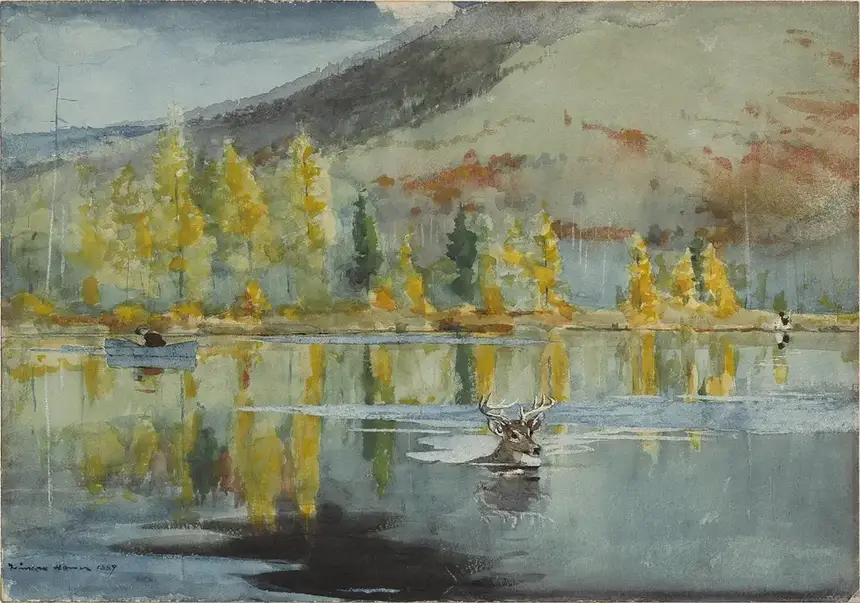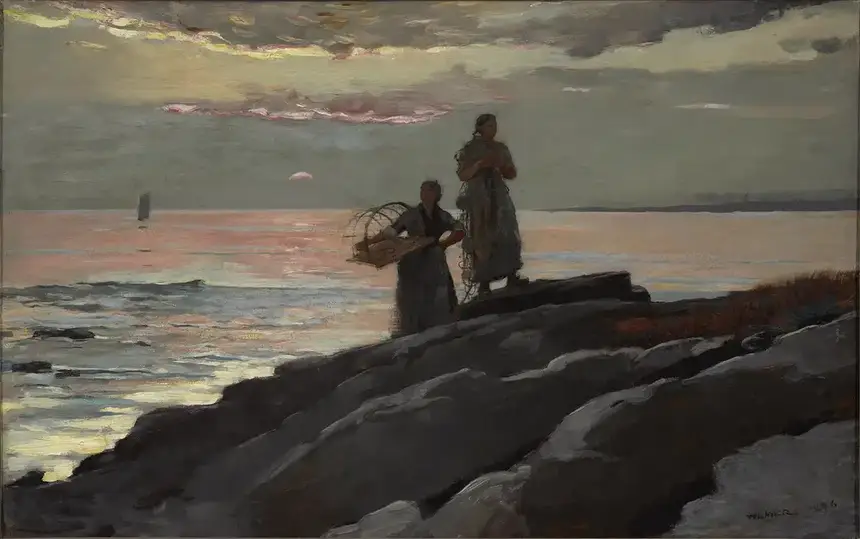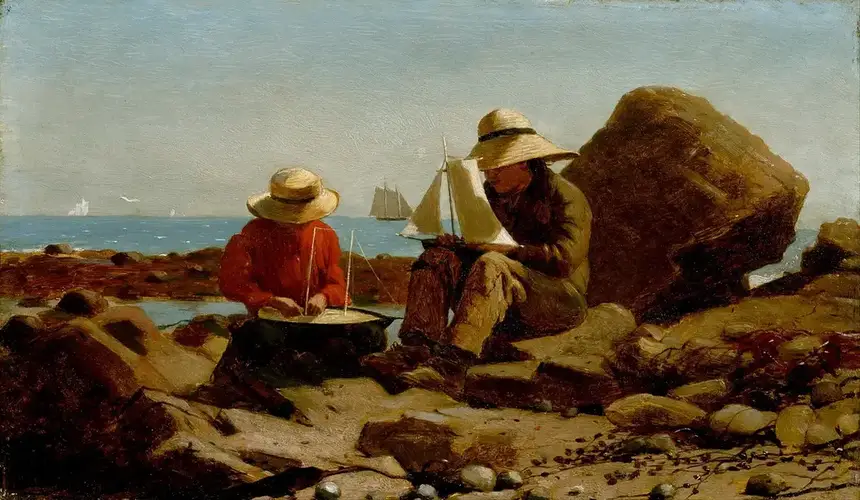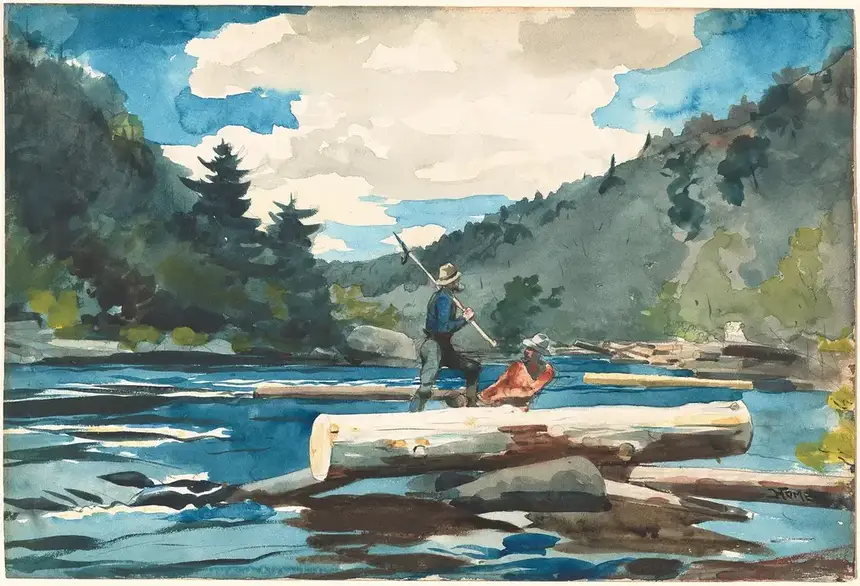
About 'Hudson River'
Winslow Homer died in 1910. That puts the painting well outside copyright, which is why we can paint it and you can own it anywhere in the world.
Every version we make is oil on canvas, painted by one painter from start to finish. No printing is involved at any stage.
The painting was made in the years before 1910, and what we reproduce is the record of it, not the object.
If you want something printed, we are the wrong workshop. We do not own a printer that touches canvas.
How to read it
There is a reason a water subject is the hardest thing to print and the easiest thing to paint: the paint itself carries the depth.
The near ground is painted loaded and the far ground thin. That single decision creates the whole space.
Where the source has light coming through the paint, we glaze rather than paint opaque white.
The darks are mixed, not blackened — black straight from the tube would kill the passage.
The last marks are the ones that are left alone. Overworking is the enemy.
The risk with a water subject is overworking, and the way to avoid it is knowing when to stop.
It is a picture for a room you use, not a corridor you walk through.
| Artist | Winslow Homer |
|---|---|
| Title | 'Hudson River' |
| Created (original) | 1891 |
| Medium | Oil on canvas, hand-painted to order |
| Our version | Oil on canvas, painted by hand to order |
| Public domain | Yes — the artist died over 70 years ago |
The case for painting it by hand
Prints are good at information and bad at paint. This subject is mostly paint.
Edges are left soft where the form turns away and sharp where it does not. That single habit is what separates a painting from a copy.
| Aspect | Hand-painted oil | Printed canvas |
|---|---|---|
| Value over time | Can be re-stretched, cleaned and re-framed | Little value beyond the print |
| Edges | Chosen by the painter, passage by passage | Whatever the file happens to contain |
| Surface | Hand-painted oil on canvas | Ink on canvas, flat |
| Colour | Mixed for each passage, warm and cool versions | One flat value per area |
| Impasto | Real paint standing off the canvas | Flat ink, sometimes embossed to imitate |
Anyone can copy the shapes. The skill is in the transitions, and that is what takes the days.
Each commission is priced on its own terms: dimensions, surface build-up, frame. WhatsApp us the details and you will have an exact quote back, typically within the hour. There is no agency in between; the studio that paints your canvas is the one answering your messages.
How it gets painted
Every canvas is painted to order, so nothing is pulled off a shelf. This is the sequence:
- We start with the canvas itself — stretched, sized and left to settle before any colour is mixed.
- The drawing goes down — charcoal or thin paint, done by eye rather than traced from a printout.
- The first colour pass — thin and simple, establishing the main shapes only.
- The values are established — this is the stage that decides whether the painting works.
- Colour is built up — warmer and cooler versions of each passage, laid over the underpainting.
- Finishing passes — the loaded highlights go on at the end and stay there.
- Left to dry before varnish — nothing is photographed or packed until the surface is ready.
The difficult part is not the detail. It is keeping the whole canvas at the same stage of finish.
Frames
We can supply a simple floater frame, a traditional gilt, or nothing at all. It is your call.
Most clients wait for the photographs before choosing a frame, which is the sensible order.
Keeping it
Once the varnish has cured the surface can be cleaned by a conservator, but in a normal house it will not need it for decades.
Canvas, paint and varnish
Brushes, knives and rags. That is the equipment list; there is no machine in the process. The varnish is removable, so a conservator can clean the painting in fifty years without touching the paint.
We do not use a printer at any stage. There is no giclée, no canvas transfer, no digital underlayer. Each painter works on one canvas at a time — the painting you ordered is not shared with another order.
What size works
You are not choosing from a list; you are telling us a measurement. These are the common ones:
| Size (inches) | Size (cm) | Best for |
|---|---|---|
| 60 × 20 in | 152 × 51 cm | Lobby, hospitality corridor, large loft |
| 72 × 24 in | 183 × 61 cm | Villa scale, double-height wall |
| 30 × 12 in | 76 × 30 cm | A long wall that would swallow a normal canvas |
| 36 × 14 in | 91 × 36 cm | Above a wide sideboard or a long console |
| 40 × 16 in | 102 × 41 cm | Stairwell, or a hallway with room to run |
Tell us the wall width and we will tell you what looks right rather than what is standard. We quote DAP, so any duty or tax your country charges is settled by you at import. We do not add a tax line of our own.
It works best on a wall you pass rather than one you sit and stare at — the paint rewards a moving eye.
Tell us where it will hang and how big it needs to be — we will price it properly.
💬 Get a Quote for 'Hudson River'Getting it to you
Painting takes 9–15 days. Freight is quoted as its own line on the quote, agreed before you pay anything, and never added afterwards.
Transit is usually 7–10 business days, tracked all the way. Rolled in a tube it travels cheaper and safer than framed; most overseas clients take it that way.
You see photographs of the finished painting before it ships, and you tell us what to adjust. Changes are handled by telling us what to change; we change it and send new photographs.
We sell DAP: the price covers the painting and the freight, and any import duties or taxes are the buyer's to settle with customs. We do not collect them and we do not estimate them.
A deposit starts the canvas and books the painter's time; the balance is due before the crate leaves. If a crate arrives damaged, send us photographs within 48 hours and contact us directly — we will sort it out with you.
What people ask us
What does it cost?
There is no price list, because the number depends on your size and frame. Message us and we will quote exactly.
What is the canvas made of?
Cotton duck as standard, linen on request, artist-grade oil paint, and a final varnish once the paint is fully dry.
Does it come framed?
Framing is quoted separately, so you can decide once you have seen the finished painting in photographs.
Will I see it before it ships?
Yes — photographs of the actual painting go to you first, and nothing is packed until you have seen them.
Is it really painted by hand?
Yes. One painter, oil paint, brushes. We do not own a printer that touches canvas.
Do you take a deposit?
A deposit starts the canvas and the balance falls due before it ships. Both figures appear on the quote.
Who pays the import duty?
You do. We sell DAP, so any duty or tax your customs authority charges is settled by you at import. We do not collect it and we do not estimate it.
Do you ship to my country?
We export to more than 20 countries. Tell us where you are and we will quote the freight as a separate line.
Can you paint a different work by Winslow Homer?
Yes. Send the image and we will quote it, or browse the other paintings we have listed.